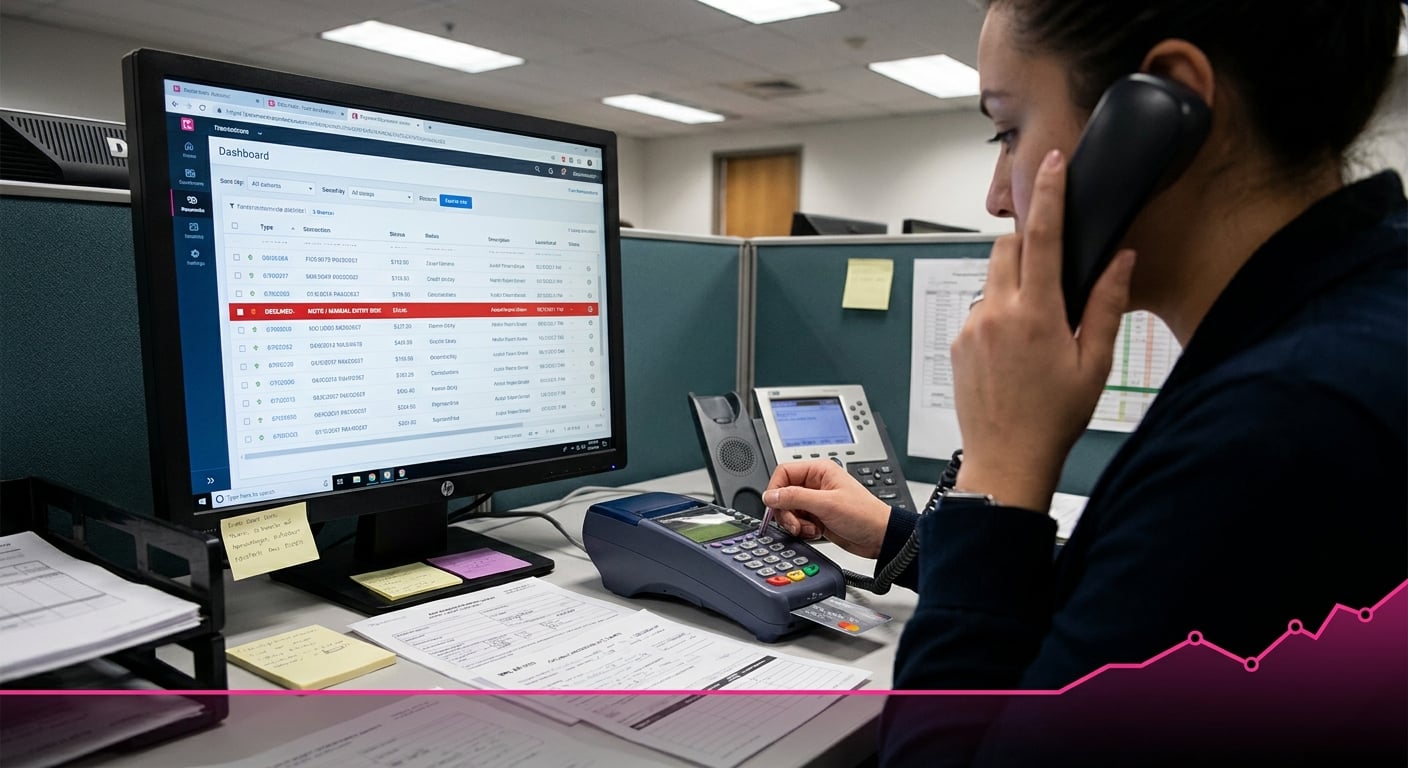
Queue management is the systematic pacing, scheduling, and prioritization of transaction requests sent to payment processors and issuing banks. It organizes bulk transaction volumes, such as recurring billing or retry attempts, into controlled streams. This pacing prevents system overloads, avoids artificial rate limits, and ensures transactions arrive at optimal times.
This process acts as a traffic controller for automated transactions, organizing them into timed sequences rather than sending them simultaneously. It appears primarily in subscription billing systems and merchant handling bulk processing. By controlling the flow of requests, merchants avoid triggering issuer fraud alerts and significantly improve their overall approval rate.
What is queue management in the context of payments?
In real-world merchant environments, automated systems often generate thousands of transaction requests at the exact same time. Without a mechanism to control this outflow, a billing system might send a massive spike of requests directly to a payment gateway at the stroke of midnight.
Queue management solves this problem by acting as a buffer between the merchant infrastructure and the acquiring network. Instead of transmitting transactions in a single disorganized burst, the system holds the requests and releases them at a calculated pace. This steady flow aligns with the processing capacity of processors and matches the behavioral expectations of issuing banks.
How does a transaction queue operate?
A payment queue functions by evaluating pending transactions and organizing them based on specific rules, network limits, and historical data. This prevents bottlenecks during the payment authorization step and ensures each request has the highest possible chance of success.
Payment gateways enforce a maximum number of transactions per second. If a merchant attempts to process 500 tokenized payments simultaneously but their gateway limit is 50 transactions per second, the gateway will drop the excess requests. Queueing acts as an automatic throttle to keep the outbound volume safely below this threshold.
When dealing with automated billing or attempting to retry failed payments, the process generally follows a structured sequence:
- Ingestion: The billing system sends all pending transactions into a central holding area instead of directly to the processor.
- Evaluation: The system assesses each transaction to determine its priority, looking at factors like previous payment issues or the customer time zone.
- Pacing: The queue manager calculates the optimal release rate to stay below gateway limitations.
- Execution: Transactions are released in small, controlled batches to the payment processor.
- Routing: As each issuer response returns, the system either settles the approved transaction or routes declined transactions back into a specialized holding pattern for future handling.
Where does queue management appear in payment recovery flows?
This concept is deeply embedded in systems designed to handle subscription renewals and recurring billing. However, its most critical application happens during the payment recovery cycle. When an initial charge fails, aggressively attempting to charge the card again can lead to further declines or even account blacklisting.
To safely recover revenue, failed charges are placed into a specialized retry queue. For example, if a payment declined due to insufficient funds, placing it in a queue to be processed on a Friday morning when direct deposits typically clear is far more effective than immediately forcing the transaction through again. The queue holds the transaction securely until the designated window opens.
A platform like SmartRetry utilizes queue management to orchestrate intelligent retries of declined payment transactions, helping merchants recover revenue and improve transaction approval rates. By carefully timing when a payment authorization re-enters the payment processing flow, the system ensures the new authorization request occurs precisely when the issuing bank is most likely to approve it.
Why does transaction pacing matter for merchants?
For merchants operating at scale, sending too many transactions at once can actively harm their revenue. Most payment service providers enforce strict volume limits. Exceeding these limits results in instant system-level rejections, creating artificial declines that have nothing to do with the actual account balance of the cardholder.
Furthermore, issuing banks deploy complex fraud detection algorithms. If an issuer suddenly sees hundreds of identical authorization requests originating from a single merchant in a fraction of a second, their security systems may interpret the activity as a brute-force attack. This causes the bank to block the entire batch. Careful queueing prevents these false positives and protects the merchant reputation with card networks.
How does queueing impact the customer experience?
While queue management operates entirely on the backend, it directly prevents visible friction for the end user. If a merchant gateway crashes due to an unmanaged spike in recurring billing, active shoppers on the website may experience sudden checkout issues. Isolating bulk automated processing into a controlled queue ensures that live, card-present or real-time e-commerce transactions always have open network bandwidth to process smoothly.
Queue management vs traditional batch processing
It is easy to confuse dynamic queueing with older batch processing methods, but the two operate very differently in practice.
Traditional batch processing involves grouping thousands of transactions into a single file and submitting that file to an acquirer once a day. This is a rigid approach common in older banking infrastructures. Once the batch is sent, the merchant has no control over the sequence or timing of individual transactions.
Modern queue management is highly dynamic. It allows payment engineers to pause, prioritize, or reroute individual transactions in real time. If a specific card network experiences temporary downtime, an intelligent queue can temporarily hold requests destined for that bank while continuing to process other transactions normally. This flexibility is a foundational element of true payment recovery.