



The Mechanics of a Failed Transaction: Moving Beyond the Decline Code
A customer adds an item to their cart, fills out their shipping details, enters their card number, and hits submit. Then they wait. Behind that spinning loading icon, a complex web of split-second communications takes place to verify the transaction. When everything aligns, the purchase succeeds and the merchant books the revenue. When the system breaks down, a payment declined message appears, leaving both the buyer and the seller in a frustrating stalemate.
Payment failures are an inevitable reality of digital commerce, but treating them merely as a cost of doing business ignores a significant operational opportunity. Every time a card declined notification flashes on the screen, it triggers downstream consequences for revenue, customer retention, and processing health, with Mastercard reporting that 15% of customers do not complete their purchase at all after a false decline (Source). Understanding why these rejections happen is the first step in building a more resilient checkout experience.
Optimizing this system takes more than submitting the charge again and hoping for a different result. It requires a structural approach to payment authorization, blending proactive measures that keep credentials fresh with reactive strategies designed to salvage legitimate transactions. By dissecting the lifecycle of a transaction declined by the bank, teams can identify processing leaks and implement targeted strategies to recover lost volume.
Navigating the Payment Processing Flow
To understand why a payment fails, it helps to trace the exact path a transaction takes from the initial click to the final settlement. A standard credit or debit card transaction does not travel in a straight line. Instead, it hops across several independent networks, each operating with its own latency limits, risk models, and communication protocols.
When the customer initiates the purchase, the merchant’s gateway formats the data and forwards it to an acquiring bank. The acquirer then routes this request through the relevant card network, which ultimately delivers the payload to the issuing bank, the institution that provided the customer’s card. The issuer evaluates the request against a variety of risk, balance, and compliance checks before sending an approval or decline signal back through the same chain.
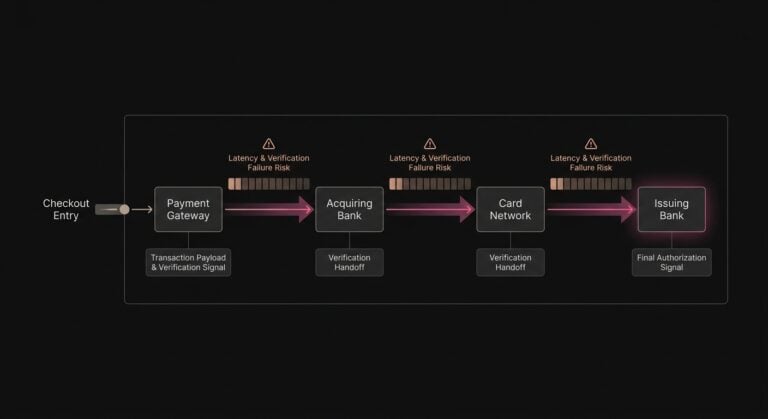
Every hop in this payment processing flow is a potential point of friction. A momentary timeout at the network level, a misconfigured merchant category code at the acquirer, or an overly aggressive anti-fraud algorithm at the issuer can all disrupt the transaction. Because the merchant sits at the very end of this chain, their visibility into what actually caused the failure is often limited to the final data packet they receive. Systemic issues, network latency, and outdated integration protocols can artificially depress authorization rates, even when the customer is using a perfectly valid, well-funded card.
Decoding the Issuer Response
When the issuing bank rejects a transaction, it attaches a decline code to its response. In theory, this code tells the merchant exactly what went wrong. In practice, the issuer response is often vague, either to protect customer privacy or simply because the bank’s legacy systems default to generic messaging.
Declines generally fall into two categories: hard and soft. A hard decline occurs when the issuing bank determines that the transaction can never be approved under current circumstances. Common triggers include a stolen card, a closed account, or an invalid credential format. When a system encounters a hard decline, the only logical step is to stop attempting the charge and ask the customer for a new payment method.
Soft declines are more nuanced and present the primary opportunity for payment recovery. A soft decline indicates that the card is fundamentally valid, but the specific transaction cannot be approved at that moment. Common triggers include:
- Insufficient funds: The account lacks the necessary balance at the time of the authorization request, though funds may become available later in the billing cycle.
- Velocity limits: The card has been used too frequently in a short period, triggering a temporary hold by the issuer’s internal security algorithms.
- Network timeouts: A momentary lapse in communication between the gateway, the card network, and the issuing bank prevents the approval signal from completing its trip.
The most notorious of these soft signals is the generic Do Not Honor code. Issuing banks use it as a catch-all when a transaction fails a risk check or falls outside normal spending patterns but they choose not to specify the exact reason. A generic decline leaves the merchant guessing, but it also leaves the door open. Because the card itself is still active, an intelligent system might succeed by attempting the charge again under slightly different parameters or at a different time of day.
The Nuance of Subscription Payment Issues
Payment issues take on a different dimension with recurring billing models. If a one-off retail transaction is declined, the customer is right there at the checkout screen. They can immediately reach into their wallet, pull out a different card, and complete the purchase. The friction is localized, and the feedback loop is immediate.
Subscription payment issues, however, typically occur in the background. The customer is often not actively engaged with the software or service when their monthly renewal triggers. If their payment is rejected during a background processing run, they remain unaware until the merchant notifies them or their service is abruptly cut off. This creates the problem of involuntary churn, where a customer who fully intended to keep using a product is canceled simply because of a mechanical failure in the billing chain.
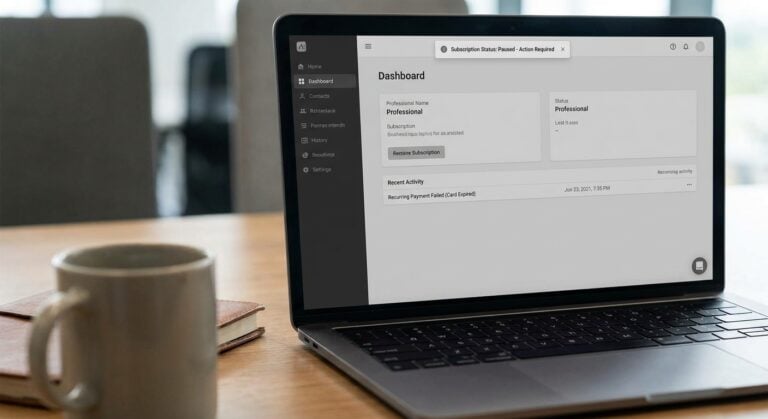
Addressing recurring declines requires a careful, phased approach to avoid unnecessary customer friction. The first line of defense should be silent, system-level retries that attempt to resolve the issue without ever bothering the user. Only when these background attempts are exhausted should the process escalate to active dunning, where the customer is asked to intervene. The goal is to shield the user from the underlying payment mechanics for as long as possible.
Proactive Strategies to Reduce Payment Declines
Before relying on retry logic to salvage failed transactions, revenue teams should look for ways to reduce payment declines before they happen. Proactive payment optimization focuses on improving the quality of the data sent to the issuer, making it easier for the bank’s risk models to approve the request on the first attempt.
One of the most structural shifts a merchant can make is adopting network tokenization. Instead of storing the raw primary account number, the merchant requests a network token from the card brand. These tokens are bound to a specific merchant or device and update automatically in the background if the underlying card is lost, stolen, or expired. Because issuers inherently trust network tokens more than raw account numbers, transactions processed this way often see a natural lift in approval rates, with Visa and Adyen reporting an authorization uplift of 2-7% over PAN-based transactions (Source).

Account updater services are another crucial preventative tool. By querying the card networks for credential changes before processing a recurring batch, merchants can preemptively swap out expiring cards. If a customer is issued a new card in the middle of a billing cycle, the account updater catches the change, preventing an entirely avoidable hard decline on the next renewal date, particularly important given that 35% of consumers globally admit to not updating credentials when they receive a new card (Source).
How a merchant passes data fields like the billing address, CVV, and authentication data also heavily influences the issuer’s decision. Clean, well-formatted data helps verify the customer’s identity, giving the issuing bank the confidence it needs to approve the transaction without triggering secondary risk protocols.
Engineering a Sophisticated Retry Flow
When preventative measures fall short and a soft decline occurs, the focus shifts to how the system responds. Historically, many billing platforms used naive retry logic, retrying failed payments on a fixed schedule, such as every three days, regardless of why the payment failed in the first place.
This rigid approach is fundamentally flawed. If a transaction fails on a Tuesday morning due to insufficient funds, trying again on Friday morning makes little sense if the customer gets paid on Friday afternoon. Hammering the gateway with rapid, uncalculated retries for the same failed transaction also incurs unnecessary network fees and risks tripping the acquirer’s fraud thresholds, which can damage the merchant’s overall processing reputation.
To successfully recover these transactions, the system must evaluate the specific variables of the decline. The response code, the type of card, the issuing bank, and the time of the month all influence the likelihood of a subsequent attempt succeeding. For example, delaying a retry until the beginning or middle of the month can align the attempt with standard payroll cycles, naturally increasing the chance that an insufficient funds error will resolve itself.
This is where platforms like SmartRetry step in. By focusing on payment optimization and intelligent retries of declined payment transactions, the platform helps merchants navigate these complex variables to recover revenue and improve transaction approval rates. Rather than relying on static schedules, these systems evaluate the context of each decline to sequence subsequent attempts dynamically, respecting network rules while maximizing the probability of a successful authorization.
Tracking the Transaction Approval Rate
To determine whether optimization efforts are actually working, teams need to track the right data. The baseline metric for any payment operations team is the transaction approval rate, but viewing it as a single, blended number often masks underlying performance issues and structural inefficiencies.
A strong measurement framework separates the initial authorization rate from the final recovery rate. The initial rate tracks how many transactions clear on the first attempt. If this number begins to slide, it typically points to a problem at the top of the funnel, perhaps an issue with tokenization, a sudden change in an issuer’s fraud algorithm, or an influx of poorly formatted data from a new checkout flow.
The recovery rate measures the effectiveness of the retry logic and dunning processes. It tracks the percentage of initially declined transactions that are eventually captured. Monitoring this metric lets teams tweak their retry intervals and messaging cadence, testing different hypotheses to see what genuinely moves the needle without aggravating customers.
Beyond these high-level metrics, experienced teams often slice their decline data by specific dimensions. Grouping checkout issues by Bank Identification Number, gateway, or geographic region can isolate specific outages or routing inefficiencies, allowing merchants to pinpoint exactly where their payment flow is leaking revenue-for example, VisaNet data revealed that overall card transaction approval rates in the U.S. fell below 87 percent from April 2023 through March 2025 (Source).
Building a Resilient Payment Infrastructure
Handling payment failures is not a one-time project but a continuous operational discipline. The ecosystem connecting merchants, gateways, networks, and issuers is constantly shifting as new risk models are deployed and new compliance mandates take effect. What worked smoothly one quarter might need adjustment the next.
By moving away from static billing rules and developing a deeper understanding of the issuer response, merchants can stop treating declined transactions as an inevitable loss. With cleaner data, proactive credential management, and intelligent, context-aware retry logic, teams can actively plug the leaks in their revenue engine. Ultimately, the goal is to shift from merely reacting to declines to proactively engineering the payment flow, ensuring that every valid transaction has the best possible chance of finding its way to approval.



 Find me on Linkedin