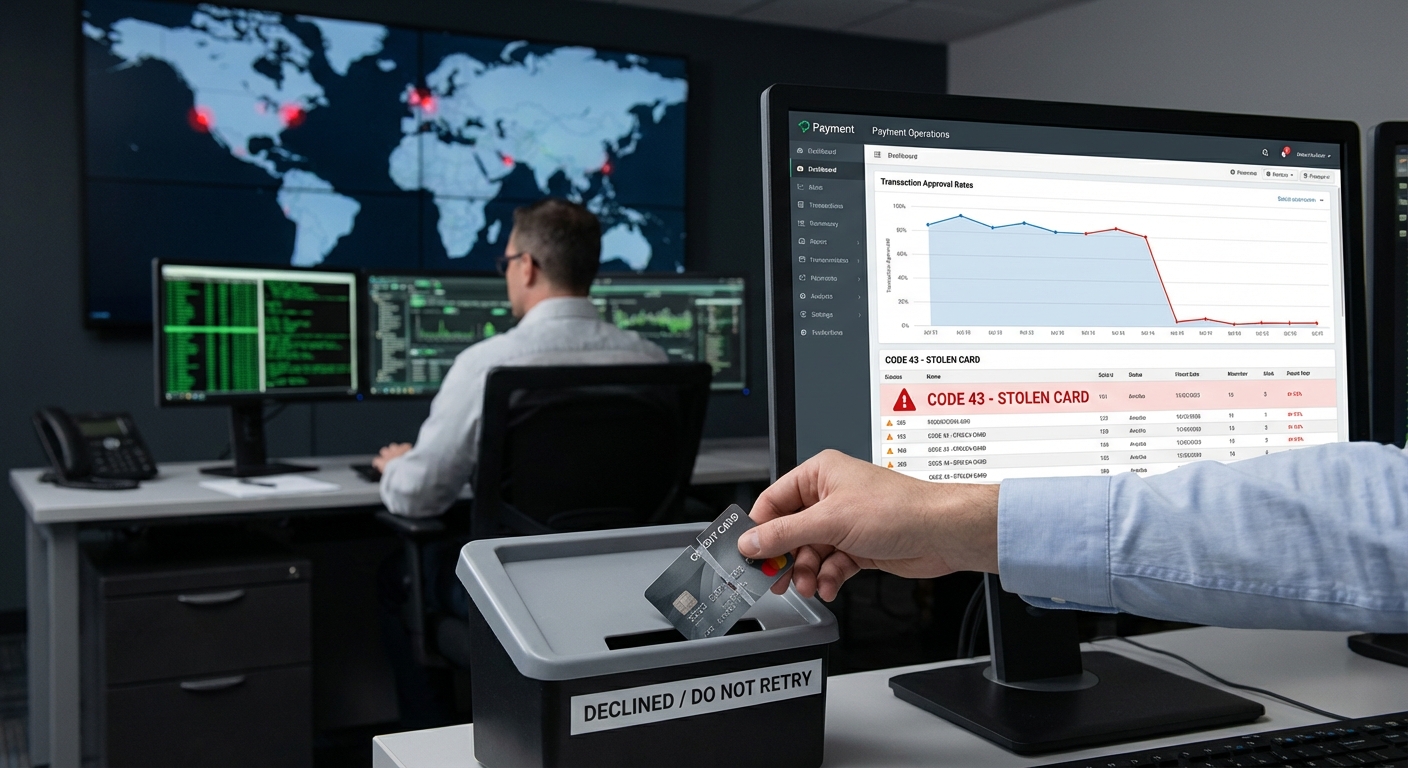
High-Risk Merchant refers to a business classification assigned by acquiring banks and payment processors to companies presenting an elevated likelihood of chargebacks, fraud, or financial instability. Payment networks apply this designation based on a company’s industry, billing model, or historical processing data. These merchants typically face stricter underwriting requirements, higher processing fees, and lower baseline approval rates.
A high-risk merchant classification designates businesses operating in verticals with historically high chargeback rates, complex regulations, or significant payment decline risk. This label appears during initial merchant underwriting and heavily influences how acquiring banks and processors route and evaluate transactions. Operationally, it requires businesses to proactively manage fraud, monitor network data, and deploy robust logic to handle strict issuer responses safely.
What makes a business a high-risk merchant?
Payment processors and acquiring banks evaluate risk based on statistical data. When a business applies for a merchant account, the underwriter looks for specific patterns that indicate a higher probability of financial loss. If the perceived risk exceeds standard thresholds, the business receives a high-risk classification.
Several factors contribute to this designation:
- Industry vertical: Businesses operating in travel, digital goods, adult entertainment, cryptocurrency, gaming, or highly regulated sectors are automatically classified as high-risk due to historical industry data.
- Chargeback history: Processors closely monitor the ratio of chargebacks to successful transactions. If a merchant’s chargeback ratio consistently exceeds 0.9 percent, processors often reclassify them as high-risk.
- Billing models: Recurring billing models and free-trial conversions are notorious for generating subscription payment issues and buyer disputes, making businesses that rely on them appear riskier to banks.
- Transaction patterns: High average ticket size, large volumes of cross-border sales, or inconsistent processing volumes make it difficult for banks to predict revenue and detect fraud reliably.
How does high-risk status impact the payment processing flow?
Being classified as a high-risk merchant changes the dynamics of how a business interacts with the broader payment ecosystem. This status introduces friction at several stages of the payment processing flow, from the initial setup to daily settlement operations.
For standard merchants, acquiring banks typically deposit funds within one to two business days. High-risk merchants, however, often face rolling reserves. A rolling reserve means the acquirer holds back a percentage of the merchant’s daily sales for a set period, sometimes up to six months, to cover potential future chargebacks.
Additionally, this status changes how transactions are routed. High-risk accounts are often assigned specific merchant category codes (MCC) that issuing banks monitor closely. When an issuing bank sees an incoming request from a high-risk MCC, its internal security algorithms apply stricter scrutiny, increasing the likelihood of an unexpected payment declined status.
Why do high-risk merchants experience higher decline rates?
Payment declines are a major operational challenge for high-risk merchants. The root cause lies in the payment authorization phase. When a customer attempts a purchase, the merchant’s gateway formats a request and sends it through the network to the customer’s issuing bank.
The issuing bank’s primary goal is to protect its cardholder from fraud and itself from liability. Because the bank knows the merchant operates in a high-risk category, it configures its automated risk engines to be highly sensitive. Even minor discrepancies in the authorization request, such as a slight mismatch in billing address formatting or an unusual purchase time, can trigger a block.
Consequently, high-risk merchants suffer from elevated rates of false positives. A perfectly legitimate customer with adequate funds might see their card declined simply because the issuing bank’s algorithm deemed the broader merchant category too risky at that specific moment.
How can high-risk merchants improve their transaction approval rate?
Navigating high-risk payment environments requires a proactive approach to data and routing. Merchants cannot simply send transactions and hope for the best. They must actively format their authorization requests to provide issuing banks with maximum confidence.
One of the most effective strategies is implementing 3D Secure. By forcing a liability shift and proving the customer’s identity at checkout, merchants can bypass some of the issuer’s internal risk checks. Sending enhanced data payloads, including level 2 and level 3 processing data, also helps issuing banks verify the legitimacy of the purchase.
Furthermore, analyzing decline codes is critical. Merchants must distinguish between hard declines, such as insufficient funds or stolen cards, and soft declines, which occur due to temporary network blocks or overly strict fraud filters. Grouping and analyzing these codes allows payment teams to adjust their processing strategy and prevent future payment failures.
How does intelligent retry logic help high-risk payments?
When a transaction declined message is returned, the immediate operational instinct is often to try again. However, high-risk merchants must handle retries with extreme care. Blindly attempting to charge a card multiple times in rapid succession signals desperate or fraudulent behavior to the issuing bank, which can lead to permanent blocks or account termination.
Effective payment recovery relies on interpreting the exact network response code and applying conditional logic. For example, a decline due to a temporary system timeout might warrant an immediate retry, whereas a decline for suspected fraud requires an entirely different approach, perhaps waiting hours or days before a subsequent attempt. See Decoding Authorization Code 59: How Suspected Fraud Declines Affect Payment Recovery for more details.
This is where specialized infrastructure becomes necessary. Using a platform like SmartRetry, which is focused on payment optimization and intelligent retries of declined payment transactions, helps merchants recover revenue and improve transaction approval rates safely. By applying data-driven schedules and respecting retry logic and issuer rules, merchants can safely salvage lost sales without jeopardizing their processing accounts.
High-risk merchant account vs standard merchant account
Understanding the differences between standard and high-risk accounts helps businesses set realistic operational expectations.
Standard merchant accounts benefit from straightforward underwriting, lower processing fees, and access to a massive pool of acquiring banks. They generally enjoy faster settlement times and higher baseline approval rates because issuing banks trust their assigned merchant category codes.
High-risk merchant accounts require specialized processors willing to underwrite complex business models. These accounts come with higher per-transaction fees, mandatory financial reserves, and strict monthly processing limits. While operating a high-risk account requires more diligent engineering and financial oversight, it is often the only pathway for businesses in complex but lucrative industries to accept electronic payments reliably.