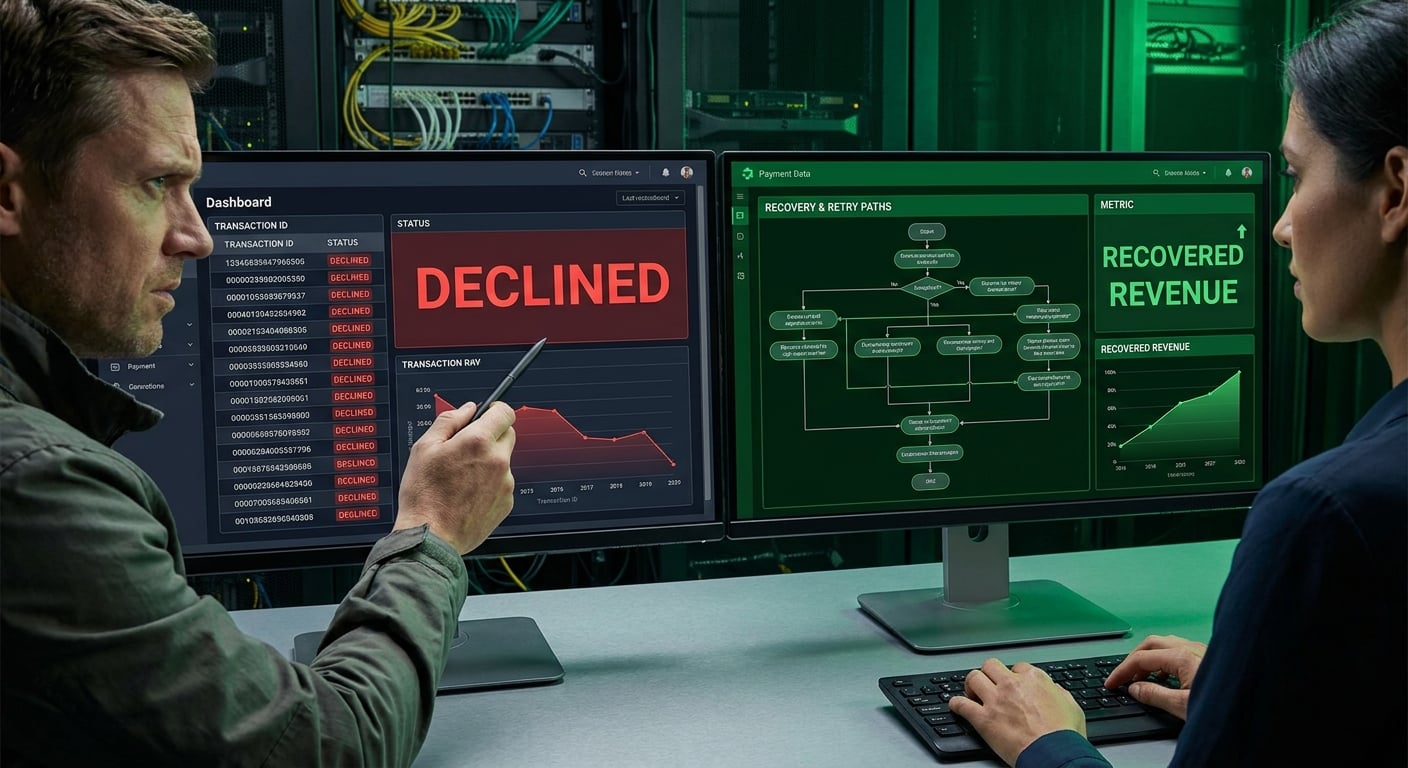
Load balancing is the process of distributing payment transaction volume systematically across multiple payment service providers, gateways, or acquiring banks. This routing strategy prevents any single processing endpoint from becoming overwhelmed by high traffic. Merchants use this technique to maintain system uptime, reduce processing latency, and ensure continuous payment authorization during volume spikes or technical outages.
At its core, load balancing is a routing mechanism that directs checkout traffic among available payment processors based on predefined rules like volume limits or system health. It operates at the payment orchestration layer, acting as a traffic controller before a transaction reaches the acquiring bank. This concept matters operationally because it prevents checkout issues caused by gateway downtime, minimizes technical payment failures, and provides a highly available infrastructure for processing transactions.
What is load balancing in a payment environment?
In general computing, load balancing refers to dividing network traffic across multiple servers to keep websites online. In the payments industry, the concept is similar but focuses specifically on the flow of money. It involves distributing transaction requests across a network of payment gateways or acquirers to optimize performance and reliability.
When a merchant scales globally or processes high volumes of transactions, relying on a single payment provider becomes a structural risk. If that provider experiences an outage, every customer attempting to buy something will face checkout issues. Load balancing solves this by allowing a merchant to connect to multiple processors and split the transaction volume among them.
This distribution can be even, such as sending exactly half of all transactions to one provider and half to another. It can also be weighted, where a primary provider handles the bulk of the volume while a secondary provider acts as a backup to absorb overflow or step in during technical disruptions.
How does payment load balancing work?
Payment load balancing relies on a central orchestration layer or a specialized routing engine. This system sits between the merchant storefront and the various acquiring banks or processors.
When customers initiate a purchase, the load balancer evaluates the available processing endpoints in real time. It monitors response times, system health, and pre-set distribution rules before deciding where to send the transaction data.
A typical payment processing flow works in the following sequence:
- The customer submits their payment details on the merchant checkout page.
- The payment orchestration layer receives the request and checks the health and capacity of connected acquirers.
- The system selects the best available endpoint based on the established load balancing rules.
- The chosen acquirer attempts the payment authorization with the customer issuing bank.
- The issuer response is passed back through the orchestration layer to the merchant to complete the checkout.
If the selected processor times out or returns an error indicating a system failure, the load balancer can immediately reroute the transaction to an alternate provider. This redundancy prevents a technical error from resulting in a lost sale.
Where does load balancing appear in payment flows?
Load balancing primarily occurs at the very beginning of the transaction lifecycle. The decision of where to send the payment must be made before the authorization request leaves the merchant environment.
For enterprise merchants, this routing logic is often housed within a payment orchestration platform or a custom-built payment vault. These systems tokenize the customer payment data, making it agnostic to any specific processor. Because the data is tokenized centrally, the load balancer can freely direct the payment to whichever acquirer has the best current availability.
This setup is highly relevant for businesses dealing with massive bursts of traffic. For example, ticketing platforms or major retailers running flash sales often face sudden spikes in transaction volume. A load balancer ensures that the surge does not overwhelm a single gateway, which could otherwise trigger a wave of payment failures.
Why does load balancing matter for merchants?
The primary business impact of load balancing is risk mitigation. Gateway downtime is an inevitable reality in digital commerce. When a processor goes down, an unoptimized merchant simply stops making money until the system recovers. A load-balanced setup ensures that transactions keep flowing even when a major infrastructure provider experiences an outage.
Beyond disaster recovery, load balancing directly impacts the overall transaction approval rate. By managing traffic efficiently, merchants reduce the likelihood of timeouts and technical declines. Acquirers that receive a steady and manageable flow of transactions are less likely to flag incoming volume as an anomaly.
Load balancing also plays a crucial role in managing volume-based pricing tiers. Merchants can configure their load balancers to distribute volume in a way that maximizes cost efficiency across different processor contracts.
Finally, a stable multi-processor setup forms the foundation for advanced payment recovery. Platforms like Smart Retry, which focus on payment optimization and intelligent retries of declined payment transactions, benefit heavily from multiple available endpoints. If a transaction is declined due to a technical failure at one acquirer, having load-balanced redundant connections makes it possible to retry failed payments securely through a different route, helping merchants recover revenue.
Load balancing vs smart payment routing
While load balancing and smart payment routing are closely related, they serve slightly different purposes within a payment optimization strategy. Both involve directing transactions to multiple endpoints, but their decision-making criteria differ.
Load balancing is primarily concerned with capacity and system health. Its goal is to distribute volume fairly or according to specific limits to ensure no single processor is overwhelmed. It acts as a safety net against infrastructure failure.
Smart payment routing is focused on maximizing the probability of an approval or minimizing costs for a specific transaction. Instead of just looking at system capacity, a smart routing engine analyzes the specific details of the payment. It might route a transaction based on the customer card bin, the transaction currency, or the geographic location of the issuing bank.
For example, if a customer attempts a cross-border transaction, smart routing will send the payment to a local acquirer to avoid a decline. If a recurring purchase faces a card declined status, advanced routing rules dictate how and where that transaction should be retried.
In modern payment architectures, these two concepts work together. A merchant uses smart routing to determine the best possible acquirer for a specific payment, while load balancing ensures that the chosen acquirer has the operational capacity to handle the request. Together, they eliminate single points of failure and keep approval rates as high as possible.