

Decoding the Sudden Spike: How to Diagnose and Resolve Generic Card Declines
It usually happens on a random weekday morning. You open your analytics dashboard to find that the trend line for successful checkouts has suddenly fallen off a cliff. Nobody touched the codebase, and no one launched an unpredictable overnight marketing campaign. Yet, you are suddenly dealing with unexplained payment issues. Your engineering team confirms that the API is responding normally, but a specific segment of your transactions is failing at an alarming rate. When you dig into the logs, the culprit is frustratingly vague: a massive spike in decline codes.
A generic payment declined message, often categorized as code 05 or simply Do Not Honor, is the ecosystem’s equivalent of a check engine light. It tells you that something is fundamentally wrong with the approval rate, but it deliberately obscures the underlying cause. When these spikes occur, especially if they are heavily concentrated on specific card networks like Visa or isolated to particular geographic regions, panic is the natural first response. However, resolving the issue requires a calm, methodical, and deeply analytical approach.
To restore a healthy transaction approval rate, payment operations teams must act like forensic investigators. You have to systematically eliminate variables across a highly interconnected chain that includes your internal fraud configuration, your payment gateway, the acquiring bank, the card network, and finally, the issuing bank. Understanding how to slice your data and where to look can mean the difference between a minor localized hiccup and a multi-day revenue leak.
The Anatomy of a Generic Decline
Before jumping into the diagnostic process, it is helpful to understand why generic declines exist in the first place. The digital payments infrastructure is built on legacy rails that have been heavily upgraded with modern machine learning and risk-scoring layers. When a customer clicks the checkout button, an intricate conversation takes place between multiple financial entities in a matter of milliseconds.
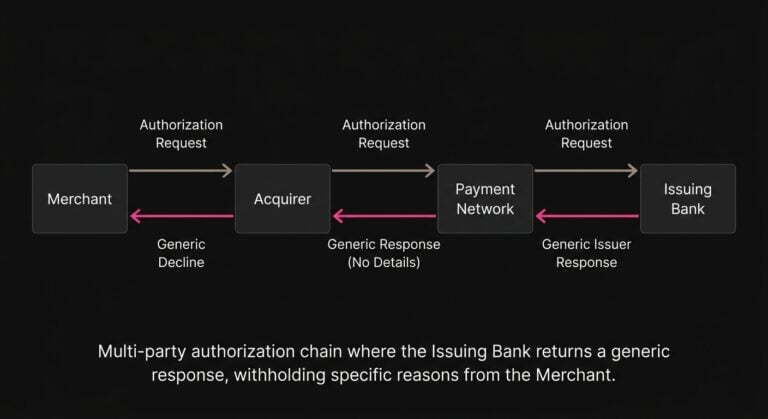
If any participant in that chain feels uncomfortable with the transaction context, they will reject it. However, issuers rarely send back a detailed explanation like “we suspect this is fraud because the user’s IP address is 500 miles away from their billing zip code.” Providing that level of granularity would be a gift to bad actors, allowing them to reverse-engineer the issuer’s risk models. Instead, the issuing bank simply returns a generic issuer response. This polite but firm rejection leaves the merchant to guess the exact reason.
While occasional generic declines are a normal part of doing business online, a sudden, concentrated spike indicates a structural shift. Someone, somewhere in the chain, changed a rule, updated a risk threshold, or experienced a technical degradation.
Slicing the Anomaly
When the spike hits, your first operational step is to isolate the blast radius, as looking at a blended global decline rate will only obscure the root cause. You need to segment the failing transactions to find the common denominator.
Start by filtering your recent transaction data by card brand to see if the issue is happening equally across Mastercard, American Express, and Discover, or if it is heavily skewed toward Visa. Then, pivot the data by geography. Are the failed payments originating globally, or are they isolated to a specific region like cross-border transactions from the European Union? You should also check the transaction type to determine whether these are first-time checkouts or an unexpected surge in subscription payment issues where previously successful recurring billing profiles are suddenly failing.

By isolating the specific characteristics of the failed cohort, you create a baseline for your investigation. If the spike is isolated to a single network and region, you are likely dealing with a network mandate or an issuer-level algorithm change. If the declines are happening across the board, the call is likely coming from inside the house.
Evaluating the Issuing Bank and Network Dynamics
When a transaction leaves your gateway, it travels through the card network to reach the issuing bank, which holds the ultimate authority on whether a transaction is approved. Because issuers manage the financial risk of extending credit or moving funds, their machine learning models are constantly adjusting to global fraud trends.
Shifts in Issuer Risk Appetite
If your data segmentation reveals that the declines are heavily concentrated among a specific group of BINs, or BINs, belonging to one or two major issuing banks, you are likely looking at an issuer-level risk update. Large financial institutions frequently deploy updates to their algorithms, and if your typical transaction profile suddenly trips a newly deployed velocity check or risk threshold at a major bank, your approval rates will plummet.
For example, an issuer might decide overnight that low-value cross-border transactions from specific merchant categories are now high-risk due to a recent wave of card testing attacks. If your business model relies on exactly that type of transaction, you will catch the blunt end of the issuer’s defensive maneuver. Unfortunately, there is no dashboard that announces these changes, so you can only infer them by observing BIN-level decline concentrations.
Navigating Network-Level Mandates
If the issue is broader than a single bank but isolated to one card brand, such as Visa, the network itself may be the friction point. Card networks frequently roll out new compliance mandates, data formatting requirements, or security protocols. A classic example is the rollout of Strong Customer Authentication (SCA) and dynamic routing in Europe. During the transition periods, merchants who had not perfectly configured their 3DS flows saw massive spikes in generic soft declines, as issuers mandated by the network refused to process non-authenticated traffic.
Additionally, networks use advanced authorization scoring systems that evaluate the transaction in flight and append a risk score before it even reaches the issuer. If the network’s overarching algorithm detects an anomaly in your traffic pattern, such as a sudden surge in volume that looks like a bot attack, it will artificially inflate the risk score sent to the issuer and practically guarantee a decline.
The Influence of Your Merchant Category Code
Every business processing credit cards is assigned a four-digit Merchant Category Code, or MCC, by their acquirer to classify the type of goods or services provided. The MCC is a surprisingly heavy variable in the payment authorization equation because it carries inherent risk assumptions.
Risk Perception and Category Drifts
Some MCCs, such as those for airlines, ticketing events, or digital goods, carry historically higher chargeback ratios and are inherently viewed with more suspicion by issuing banks. If you operate in a borderline category, or if macro-economic events suddenly make your industry riskier in the eyes of financial institutions, issuers may quietly lower their tolerance for your specific MCC.
Furthermore, if your business model has recently evolved to include a new digital wallet feature, high-ticket hardware, or a complex recurring billing tier, your original MCC might no longer accurately reflect your transaction profile. If an issuing bank detects a mismatch between the MCC provided and the actual behavioral data of the transactions, their automated systems will often default to a generic decline to prevent potential fraud. Reviewing your MCC alignment with your acquiring partner is a critical diagnostic step if the spike cannot be attributed to a specific network or geographic region, especially because MCC alignment can represent several points of approval rate headroom.
Interrogating Your Internal Configuration
If you have ruled out localized BIN issues, network mandates, and MCC mismatches, you must turn a critical eye toward your own infrastructure. Often, the spike in generic declines is not the result of an external bank rejecting the card, but rather your own payment gateway or fraud prevention tool silently blocking the transaction before it ever hits the network.
Unpacking Gateway Fraud Engines
Modern payment service providers like Stripe offer sophisticated, built-in fraud prevention tools such as Stripe Radar, which operate using a combination of merchant-defined rules and overarching machine learning models. A sudden spike in declines can frequently be traced back to these internal systems.
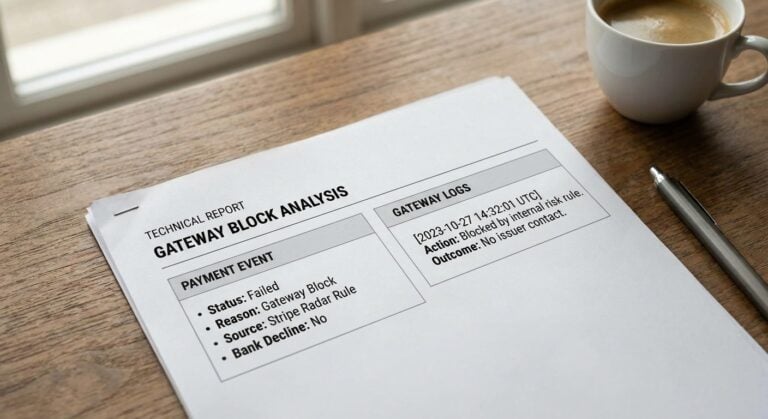
It is crucial to distinguish between a gateway block and an actual bank decline. When a tool like Radar blocks a transaction, it often registers in your high-level analytics simply as a failed payment, blending in with genuine issuer declines. You must dig into your gateway logs to see if the transactions actually received a network response or if they were stopped at the front door.
The Machine Learning Threshold Trap
If your gateway logs show that the transactions were indeed blocked internally, you need to evaluate your risk rules. If you have custom rules configured to block transactions when the risk score is above a certain number or the billing address zip code fails an AVS check, those rules might be misfiring.
Machine learning models are dynamic, meaning the gateway’s underlying algorithm that determines a transaction risk score is constantly learning and adjusting. A transaction profile that scored a safe 45 out of 100 last month might suddenly score an 85 today because of new data ingested by the gateway’s global network. If your custom rules dictate that anything over 80 should be blocked, you will experience a sudden spike in failed checkouts even though you never explicitly changed your configuration. Calibrating these thresholds requires a delicate balance between minimizing fraud and maximizing revenue.
Designing a Strategic Response and Recovery Plan
Once you have identified the most likely source of the decline spike, you must move from diagnosis to active payment recovery. Blindly pushing transactions through the system again in the hope that they will magically succeed is a dangerous tactic.
The Danger of Aggressive Retries
When a merchant sees a massive drop in approvals, the immediate instinct is often to build an automated loop that instantly retries every failed payment. This approach is highly counterproductive. Card networks have strict rules against excessive retries of hard declines like lost or stolen cards, and violating these velocity rules can result in heavy fines, account flags, or even the loss of your merchant processing account.
Even for soft declines where a later attempt might theoretically succeed, immediate retries rarely work. If an issuer declined a transaction due to a suspected velocity attack or a daily limit constraint, hitting their servers again five seconds later will only reinforce their suspicion and solidify the block.
Deploying Intelligent Optimization
To effectively reduce payment declines and recover lost revenue, merchants must implement a nuanced, data-driven approach to transaction sequencing. This involves categorizing the exact nature of the failure, understanding the specific rules of the card brand involved, and strategically timing the subsequent attempt.
This is the operational gap where platforms like SmartRetry become valuable. By focusing on payment optimization and intelligent retries of declined payment transactions, these systems analyze the specific decline codes and network contexts to automatically determine the optimal time and routing for a retry attempt. Instead of blindly hammering the network, intelligent systems evaluate variables such as time of day, payday cycles, and historical issuer behavior to maximize the chances of a successful authorization, helping merchants safely recover revenue and improve their overall transaction approval rates; Stripe reports that authorization optimization tools deliver an average acceptance rate uplift of 3.8% (Source).
[[slot:img-04]]
Testing and adapting the Flow
If your diagnosis points to an issuer-level risk change or a gateway machine learning shift, your recovery strategy might require altering the data you send with the transaction. Issuers crave context, and the more verified data you can pass through the payment processing flow, the more comfortable the issuing bank will feel.
Consider passing additional billing details, ensuring perfectly formatted zip codes, and sending Level 2 or Level 3 processing data if applicable to your industry. If the issue is related to 3D Secure adoption in a specific region, you may need to adjust your gateway rules to dynamically request step-up authentication only for the specific BINs or transaction sizes that are experiencing the highest decline rates, rather than applying friction across your entire checkout experience.
Building Long-Term Transaction Resilience
A sudden spike in generic card declines is rarely a one-time event. As long as fraud patterns evolve and financial institutions update their defensive algorithms, these anomalies will occur. The goal is not to prevent them entirely, which is impossible, but to reduce your time to resolution when they do happen.
Building resilience requires setting up granular, proactive monitoring rather than relying solely on a blended, top-level dashboard to monitor your business health. Configure automated alerts that trigger when the approval rate drops by a specific percentage for a single card brand, within a specific geographic region, or on a specific custom fraud rule.
By maintaining a deep understanding of how your transaction data interacts with acquirers, networks, and issuers, and by leveraging intelligent strategies to retry failed payments when appropriate, you can insulate your revenue streams from the unpredictable shifts of the global payments ecosystem. The key is to remain analytical, avoid reactive configurations, and treat every generic decline as a data point in the continuous effort to refine your payment architecture.



 Find me on Linkedin