What Is Chargeback Rate?
Chargeback rate is the percentage of a merchant’s transactions that turn into chargebacks during a given period. In practice, payment teams usually calculate it by dividing the number of chargebacks received by the number of sales transactions, then multiplying by 100. For example, if a merchant processes 10,000 transactions and receives 60 chargebacks, the chargeback rate is 0.6%.
This metric is used by acquirers, card networks, fraud teams, and merchant operations teams to measure dispute exposure. It is one of the clearest indicators of whether a business is creating avoidable payment disputes through fraud, fulfillment issues, recurring billing confusion, poor customer service, or weak transaction controls. Across industries, the average chargeback rate is often cited around 0.60%, or about 6 chargebacks per 1,000 transactions (Clearly Payments, Unknown).
Chargeback rate is not the same as a payment decline or refund rate. A decline happens at authorization, before settlement. A refund is initiated by the merchant after a completed sale. A chargeback happens after settlement when the cardholder disputes the transaction through the issuer. Because chargebacks move through issuer and network dispute workflows, they create direct financial loss, operational overhead, and elevated acquiring risk in ways that routine declines and refunds do not.
Why It Matters for Payment Teams
For payment teams, chargeback rate is more than a reporting metric. It directly affects the merchant’s ability to keep processing cards on stable terms. A chargeback rate that trends upward can trigger monitoring by acquirers or card networks, reserve requirements, higher processing costs, stricter fraud controls, or in severe cases account termination. Many sources cite 1% as the generally accepted upper limit for direct merchant accounts (Sift, Unknown) (Clearly Payments, Unknown). That means even a seemingly small increase from 0.6% to 1.1% can have outsized consequences.
Chargeback rate also matters because it reflects problems across the entire customer and payment lifecycle, not just fraud screening. A high rate may indicate first-party misuse, subscription confusion, duplicate billing, poor descriptor configuration, delayed shipping, product quality issues, weak cancellation flows, or slow customer support. Payment operations managers often discover that the dispute root cause sits outside the payments stack, which is why chargeback management usually requires coordination across fraud, billing, support, logistics, and finance.
Card-not-present businesses need to be especially careful. Chargeback rates for card-not-present are commonly cited in the 0.6% to 1% range, compared with about 0.5% for card-present environments (Chargeflow, Unknown). This matters for ecommerce, SaaS, digital goods, marketplaces, travel, and subscription merchants, where issuer visibility is lower and customer confusion is more common. Stripe also notes projected global chargeback transaction volume growth of 42% from 2023 to 2026 (Stripe, Unknown), which suggests many teams will face more dispute pressure, not less.
There is also a revenue quality dimension. A merchant can grow gross processed volume while quietly damaging net revenue if disputed transactions rise at the same time. Teams that optimize only for approval rate without watching post-settlement outcomes can end up approving transactions that later become losses. In that sense, chargeback rate is an important balancing metric alongside approval rate, fraud rate, refund rate, and customer retention.
How Chargeback Rate Works
The basic formula is straightforward: chargeback rate = chargebacks received during a period divided by transactions processed during a period, multiplied by 100. The operational complexity comes from what counts in the numerator and denominator, and whether the merchant is aligning with internal reporting, acquirer reporting, or network program rules.
In a typical payment flow, the merchant first submits an authorization request through its payment service provider and acquirer. If the issuer approves it, the transaction is captured and settled. Days or weeks later, the cardholder may contact the issuer and dispute the charge. The issuer then opens a chargeback under a network reason code, such as fraud, merchandise not received, duplicate processing, or subscription cancellation dispute. That disputed transaction enters the chargeback count for the relevant period.
From an operations perspective, teams usually work through chargeback rate in several steps:
-
Count all chargebacks received in the measurement window, often monthly.
-
Count the total number of qualifying sales transactions in the denominator. Some teams use all settled sales, while network or acquirer reporting may use a lagged transaction count.
-
Segment the result by channel, payment method, issuer country, MID, descriptor, product line, subscription cohort, and dispute reason code.
-
Compare the current rate with internal thresholds, acquirer thresholds, and historical baselines.
-
Investigate root causes and adjust fraud rules, billing logic, customer messaging, fulfillment workflows, or support paths.
One of the most important nuances is timing. Chargebacks are delayed events. A chargeback received this month may relate to a sale from a prior month. That delay can distort trends if teams do not cohort disputes back to original transaction date, billing cycle, or campaign source. For recurring billing businesses, this is especially important because a cardholder may dispute several months of charges after a cancellation complaint or after forgetting the merchant name on a statement.
Another nuance is threshold logic. Payment teams often hear that 1% is the line to stay under, but card network and acquirer monitoring programs can use different formulas, volumes, and time windows. Mastercard monitoring threshold in one context (Stripe, Unknown). The practical takeaway is that merchants should know exactly how each provider calculates exposure rather than relying on a single generic benchmark.
Chargeback rate should also be read together with related metrics such as fraud rate, representment win rate, refund-to-dispute deflection rate, authorization rate, and false decline patterns. A merchant with a moderate chargeback rate but poor representment recovery may still be losing too much revenue. Likewise, a merchant with falling chargebacks but collapsing approval rates may be over-tightening controls and suppressing legitimate sales.
Common Mistakes and Misconceptions
One common mistake is treating chargeback rate as a fraud-only metric. Fraud is important, but many chargebacks come from customer experience failures and so-called friendly fraud or first-party misuse. Teams that focus only on fraud models may miss obvious operational fixes such as clearer descriptors, better renewal reminders, easier cancellation, faster shipping updates, and stronger support escalation paths.
Another mistake is measuring only the headline rate without segmentation. A merchant may appear safe overall while one MID, issuer region, affiliate source, or subscription plan is generating most disputes. Without segmentation, teams cannot isolate the exact operational source of the problem or decide where to intervene first.
A third misconception is that chargebacks are unavoidable once a transaction is approved. In reality, many disputes are preventable before the sale, during fulfillment, and after billing. Pre-transaction controls reduce unauthorized use. Post-transaction controls reduce confusion and dissatisfaction. This is why chargeback prevention spans fraud detection, billing operations, statement descriptor strategy, order communication, and refund handling.
Teams also often misuse the denominator. Some compare chargebacks against attempted authorizations rather than completed sales, which understates risk. Others compare a current-month numerator against a current-month denominator without accounting for dispute lag. Both choices can produce misleading ratios and mask deterioration until an acquirer flags the account.
Finally, some merchants respond to rising chargeback rate by approving fewer transactions across the board. That may reduce disputes temporarily, but it can also harm revenue and customer lifetime value. The better approach is precision: identify which transactions, issuers, products, or customer journeys create downstream disputes, then fix those conditions instead of broadly constraining demand.
How SmartRetry Helps
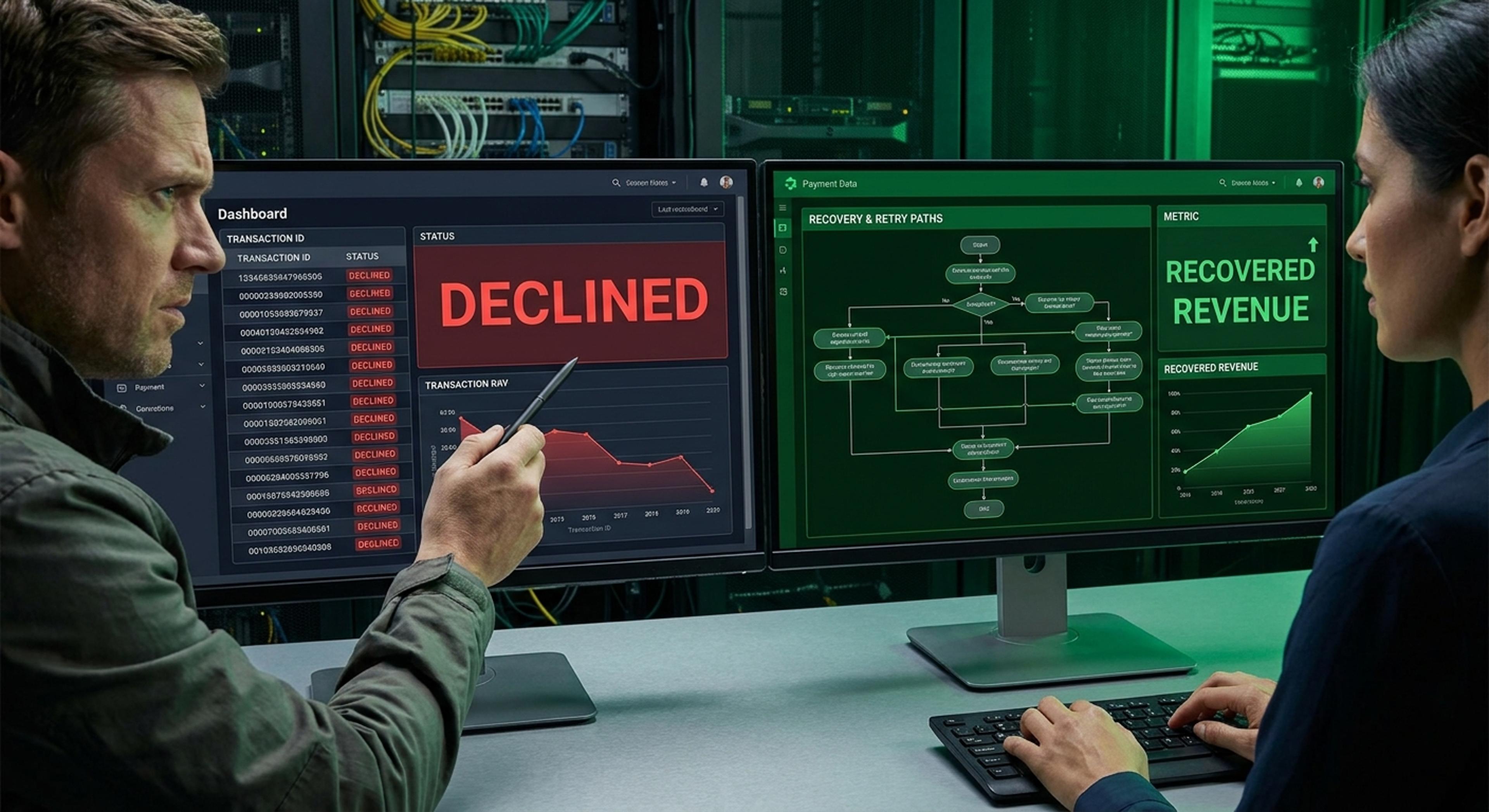
SmartRetry helps reduce the conditions that often contribute to higher chargeback rate by improving payment recovery on legitimate failed transactions without relying on blunt retry behavior. When a merchant retries declines intelligently, using better timing and routing logic, it can recover valid revenue while avoiding unnecessary duplicate attempts, customer confusion, and billing friction that may later surface as disputes. SmartRetry also gives teams clearer visibility into decline and recovery patterns across issuers, acquirers, and payment service providers, which helps separate true payment failures from broader customer or fraud issues. That operational clarity makes it easier to optimize approval performance and protect post-settlement dispute outcomes at the same time.