

After spending months analyzing the numbers and negotiating better rates, your engineering team executed a flawless integration. The new, highly optimized payment routing logic is officially live. Then you check the performance dashboard. Instead of the anticipated margin improvements, you are staring at a massive, sudden spike in payment failures. The transaction approval rate is plummeting, and good customers are seeing declined messages at checkout. Consequently, customer support is overwhelmed with complaints. This is the optimization hangover. It happens to some of the smartest payment operations teams in the industry. While it feels like an acute technical failure, the issue is usually much more nuanced. The drop in approvals is actually a behavioral mismatch because your newly designed payment processing flow has inadvertently tripped the highly sensitive risk models used by issuing banks.
The mechanics of an optimization hangover
When a merchant decides to optimize their payment stack, the goals are usually straightforward: reduce processing costs, build redundancy, or increase geographical acceptance by routing transactions to local acquirers. From a systems perspective, changing a gateway or adjusting routing rules is just a matter of changing where the API calls are sent. If the payload is correctly formatted and the card is valid, the logic dictates that the transaction should be approved.
However, the global payment network does not operate on pure technical logic, but rather on trust, history, and probability. The issuing bank, the institution that actually holds the cardholder’s funds and makes the final decision on whether to approve or decline a transaction, looks at much more than just the card number and the CVV. Issuers employ highly sophisticated machine learning models to detect fraud in milliseconds.
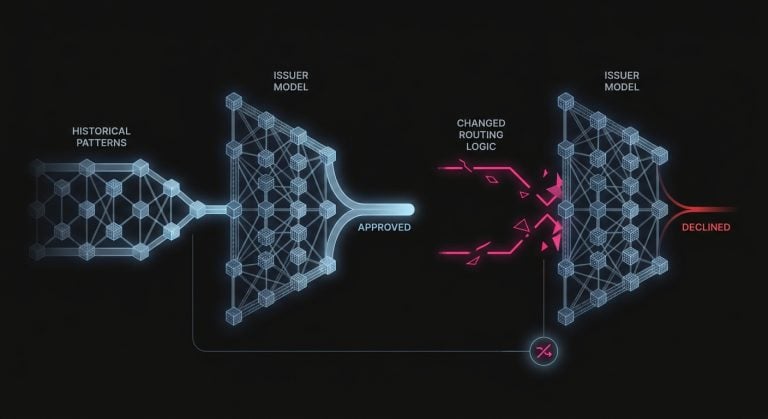
These anti-fraud models rely heavily on historical patterns. When you suddenly shift a large volume of transactions from one payment service provider to another, the historical pattern breaks. From the perspective of the issuer’s risk model, a massive influx of volume coming from an unfamiliar acquiring setup does not look like a clever payment optimization strategy. To them, it looks like a coordinated fraud attack.
Why issuers suddenly mistrust your traffic
To understand why a routing change triggers so many declines, it is helpful to look at how transactions are identified as they travel across the card networks. Issuers do not simply see your brand name and automatically trust the volume. They look at the merchant identifier (MID), the Acquirer Bank Identification Number (BIN), and the specific combination of data points associated with the request.
If you have been processing millions of dollars through Acquirer A for the past three years, the issuing banks have built a detailed profile of your typical transaction. They know your average order value, your typical chargeback ratio, and the exact digital footprint of your processing flow. When you suddenly switch 100% of your routing to Acquirer B, you are essentially given a blank slate.
The trust deficit in new merchant IDs
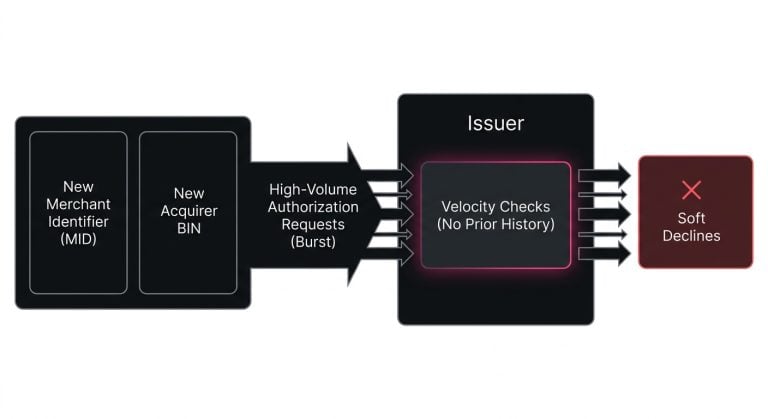
Trust in the payment ecosystem is earned at the MID and Acquirer BIN level. When you spin up a new routing path, you are often using a newly provisioned MID. To an issuer’s neural network, this new MID has zero history and has not yet proven that it represents legitimate, low-risk commercial activity.
When a completely new MID suddenly blasts thousands of authorization requests across the network, it triggers automated velocity checks. The risk models assume that a sudden, high-volume burst from an unknown source might be a botnet attempting to test stolen credit card numbers. In response, the issuer adopts a defensive posture, resulting in a wave of generic soft declines.
Volume velocity and the machine learning tripwire
The speed at which you transition your traffic is often the primary culprit behind a spike in issuer declines. Many engineering teams treat routing switches like a light switch, turning the old provider off and the new provider on overnight. While this makes for clean technical deployments, it is highly disruptive to payment authorization models.
Machine learning algorithms are trained to flag anomalies, and a 10,000% day-over-day increase in volume on a specific routing path is the very definition of one. The issuer response in these scenarios is often to throttle approvals by issuing soft declines such as Do Not Honor or High Risk until the pattern normalizes or the acquiring bank vouches for the traffic.
The technical translation problem
Beyond the behavioral risk models, there is often a technical layer to the decline spike. Even if two payment gateways use the same underlying card network, they rarely format data in the exact same way. A payload that passes perfectly on one gateway might be slightly truncated or misinterpreted by another.
These subtle technical mismatches might not fail the gateway’s basic API validation, but they can degrade the quality of the authorization request by the time it reaches the issuer. If the issuer feels that the data is incomplete or suspicious, they will default to declining the transaction.
Discrepancies in data payloads
When migrating traffic, it is common to inadvertently drop secondary data fields that issuers rely on for fraud scoring. For instance, Level 2 and Level 3 data, which includes specific line-item details of the purchase, can significantly boost authorization rates, especially for B2B transactions. If your new routing setup strips this data out, the issuer’s confidence in the transaction drops.
Similarly, Address Verification System formatting can vary wildly between providers. If the new gateway misinterprets the postal code field or fails to pass the street address in the exact format the network expects, you will start seeing an increase in AVS mismatches. While some issuers will still approve transactions with an AVS mismatch, conservative banks will decline them outright.
The complexities of network tokens and 3DSecure
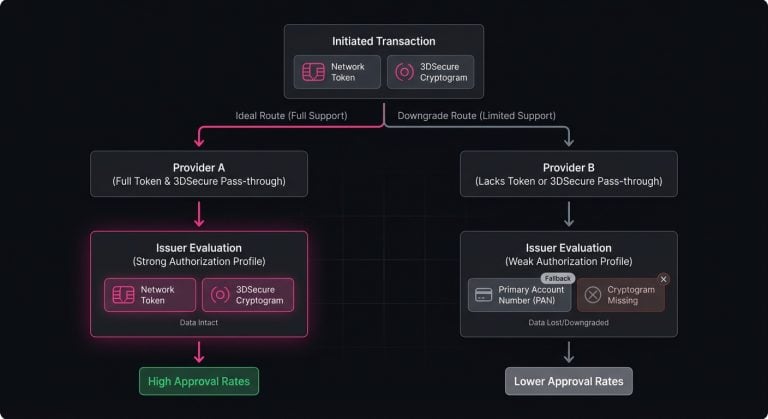
Another frequent culprit in the optimization hangover is the handling of advanced payment features like network tokens and 3DSecure. If your previous setup relied heavily on network tokenization, you benefited from the higher approval rates that tokens generally command. If you route traffic to a new provider that does not yet support those specific tokens, forcing a fallback to raw Primary Account Numbers, issuers will immediately notice the downgrade in security posture and adjust their approval logic accordingly.
The same applies to 3DSecure authentications. If the new routing logic fails to pass the correct authentication cryptograms, or if the step-up rules are misconfigured, the issuer will reject the transaction because the expected liability shift parameters are absent.
Strategic steps to stabilize the payment flow
When you are in the middle of a severe approval rate drop, the immediate instinct is often to panic and roll everything back. While a temporary rollback might be necessary to protect immediate revenue, abandoning the optimization effort entirely means leaving money on the table in the long run.
Instead, the recovery process requires a methodical approach to identifying the root causes, adjusting the traffic flow, and systematically rebuilding trust with the issuing banks.
The art of the volume warm-up
The single most effective strategy for preventing or recovering from a routing-induced decline spike is traffic shaping. Instead of shifting 100% of your volume on day one, treat your new payment routes like a volume dial.
Start by routing a very small percentage of traffic, perhaps 5% or 10%, through the new gateway while monitoring the transaction approval rate closely. A/B testing new routing rules on 10-20% of traffic is a common recommendation. This slow trickle of volume allows the issuing banks’ risk models to build a profile of the new MID. They begin to see that the transactions are legitimate, the chargeback rates are low, and the behavior matches standard consumer purchasing patterns. Over the course of several weeks, you can gradually increase the volume allocation so that by the time you reach 100%, the new route has a mature, trusted history.
Auditing the authorization payload
While the volume is warming up, you must also conduct a forensic audit of your data payloads. Pull a sample of successful transactions from your old routing setup and compare them side-by-side with the declined transactions on the new setup.
Look for subtle differences. Are the CVV codes passing correctly? Is the customer IP address being forwarded, or is the new gateway inadvertently sending the IP address of your own server? Are the Merchant Initiated Transaction flags formatted correctly for recurring billing? Identifying and fixing these micro-mismatches will often recover a significant portion of the lost approvals.
Designing a safety net for failed authorizations
Even with the most careful warm-up strategy and meticulous payload auditing, you will still experience some friction when modifying your payment processing flow. Issuers are inherently conservative, and some legitimate transactions will inevitably get caught in the crossfire of risk models.
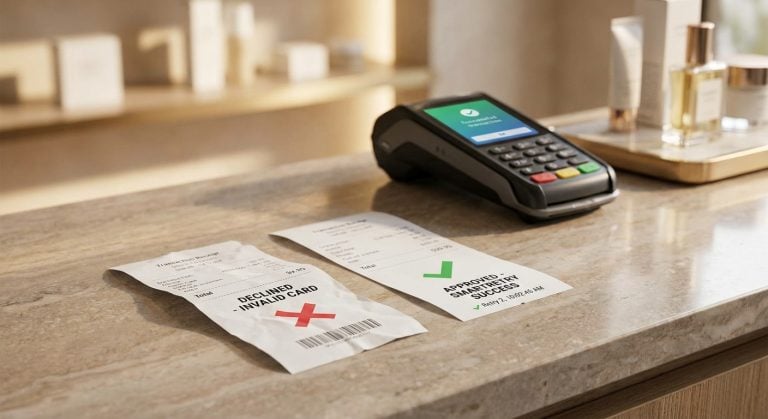
This is where a robust strategy to retry failed payments becomes critical, as how you handle these retries can either save the transaction or severely damage your MID’s reputation.
The danger of blind retries
When a declined message is received, the easiest programmatic response is to simply try the card again, but this is a dangerous approach. If an issuer has declined a transaction for suspected fraud or velocity reasons, immediately hammering the network with the exact same request will only validate their suspicion.
Rapid, blind retries can lead to increased decline rates, higher network penalty fees, and in extreme cases, the issuing bank blocking your MID entirely. A declined transaction requires a thoughtful response, not a brute-force attack.
Implementing intelligent retry logic
To actually recover revenue without damaging your ecosystem standing, the retry logic must be contextual. An intelligent system looks at the specific issuer response code and determines the optimal next step. If a transaction returns a hard decline, such as Card Expired or Account Closed, retrying is futile and should be avoided entirely.
For soft declines, however, the strategy changes. If the decline suggests a velocity limit or a temporary hold, the system might schedule a retry for 24 hours later. Platforms like SmartRetry specialize in this exact layer, focusing on payment optimization and intelligent retries of declined payment transactions. By analyzing the decline code, the time of day, and the context of the failure, these systems help merchants recover revenue and improve transaction approval rates without blindly hammering the issuing bank and worsening the problem.
Fallback routing as a contingency
Another effective method for handling the optimization hangover is fallback routing. If a transaction fails on the newly optimized route due to a soft decline, your payment orchestration logic can instantly catch the failure and route a retry through the legacy gateway.
Because the legacy gateway still holds the historical trust of the issuing bank, the transaction is often approved on the second attempt. This allows you to continue pushing volume to the new, cost-effective provider while using your older, more expensive provider strictly as an insurance policy to catch the fallout. Over time, as the new route builds its own trust, the reliance on the fallback route will naturally diminish. Optimized payment routing can increase acceptance rates by 3-8 percentage points without other business changes.
The specific challenge for recurring billing
Merchants operating on subscription models face a particularly steep challenge when switching payment providers. Subscription payment issues are notoriously difficult to untangle because they rely heavily on stored credentials and specific processing agreements.
When you migrate stored cards from one vault to another, or when you begin routing existing subscriptions through a new acquirer, the transaction type changes subtly. The issuing bank needs to know that the cardholder previously consented to these ongoing charges, even though the merchant’s acquiring setup has changed.
Managing MIT and CIT flags
To prevent subscription declines, merchants must ensure that the Merchant Initiated Transaction, or MIT, and Customer Initiated Transaction, or CIT, flags are perfectly mapped. The initial purchase where the customer is present and authenticates the transaction is a CIT. All subsequent automated billing events are MITs.
If your new routing logic fails to correctly reference the original CIT network transaction ID when processing a subsequent MIT, the issuer will likely decline it. They will view the transaction as an unauthenticated, card-not-present charge missing the required 3DSecure step-up. Ensuring that the traceability chain remains unbroken during a gateway migration is paramount to keeping subscription approval rates stable.
Graceful dunning and customer communication
When subscription renewals fail during a routing optimization phase, it is vital to protect the customer relationship. The customer did not change their card, and they did not run out of funds. The failure is entirely on the backend infrastructure.
Before triggering aggressive dunning emails that warn the customer of impending service cancellation, your systems should exhaust all intelligent retry and fallback routing options. Only when a soft decline proves unrecoverable, or a hard decline is received, should the customer be asked to update their payment method. Shielding the customer from the friction of your backend optimization is a critical component of churn prevention.
Long-term optimization and steady growth
Achieving the perfect payment processing flow is not a one-time project. It is a continuous operational discipline. The initial shock of an approval rate drop after a routing change is understandably stressful, but it is also a very normal part of scaling a complex financial infrastructure.
Issuers and their machine learning models are fundamentally risk-averse, designed to protect cardholders and limit liability. They do not know about your cost-saving initiatives, and they do not inherently trust your new technology stack. Trust in the payments world is rented, not owned, and it must be rebuilt carefully every time you change the plumbing.
By understanding the mechanics of issuer behavior, treating volume migration as a gradual process, meticulously auditing data payloads, and leaning on intelligent retry frameworks to catch the inevitable soft declines, merchants can successfully navigate the optimization hangover. Ultimately, the goal is to reach a state where you are processing through the most cost-effective, resilient routing paths available, without sacrificing the transaction approval rates that drive your business forward.


 Find me on Linkedin