

The Mystery of the Generic Decline: Decoding Vague Payment Failures
The checkout is complete, the customer hits the buy button, and the system spins. As you wait for the transaction to clear, the process suddenly halts and spits back a completely unhelpful message indicating the transaction declined. There is no clear explanation, actionable advice, or indication of what went wrong. You are left staring at a generic error code like Do Not Honor or a hopelessly vague Payment Failed status.
Few things are as frustrating for merchants as vague payment failures. You have done the hard work of acquiring the customer, guiding them through the funnel, and convincing them to convert. The product is ready to ship or the software is ready to provision. Yet revenue slips through the cracks simply because a distant server in the payment ecosystem decided to say no without offering a reason. Global merchant sales lost to false declines reached US$174.4 billion in 2024 (Source), showcasing exactly how much value is left on the table.
For professionals managing payment operations, revenue growth, or product flows, navigating this ambiguity is a daily operational reality. You cannot fix a problem if you do not understand the root cause. When issuer responses are opaque and acquirer messaging is abstracted, diagnosing checkout issues becomes an exercise in educated guessing.
Understanding why these vague declines happen, how the underlying infrastructure strips away context, and what practical steps you can take to recover that revenue is critical to modern payment optimization.
The Telephone Game of Payment Processing
To understand why decline codes are so notoriously vague, you have to look at the payment flow itself. This highly complex, multi-hop journey happens in a fraction of a second and relies on infrastructure largely designed decades ago.
When a customer attempts a purchase, the payment authorization request travels from your checkout page to your payment service provider or gateway. From there it moves to the acquiring bank before passing through a card network such as Visa or Mastercard. Finally, it routes to the customer’s issuing bank. The issuer decides whether to approve or decline the request, and the response makes the exact same journey in reverse. Across this vast network, one in every 10 ecommerce dollars is declined by issuers during payment authorization (Source).
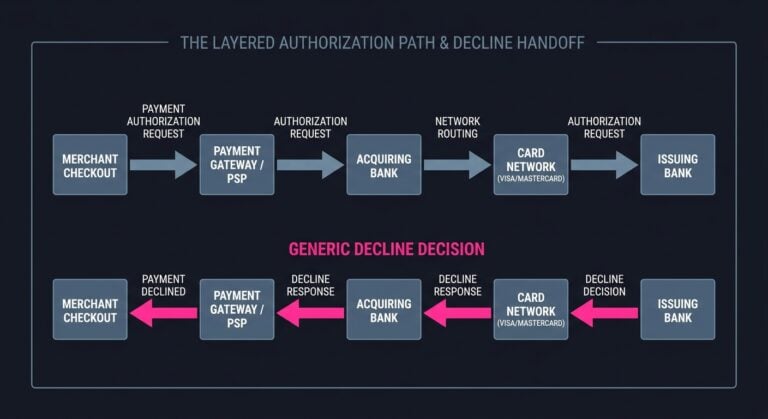
Every step in this chain is a potential point of translation. The underlying language governing most of these network communications is an ISO standard established in the 1980s. When this standard was built, bandwidth was incredibly expensive and message sizes were strictly limited, forcing the system to rely on rigid, two-digit response codes.
An issuing bank might use an incredibly sophisticated machine learning model to evaluate hundreds of data points in real time. The model could determine a transaction is too risky because the velocity of purchases on the card is unusually high, the IP address originates from a different time zone than the billing address, and the merchant category code does not align with the cardholder’s typical behavior.
The issuer’s system knows exactly why it is declining the transaction. However, because it must send that decision back through legacy ISO 8583 pipes, it cannot attach a detailed JSON payload explaining the nuances of its risk model. It has to map that complex decision to a legacy two-digit code, and most of the time, the closest fit is simply 05 Do Not Honor.
The Gateway Abstraction Layer
The loss of fidelity does not stop at the card network. Once the generic code reaches your payment gateway or acquirer, another layer of translation often occurs.
Modern payment service providers have done a remarkable job of simplifying the developer experience by replacing esoteric banking protocols with clean, predictable REST APIs. However, in their quest to make integration as smooth as possible, gateways often abstract the raw network codes into their own simplified statuses. In fact, 65% (Source) of businesses do not receive detailed raw response codes on failed payments.
An acquirer might receive a network code indicating a temporary system malfunction at the issuer level. Instead of passing that specific context down to the merchant, the gateway’s API might normalize the response into a blanket card declined string. The intent is to provide a uniform experience across multiple acquiring banks and networks, but the unintended consequence is that the merchant is left entirely blind to the actual reason for the failure.
When you combine issuer data truncation with gateway API abstraction, you end up with a payment processing flow that feels like a black box. The data you need to make intelligent routing or retry decisions simply vanishes before it reaches your dashboard.

Security by Obscurity: The Issuer’s Perspective
It is easy to blame legacy technology for vague payment issues, but system limitations are only part of the story. Issuers often keep decline reasons intentionally ambiguous as a defense mechanism against fraud.
Fraudsters constantly probe payment networks to figure out how risk models operate. They use automated scripts to run thousands of stolen card numbers while testing different combinations of billing addresses, expiration dates, and security codes. If an issuer were to return a highly specific decline reason, such as a note that the CVV matches but the billing zip code is incorrect, they would effectively be handing the fraudster a roadmap to bypass the security checks. The fraudster would simply adjust their script to guess different zip codes until the transaction goes through.
To prevent this kind of systemic probing, issuers employ security by obscurity. By using a catch-all decline code they give the fraudster no actionable intelligence, though this blunt-force approach unfortunately catches legitimate merchants in the crossfire. Studies reveal that 70% (Source) of issuer-declined orders are from qualified, legitimate customers, resulting in $118 billion of legitimate transactions declined due to suspected fraud over the past year (Source). A well-intentioned customer who accidentally transposed two numbers in their zip code receives the same opaque error message as a malicious botnet attempting a card-testing attack.
Decoding the Most Common Offenders
While there are dozens of decline codes that can appear in your logs, a few specific culprits are responsible for the vast majority of vague payment failures. Understanding the tendencies behind these codes is the first step toward effective payment recovery.
Code: Do Not Honor
This is the most notorious decline code in the payments industry. It essentially tells the merchant the transaction is being declined without providing any specific reason why. Currently, close to 50% (Source) of global card decline responses use the ‘Do Not Honor’ reason code, with an astonishing peak reported by specific US banks. Based on unique merchant volumes, a significant share of declined payments is accounted for by the 05 Do Not Honor response (Source).
In practice, Do Not Honor is often used as a masking code for insufficient funds. Many banks prefer not to explicitly state that their customer lacks the money to complete a purchase. This protects privacy and avoids potential embarrassment at a physical point of sale, so the bank maps the insufficient funds decline to the Do Not Honor code.
However, Do Not Honor can also trigger for a variety of other reasons, including suspected fraud, temporary account freezes, or unusually high cross-border transaction volume. Because it is a catch-all, treating every Code 05 as an insufficient funds issue can be a costly mistake.
Generic Risk Declines
Sometimes a transaction is declined purely based on the merchant’s risk profile or category. If a merchant operates in a highly regulated or traditionally high-risk industry, an issuer’s automated systems might block the transaction proactively. The issuer response will rarely state that the merchant category code is restricted and will instead present a generic failure.
Try Again Later / System Malfunction
These codes suggest a technical timeout or a temporary outage. The ambiguity lies in where the outage occurred, leaving you to wonder if the acquiring bank failed to reach the network, the network failed to reach the issuer, or the issuer is simply undergoing scheduled database maintenance. While these are technically soft declines, the lack of clarity makes it difficult to know exactly when to attempt a retry.
The Ripple Effect on Subscriptions
Vague payment failures are painful for any merchant, but they are uniquely destructive for businesses relying on recurring revenue. When dealing with subscription payment issues, the dynamics of a decline change entirely.
In a traditional e-commerce checkout, the customer is actively engaged on the screen. If they encounter a vague decline, they have the immediate opportunity to pull out a different credit card, double-check their billing address, or call their bank. The merchant can prompt them to try another payment method while their intent to purchase is still high.
Subscription renewals happen in the background when the customer is not present. If a card on file is hit with a Do Not Honor code on the first of the month, the transaction simply fails. The merchant is left holding a vague error code and faces a difficult operational dilemma. They must decide whether to immediately interrupt the customer’s service to demand a new payment method or quietly attempt to recover the payment behind the scenes.
If you email the customer immediately for every generic decline, you risk causing unnecessary friction, which often leads to voluntary churn. The customer might realize they no longer need the service and simply ignore the email. On the other hand, if you wait too long to resolve the issue, you provide services for free and damage your cash flow. In the subscription space, interpreting vague issuer responses accurately is the difference between retaining a loyal user and losing an account to involuntary churn. This retention threat is well-documented: 78% (Source) of financial institutions report failed payments critically hurt customer experience, and 33% (Source) of consumers are permanently deterred from shopping on a site due to a payment decline.

Reading the Metadata Context Clues
If the decline code itself is useless, how do you reduce payment declines and improve your transaction approval rate? The answer lies in looking beyond the primary error code and analyzing the surrounding metadata.
Every payment authorization carries secondary characteristics that can help you reverse-engineer the likely cause of a generic failure. By treating the authorization request as a comprehensive data package, experienced payment teams can spot patterns that point toward the real issue.
Sifting Through AVS and CVV Responses
Address Verification System, or AVS, and Card Verification Value checks happen alongside the primary authorization. Often, an issuer will decline a transaction with a vague code, but the gateway will still return the results of the AVS and CVV checks.
If you receive a Do Not Honor code but the metadata shows the CVV was incorrect or the AVS returned a complete mismatch, the generic decline is likely masking a fraud or data entry issue. Retrying the exact same payload in this scenario is a waste of time and money because the customer needs to be prompted to correct their information.
Analyzing the BIN Data
The Bank Identification Number, or BIN, consists of the first six to eight digits of a credit card and reveals a wealth of information about the card type. This data tells you whether the payment method is a debit, credit, prepaid, corporate, or consumer card, as well as the country that issued it.
If you see a surge of generic declines on consumer debit cards, especially toward the end of a week or the end of a month, there is a strong statistical probability that the underlying issue is insufficient funds. Conversely, if you see generic declines clustered around cross-border credit card transactions, the issuer’s fraud rules regarding international purchases are likely the culprit.
Time-Based Patterns
Sometimes the clue is in the clock. If you notice a spike in System Error or generic decline codes occurring at 2:00 AM on a Sunday, you are likely hitting an issuer’s scheduled batch processing or maintenance window. These are temporary outages disguised as generic failures that usually resolve themselves if you simply wait a few hours.
The Pitfalls of Aggressive Retries
When faced with a soft decline or a vague error, the natural instinct is to try again. If the system says Do Not Honor, merchants often hope it will change its mind upon a second or third attempt. This brute-force approach to retrying failed payments is one of the most common and expensive mistakes a business can make.
Payment networks do not like endless retries. From their perspective, repeatedly submitting the same payment authorization that has already been rejected strains their infrastructure and looks highly suspicious. Visa, Mastercard, and other networks have strict rules regarding how many times a transaction can be retried in a given timeframe.
If you blindly loop a retry script on a transaction that failed due to a hard block disguised as a generic error, you will incur processing fees for every single attempt. Worse, if your overall decline ratio spikes because of automated, unintelligent retries, the networks may penalize you, fine your acquiring bank, or even threaten your ability to process payments entirely. When a retry logic goes unchecked, merchants face a compounding problem. First, many consumers abandon their purchase after a false decline. Second, the overarching global cost of false declines to the card industry is expected to reach US$213 billion (Source) in 2025.
To safely recover revenue, the retry logic must be decoupled from emotion and grounded in data.
Implementing Intelligent Payment Recovery
To combat the opacity of the payment ecosystem, merchants rely on sophisticated strategies to retry failed payments safely and effectively. This involves moving away from static dunning schedules, such as retrying every failed card three days in a row, and shifting toward dynamic, rules-based logic.
Effective payment optimization requires categorizing vague errors based on the metadata clues discussed earlier, and then applying a specific recovery strategy to each category.
If the BIN data suggests a debit card and the timing implies insufficient funds, an intelligent strategy might pause the retry schedule until the next common payday, such as the 1st or 15th of the month, or adjust the timing to hit the card on a Friday morning when direct deposits typically clear.
If the metadata suggests a cross-border friction issue, the strategy might involve routing the next attempt through a different acquiring bank that has a local presence in the cardholder’s region, thereby increasing the likelihood of approval. This routing flexibility is vital, as 60% (Source) of APAC merchants are reporting an increase in false declines, while the average false decline rate across merchant responses currently sits at 1.51% (Source).
Platforms like SmartRetry are built specifically to navigate these complexities by applying intelligent logic to declined transactions. Rather than relying on rigid rules, such a system analyzes the nuanced metadata surrounding a vague decline to determine the optimal timing, routing, and frequency for a subsequent attempt. By automating these contextual decisions, merchants can recover lost revenue and significantly improve their transaction approval rates without running afoul of network retry limits or increasing their processing costs.
Modernizing the Payment Stack
While navigating generic decline codes is currently a required skill for any payment operations team, the industry is slowly moving toward better data visibility.
The adoption of the ISO 20022 messaging standard is a massive structural shift in global finance because, unlike the restrictive two-digit codes of the 1980s, it utilizes rich XML data structures. As this standard becomes more widely implemented across domestic and international clearing networks, the pipes that carry payment data will finally be wide enough to support detailed, contextual decline messaging.
Additionally, the rise of network tokenization is helping to bypass some of the friction that causes vague declines in the first place. By replacing primary account numbers, or PANs, with merchant-specific tokens that are mathematically linked to the issuer, network tokens inherently carry a higher degree of trust. When issuers see a network token, they are far less likely to trigger a generic fraud decline because the token itself acts as a strong signal of legitimacy.
Embracing the Ambiguity
Until legacy infrastructure is fully retired and new messaging standards achieve universal adoption, the generic decline code will remain a persistent reality in digital commerce.
You cannot control the limited data an issuer chooses to send back, nor can you force an acquiring gateway to expose raw network codes they have chosen to abstract. However, you can control your operational response to that ambiguity.
By treating a vague decline not as a dead end, but as a puzzle to be solved through metadata analysis, careful routing, and intelligent retry logic, you can reclaim a significant portion of the revenue that otherwise slips away. Optimizing your payment processing flow requires accepting that the system is inherently probabilistic. The merchants who succeed are the ones who stop wishing for perfect clarity and instead build the systems capable of thriving in the fog.



 Find me on Linkedin