

Payment Processing Outage: Causes and Response Plan – Shopify
The checkout is the most critical point in digital commerce. When it fails, operations halt-a widespread challenge given that 46% of UK shoppers experienced a failed payment at checkout in the past 12 months(Source).
What Just Happened in the Payment Ecosystem
The digital payments landscape is undergoing a period of rapid modernization, introducing both new capabilities and new points of friction. Recent industry shifts highlight a growing reliance on complex, layered decisioning engines. From open banking to AI, payments are becoming more intelligent, with data moving faster between merchants, acquirers, and issuers.
However, this added intelligence requires computational overhead and intricate API dependencies. When Visa acquires entities like BioCatch, it signals a broader market trend where AI reshapes payment fraud prevention through real-time behavioral biometrics. These security layers evaluate variables in milliseconds to authorize or reject a transaction. Similarly, platforms like Trustmi are expanding their partner ecosystems as market demand grows for AI-powered payment security.
While these advancements protect the payment processing flow, they also introduce new potential points of failure. If an AI fraud engine experiences latency or an API endpoint degrades, legitimate transactions may time out or be incorrectly flagged. The result is often a localized outage or an unexpected spike in false declines. For merchants operating on hosted platforms like Shopify, these upstream issues manifest as immediate checkout problems, leaving revenue stranded at the finish line.
The Anatomy of an Outage: Core Causes
Understanding how to build a response plan requires deconstructing why a payment fails in the first place.
Infrastructure and Gateway Degradation
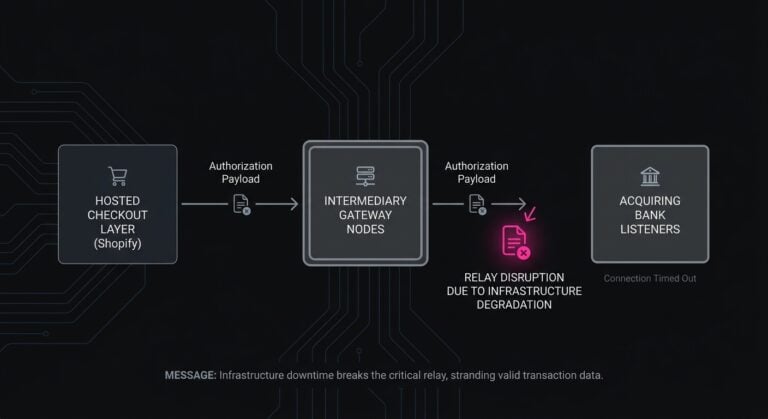
When merchants experience widespread payment failures, the issue often originates at the gateway or the underlying processor level. Platforms like Shopify abstract the complexity of payment processing, routing transactions through white-labeled processors or third-party gateways. If a core processor experiences server downtime or database latency, the communication chain breaks. In these scenarios, the checkout button may still function, but the transaction data never reaches the acquiring bank, resulting in immediate failure messages for the customer.
Issuer Response and Network Latency
Not all outages are caused by the merchant’s platform. Often, the breakdown occurs between the card network and the issuing bank. Network latency can cause a transaction to time out before an issuer response is received. When this happens, a standard card declined message is passed back to the customer, even if they have sufficient funds. During periods of high network congestion or banking infrastructure updates, these timeouts cluster together, creating what appears to be a systemic outage but is actually a temporary degradation in bank communication.
Over-Tuned Security and Fraud Filters
Sometimes the system functions exactly as designed but still produces an unintended operational outage for legitimate customers. As AI-powered security systems update their risk models, they can inadvertently create friction. A sudden shift in fraud scoring logic might reject a specific cohort of transactions, causing a spike in transaction declined statuses. Identifying whether an issue is a true infrastructure outage or simply an over-tuned fraud filter is a critical step in payment optimization, especially since 52 per cent of the orders that merchants thought were fraud turned out to be good orders(Source).
Why Payment Teams Should Care
For product and revenue teams, a payment disruption extends far beyond a temporary IT inconvenience. The financial and strategic implications of degraded payment authorization require careful attention and deliberate planning.
The True Cost of False Declines
When systems falter, legitimate customers are turned away, and the financial impact of this friction is well-documented across the industry. Current data shows that false card declines significantly hit payment revenue. For merchants, the downstream effect is equally punitive. When a platform experiences an outage or elevated friction, the cost is measured in lost customer trust, increased support tickets, and direct revenue leakage-in fact, payment system failures cost UK businesses £1.6 billion annually(Source).
Regulatory Pressure on Subscriptions
Subscription payment issues are particularly sensitive to processing outages. If a scheduled recurring charge attempts to process during gateway downtime, it fails. Historically, merchants might have relied on aggressive, continuous retry logic to capture these funds once the system stabilized. However, the regulatory environment is shifting.
The FTC’s recent subscription crackdown highlights a growing focus on consumer protection, billing transparency, and how merchants manage recurring revenue. Payment processors need to know that regulatory oversight is tightening, which means merchants can no longer afford to use blunt-force retry tactics on failed subscription renewals. If a card is repeatedly hammered after an outage without respect for network rules, it creates compliance risks and can artificially inflate chargeback ratios. A measured, compliant approach to retry failed payments is now a strategic necessity.

The Impact on Network Metrics
Every time a merchant attempts to process a transaction during an outage, it registers as a failure, which suppresses the overall payment retry authorization rate. Card networks and issuers monitor authorization ratios closely. If a merchant’s authorization rate drops too low due to poorly managed automated retries during a disruption, their merchant account may be flagged for elevated risk. Issuers tend to penalize accounts that exhibit erratic processing behavior, meaning a temporary outage can have long-lasting effects on your baseline transaction approval rate if not managed thoughtfully.
Recommended Actions for Outage Response
When payment issues arise, the difference between a minor hiccup and a major revenue loss depends on the merchant’s response plan. Building a playbook in advance ensures that teams act with precision rather than panic.
Immediate Triage and Containment
The first step during a suspected outage is isolation. Teams must determine if the issue is a global platform failure, a specific gateway degradation, or isolated to a particular card network. Monitoring dashboards should be configured to alert on sudden drops in payment authorization rather than just server uptime.
If an active outage is confirmed on a platform like Shopify or its underlying processor, the immediate action should be to pause automated dunning and retry loops. Continuing to push transactions through a broken connection will only result in an accumulation of payment declined statuses. Temporarily halting the payment processing flow protects the merchant’s authorization health and prevents unnecessary frustration for the customer.
Post-Outage Payment Recovery
Once the infrastructure stabilizes, the focus shifts to payment recovery. The backlog of failed transactions must be processed, but doing so all at once can trigger velocity limits at the issuing bank, leading to a secondary wave of soft declines.
Instead of a bulk upload, recovery efforts should rely on spaced, intelligent scheduling. Analyzing the initial issuer response codes helps determine which transactions are viable for recovery. For example, a failure coded as a generic system error or network timeout is highly recoverable once the outage clears. A hard decline unrelated to the outage, on the other hand, requires a different customer communication strategy entirely.

Optimizing the Payment Stack
Long-term resilience requires architectural planning. While merchants on hosted platforms have limited control over the core checkout infrastructure, they can still utilize secondary payment methods. Offering digital wallets or alternative payment rails gives consumers options if the primary card processing gateway is experiencing friction. Diversifying the checkout experience reduces the total dependency on a single point of failure and helps reduce payment declines organically.
SmartRetry’s Response & Capabilities
When navigating the aftermath of an outage or managing baseline payment failures, platforms like SmartRetry provide intelligent retries of declined payment transactions to help merchants recover revenue thoughtfully. Instead of relying on static, rules-based loops that risk network penalties, SmartRetry evaluates historical transaction data, issuer behavior, and optimal timing windows. This approach ensures that payment recovery efforts align with network compliance, ultimately helping to optimize the payment retry authorization rate and improve overall transaction approval rates without creating operational strain.
Building Resilience in Payment Operations
The modern payment ecosystem is a balance of advanced technology and inherent fragility. As AI and intelligent routing become standard, the layers between the customer and the acquiring bank will only grow more complex. Outages, micro-degradations, and unexpected friction will remain a part of digital commerce.
A mature payment strategy accepts this reality. By moving away from reactive troubleshooting and toward structured, intelligent payment optimization, merchants can turn system failures into manageable events. Protecting the authorization rate, respecting compliance frameworks, and utilizing thoughtful recovery logic ensures that a temporary disruption in processing does not result in a permanent loss of revenue.



 Find me on Linkedin