

Enterprise payment architecture is undergoing a structural shift. For years, the traditional approach to capturing funds involved stitching together disparate systems, with hardware provisioning, point-to-point encryption (P2PE), gateways, and acquiring relationships operating in distinct silos. This fragmentation created significant technical debt, complicated compliance efforts, and introduced friction into the transaction lifecycle. Payment professionals often treated these disparate components as an unavoidable cost of doing business, but the economic realities of maintaining legacy systems are changing the calculus. As organizations seek to streamline their operations, industry leaders are beginning to consolidate the infrastructure required to capture, secure, and route transactions effectively.
What Just Happened
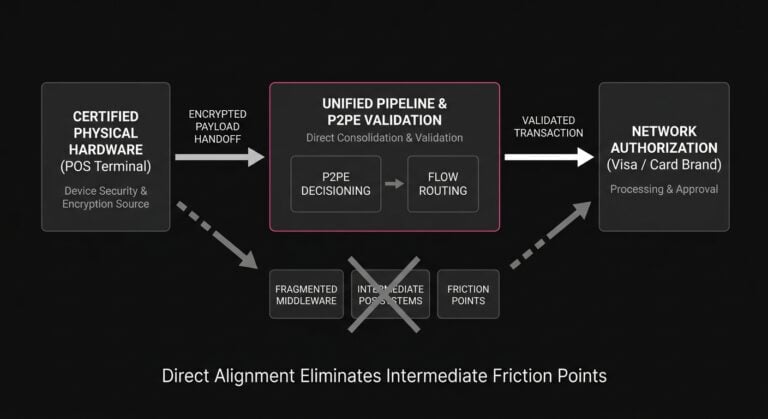
Recently, two major entities in the payment space announced a structural alignment designed to simplify omnichannel commerce. Bluefin and Visa are collaborating on in-person payment acceptance, merging their respective capabilities into a single, cohesive architecture. The integration fundamentally shifts how merchants deploy and manage point-of-sale infrastructure by removing the need to independently source security and processing layers.
By bundling device lifecycle management directly with the payment processing flow, merchants can deploy a certified payment application that natively supports secure interactions. Initially launching with selected certified Ingenico Lane series devices, the solution aims to provide an immediate path to operational simplification for complex physical environments like retail, hospitality, healthcare, and higher education, where 97% of card-present transactions were completed using EMV chip in the 12‑month period ending 2025 (Source).
Why Payment Teams Should Care
For product managers and payment operations teams, an infrastructure integration like this matters because it directly addresses the day-to-day friction of terminal management and data security. At the surface level, it solves a persistent compliance headache. The Payment Card Industry Data Security Standard (PCI DSS) dictates that compliance scope is tied directly to where unencrypted cardholder data touches a merchant’s local network. By utilizing a PCI-validated P2PE solution that encrypts data at the exact point of interaction inside the hardware device, the merchant’s broader network is largely insulated from raw card data, significantly reducing the cost and complexity of annual compliance audits.
However, the operational implications extend well beyond reducing audit scope. Terminal fleet management is a frequent pain point. Handling key injections, deploying firmware updates, and managing the logistics of routing hardware across hundreds of physical store locations is traditionally fraught with technical delays. Integrating these management layers natively into the overarching payment authorization platform creates a single point of operational visibility. This consolidation reduces the risk of localized checkout issues caused by outdated terminal software, misconfigured decryption keys, or mismatched communication protocols between the hardware and the gateway.
Furthermore, a unified architecture changes how teams approach the underlying economics of their payment stack. Legacy infrastructure often feels cost-effective because the initial sunk costs were absorbed years ago. Terminals are paid, and the gateway integration is already built. But the hidden costs of legacy systems manifest in technical debt, manual reconciliation, and a rigid architecture that struggles to adapt to modern optimization strategies. When the mechanisms handling physical interactions, network tokenization, and transaction routing operate as a cohesive unit, the data payload passed to the issuing bank is structurally cleaner and better formatted.
Clean data is the foundational requirement for high transaction approval rates. Disparate, pieced-together systems often introduce latency or inadvertently strip out valuable contextual data fields during handoffs between third-party gateways and processors. This fragmentation can lead to a frustrating card declined response based purely on risk flags triggered by irregular data formatting, rather than actual consumer insolvency or fraud.
The Tokenization Bridge and Omnichannel Realities
One of the most critical elements of modernizing in-person acceptance is the integration of tokenization natively into the point-of-sale layer. Historically, merchants have struggled to bridge the gap between a person tapping a card at a physical terminal and the creation of a persistent, acquirer-agnostic token for future digital use. When these systems are siloed, a customer who buys an item in-store and later attempts to manage a subscription online might be treated as two entirely different entities in the merchant’s backend system.
By unifying the physical interaction with robust, network-level tokenization services, merchants can establish a more portable, secure token architecture. This has direct downstream effects on resolving subscription payment issues. If a customer transitions from an in-store interaction to a recurring billing model, having a standardized network token greatly improves the chances of subsequent authorizations-with network-tokenized card-not-present transactions yielding a 4.6% authorization rate uplift over raw card numbers for Visa (Source). Conversely, when token architectures are fragmented, merchants often face elevated payment failures because the token vault logic is disjointed from the physical point of sale.
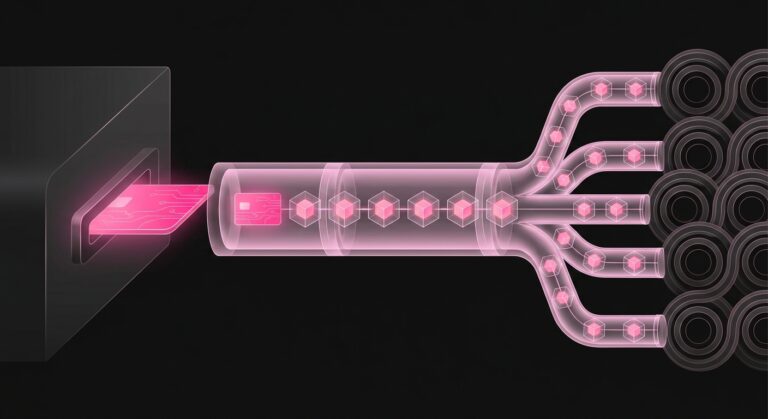
A cohesive token strategy also shields merchants from acquirer lock-in. When tokens are generated and stored at the network or specialized vault level rather than being restricted to a single processing partner, merchants maintain the flexibility to route transactions intelligently across different acquiring banks. This routing flexibility is a core component of modern payment optimization strategies, enabling teams to mitigate processor outages or route volume based on interchange efficiency without disrupting the customer experience.
Managing the Downstream Impact of Physical Payments
When an initial authorization occurs in person, the data captured sets the precedent for any subsequent interactions with that payment method. For businesses that operate omnichannel models, such as a retailer offering buy-online-return-in-store, or a health club signing up members at a physical desk for a recurring monthly fee, the quality of that first transaction is paramount.
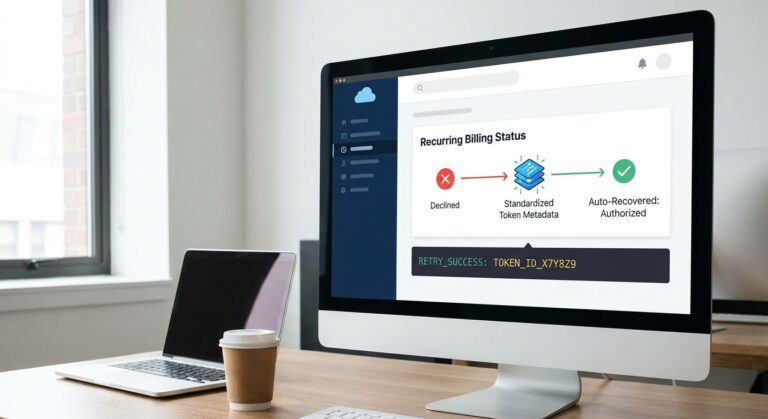
If a recurring transaction declined event occurs months down the line, the merchant’s ability to recover that revenue depends heavily on the metadata associated with the initial token. If the physical point-of-sale integration was pieced together with legacy middleware, the resulting token might lack the necessary network credentials, such as a properly formatted network transaction ID, required to successfully retry failed payments in the card-not-present environment.
Therefore, upgrading the point-of-sale infrastructure is not just about modernizing the physical checkout experience. It is a foundational step in broader payment recovery efforts. Cleaner data capture at the terminal level translates to more informed, strategic interactions when subsequent billing cycles encounter friction. Understanding specific issuer response codes becomes much more actionable when the underlying token architecture is standardized and reliable.
Recommended Actions
Navigating architectural shifts requires a methodical approach. Merchants and payment teams should consider a structured evaluation of their current acceptance infrastructure to determine if a consolidated model fits their strategic roadmap.
Map the Hardware Estate and Lifecycle
Teams should begin by mapping their existing terminal inventory across all physical locations. Identify the end-of-life horizons for current devices. If a significant portion of the terminal fleet requires replacement or extensive firmware patching in the near term, it presents a natural window to evaluate deploying a unified, pre-certified architecture rather than purchasing new hardware under the old paradigm.
Audit the True Cost of Compliance
Calculate the actual internal cost of maintaining your current PCI compliance scope. If the business is dedicating substantial engineering, security, and audit resources to network segmentation and vulnerability scanning for environments that process payments, migrating to a PCI-validated P2PE architecture can offset those operational costs. The reduction in scope often justifies the transition effort on its own.
Evaluate Handoff Friction and Decline Data
Analyze your payment issues specifically to isolate technical declines. Are you seeing an elevated rate of issuer response codes indicating system errors, missing data fields, or formatting anomalies originating from physical channels? If your authorization rates for card-present transactions lag behind industry benchmarks, the culprit is often the middleware connecting the terminal to the processor.
Plan for Unified Token Portability
Review how cardholder data is currently converted into tokens within your organization. If your tokens are tied specifically to the gateway that provided your in-store terminals, you may face integration friction if you decide to optimize your digital routing logic or switch acquiring banks later. Evaluate whether shifting to an architecture like the newly announced integrated model provides the portability and standardization required for a truly omnichannel strategy.
SmartRetry’s Response & Capabilities
The modernization of payment infrastructure provides the clean data foundations required for advanced backend optimization. For platforms like SmartRetry, which specializes in the intelligent retry of declined payment transactions, a unified acceptance architecture on the front end directly enhances the effectiveness of recovery efforts on the back end. When merchants generate standardized, acquirer-agnostic tokens through certified channels, they provide the optimal data payload for machine learning models to analyze. If a subsequent transaction fails in a recurring billing cycle, SmartRetry can leverage this pristine token data to determine the exact optimal timing and routing logic to recover that revenue, helping merchants turn potential payment declines into successful authorizations while preserving the customer relationship.
Evolving Beyond the Component Mindset
The era of assembling a payment stack component by component out of sheer necessity is gradually giving way to integrated, platform-based architectures. As payment networks and security providers consolidate their offerings, the operational burden on the merchant shifts from maintaining baseline infrastructure to leveraging transactional data for strategic advantage.
This transition allows payment operations and engineering teams to refocus their energy. Rather than dedicating valuable sprint cycles to custom terminal integrations, decryption key management, and complex compliance audits, teams can prioritize revenue-generating activities, focusing on optimizing authorization logic, fine-tuning fraud models, and refining the overarching customer experience.
While legacy systems will continue to anchor certain segments of the industry due to inertia, the trajectory of the market is clear. By reducing the friction at the physical point of interaction and ensuring that data flows cleanly into digital environments, businesses lay the groundwork for a more resilient, flexible, and ultimately profitable payment ecosystem.



 Find me on Linkedin