

The global payments ecosystem is fundamentally connected, meaning a regulatory shift in one hemisphere often creates operational ripples in another. Right now, a major structural change is unfolding down under as Australian financial institutions significantly scale back their credit card rewards programs. For years, generous perks and points have been the engine driving consumer spending. These programs have historically dictated how merchants manage their payment processing flow, but that engine is beginning to sputter under regulatory weight. While this might seem like a localized issue for travelers and points enthusiasts in Sydney or Melbourne, it signals a much larger shift. For stateside merchants and payment teams, this development is a clear leading indicator of how margin pressures can alter cardholder behavior and influence cardholder behaviorcardholder behaviorcustomer identitycustomer identitycardholderpayment recovery platforms.
Understanding this shift requires looking beyond the consumer disappointment of losing airline miles or cashback perks. When an issuer changes its rewards structure, it is almost always a reaction to underlying economic pressures that will eventually impact how transactions are routed, approved, and settled across the globe.
What Just Happened
The Australian payments landscape has long been subject to proactive regulatory oversight, particularly concerning the interchange fees that merchants pay to accept credit cards. In 2026, the market size of the Credit Card Issuance industry in Australia reached A$8.2 billion in revenue (Source). Recently, these regulatory caps have squeezed the profit margins that Australian issuers rely on to fund their generous consumer rewards programs. Because the financial mathematics of offering high-value perks no longer align with the constrained revenue from transaction fees, banks are aggressively devaluing points, hiking annual account fees, and quietly sunsetting premium card benefits. In February 2026, total purchases on credit and charge cards on Australian-issued cards stood at A$39.7 billion (Source).
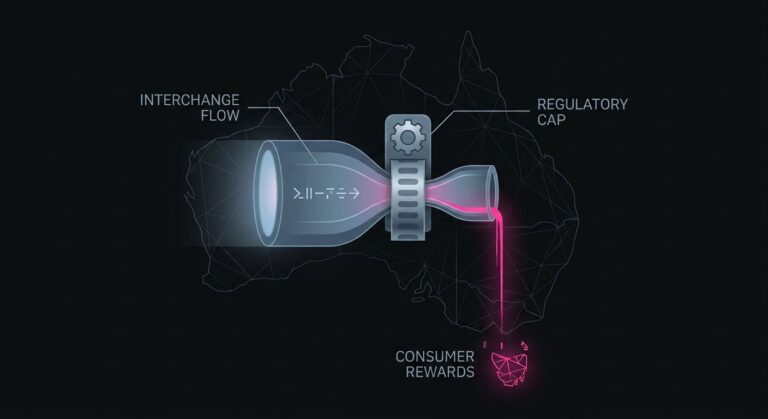
As recently highlighted by industry analysis in PaymentsJournal, Australia’s rewards cuts are a warning shot for U.S. card issuers. The U.S. market has historically enjoyed some of the most lucrative, unregulated rewards environments in the world, largely funded by higher interchange rates. However, with mounting legislative scrutiny and ongoing legal battles over swipe fees, the U.S. ecosystem is facing similar headwinds. Reports that Visa and Mastercard’s merchant settlement could imperil rewards cards suggest that American issuers may soon find themselves in the exact same margin squeeze currently affecting their Australian counterparts.
When traditional revenue streams dry up, financial institutions pivot, and the industry is already seeing a massive shift in how institutions generate yield. For instance, open banking has made payment APIs a burgeoning revenue stream, allowing banks to monetize data and access rather than relying solely on interchange. But during this transitional phase, the immediate operational reality for merchants is that card issuers are becoming highly protective of their remaining margins, fundamentally altering how they evaluate transaction risk.
The Mechanics of Margin Pressure
To understand why a change in rewards programs impacts merchant operations, one must look at the internal calculus of an issuing bank. In a highly profitable rewards environment, issuers are generally more tolerant of slight risk because the sheer volume of profitable transaction fees compensates for occasional fraud losses. The overarching goal is to keep the card top-of-wallet and ensure the cardholder encounters as little friction as possible at checkout.
However, when interchange revenue is capped and rewards are cut, the profit margin per transaction shrinks. Suddenly, the issuing bank’s risk tolerance decreases proportionally, causing their automated fraud models and authorization algorithms to become noticeably stricter. The bank is no longer willing to absorb the same level of risk, meaning a transaction that might have easily passed through the payment authorization process a year ago could now trigger a security flag.

For the merchant, this manifests as an unexpected spike in checkout issues. Consumers with valid payment credentials and sufficient funds may suddenly find their card declined due to overly sensitive issuer risk models. The merchant is left holding the bag, losing a legitimate sale not because the customer lacked funds, but because the bank’s internal risk calculus has shifted to prioritize margin protection over frictionless commerce.
Why Payment Teams Should Care
If you are leading a revenue or payment operations team, shifts in issuer behavior directly affect your bottom line. The most immediate impact of tighter issuer risk models is an increase in payment failures. When an issuer becomes conservative, your baseline transaction approval rate will inevitably drop unless you actively manage the routing and retry logic of your payment stack.
This is especially critical for businesses relying on recurring revenue models, as subscription payment issues are notoriously sensitive to changes in issuer behavior. In a card not present environment, recurring charges already carry a slightly higher risk profile in the eyes of the network. If an issuer tightens its belt, a monthly subscription renewal that has processed flawlessly for a year might unexpectedly result in a payment decline.
When a transaction decline occurs, the specific issuer response is rarely straightforward. Banks often return unclear decline codes rather than explicit explanations. This ambiguity creates a significant operational burden. If your team cannot distinguish between a hard decline, like a closed account, and a soft decline, like a temporary velocity limit triggered by a nervous fraud model, your ability to recover that revenue is severely compromised.
Furthermore, as rewards dry up, consumer behavior will change. Shoppers who previously consolidated all their spending onto a single premium travel card may begin rotating through different debit cards, digital wallets, or alternative payment methods. The share of consumer payments made using cards was around 73 percent in 2025, down from 76 percent in 2022 (Source). This fragmentation means merchants can no longer rely on the predictability of a static customer payment profile. Flexibility and dynamic routing are no longer optional.
The Shift Toward Multi-Acquiring
As issuers become more unpredictable, merchants are realizing the danger of relying on a single acquiring partner. Different acquirers have different relationships with issuing banks, and an authorization request that fails on one rail might succeed on another. Because of this, dynamic routing are rising in popularity, but are merchants ready to navigate the complexity?
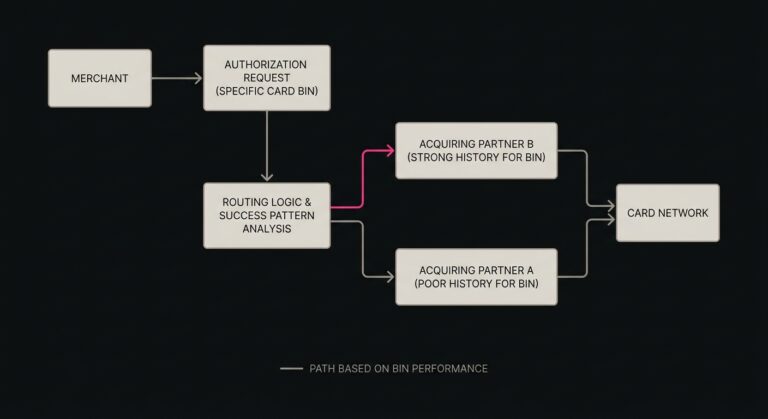
Implementing a multi-acquirer setup allows payment teams to route transactions dynamically based on which processor has the best historical success rate for a specific card BIN or transaction type. If a particular U.S. issuer begins mimicking the conservative behavior seen in Australia, a multi-acquiring strategy allows the merchant to seamlessly route those specific transactions through an acquirer that maintains a more favorable authorization history with that bank.
Simultaneously, we are seeing the rise of advanced billing strategies, and fueling agentic commerce with dual-rail recurring billing offers another layer of defense. By maintaining alternative pathways for recurring charges, merchants can ensure that if a primary credit card rail fails due to shifting issuer policies, a secondary method can gracefully catch the transaction, preserving the customer relationship and minimizing involuntary churn.
Recommended Actions
This shift requires a proactive, rather than reactive, approach to payment optimization. While merchants cannot control the interchange rates or the rewards programs offered by major banks, they possess total control over their own checkout and recovery architecture.
First, establish a pristine baseline of your current data, since you cannot fix what you cannot measure. Segment your transaction approval rate by issuer, card type, and geographic region. If you notice a gradual degradation in approvals from specific institutions, you have the early warning signs necessary to adjust your strategy before it severely impacts quarterly revenue.
Second, harden your upfront payment processing flow by aggressively utilizing network tokenization and account updater services. As consumers shuffle their primary payment methods in response to rewards cuts, ensuring you hold the most current, cryptographically secure version of their payment credential is the easiest way to prevent entirely avoidable checkout issues. Network tokens also benefit from higher trust scores with issuers, which can help offset their newly conservative authorization models.
Third, rethink your approach to declined transactions. Brute-force retrying a failed payment without analyzing the underlying reason is a fast track to network penalties and higher processing fees. To reduce payment declines effectively, your system must parse the nuanced signals hidden within the decline data. If the issuer response indicates insufficient funds, retrying the charge on a Friday when payroll typically clears makes logical sense. If the decline is due to suspected fraud, blindly retrying will only reinforce the issuer’s suspicion. For subscription merchants, using recovery dashboards and parsing issuer decline data for dynamic retry logic can make all the difference in cutting involuntary churn and recovering recurring revenue. Flexpay Login is an example of how SaaS tools address survivability by leveraging these strategies.
Finally, prepare for a broader diversification of payment methods. As the allure of credit card points fades, consumers will seek frictionless experiences elsewhere, meaning your checkout must seamlessly support digital wallets, localized bank transfers, and emerging open banking payment flows. By removing the dependency on a single type of consumer credit behavior, you build a much more resilient revenue engine.
SmartRetry’s Response & Capabilities
Navigating an environment where issuer behavior is constantly shifting requires sophisticated tooling that goes beyond simple rule-based logic. When a payment optimization strategy relies on static timelines, it cannot adapt to the real-time margin protections implemented by banks, which is why platforms like SmartRetry are purpose-built for this exact volatility. By continuously analyzing the intricate details behind why a payment fails, SmartRetry applies intelligent, machine-learning-driven logic to navigate complex issuer responses. Instead of blindly pushing a transaction through the same failing path, it determines the precise optimal window and condition to retry failed payments. This dynamic approach allows merchants to recover lost revenue and significantly bolster their transaction approval rate, all while maintaining a healthy, low-friction relationship with the card networks and issuing banks.
The Path Forward
The fundamental mechanics of global payments are undergoing a quiet but significant realignment. Australia’s transition away from heavily subsidized credit card rewards is not an isolated incident. Instead, it is a preview of the margin-conscious environment that U.S. issuers are beginning to prepare for. When banks look to protect their bottom lines, authorization models tighten, and the burden of ensuring a smooth transaction falls squarely onto the shoulders of the merchant.
However, this environment presents a distinct competitive advantage for businesses willing to engineer better payment flows. Payment recovery is no longer just a back-office reconciliation task, but a frontline growth strategy. By understanding the upstream pressures facing financial institutions, merchants can anticipate checkout friction before it occurs.
The businesses that thrive in this next era of commerce will be those that stop viewing a declined card as a lost customer. Instead, they will treat it as a data point, a temporary obstacle that can be navigated with intelligent routing, strategic multi-acquiring, and precision retries. You may not be able to control the airline miles your customers earn, but with the right infrastructure, you can absolutely ensure their payment succeeds.



 Find me on Linkedin