

Every merchant knows the sting of a failed checkout. A customer finds your product, adds it to their cart, and navigates the checkout form. They finally click the buy button, and then the screen flashes an error. The payment is rejected. It feels like hitting a brick wall right at the finish line. But a decline is rarely the end of the road. Instead, it is a complex, split-second conversation between networks, acquirers, and issuing banks. Understanding this hidden conversation is the difference between losing a hard-earned customer and recovering revenue that belongs to your business. When you look under the hood of payment issues, you realize that a decline is often just an automated request for more information, better timing, or a slightly different approach.
The Hidden Mechanics of Authorization
To understand why a transaction fails, it helps to look at what happens when it succeeds. The payment processing flow is an intricate relay race that occurs in milliseconds. When a customer attempts a purchase, the merchant’s payment gateway formats the transaction data and hands it to the acquiring bank. The acquirer forwards it through the card network, such as Visa or Mastercard, which then routes it to the customer’s issuing bank.
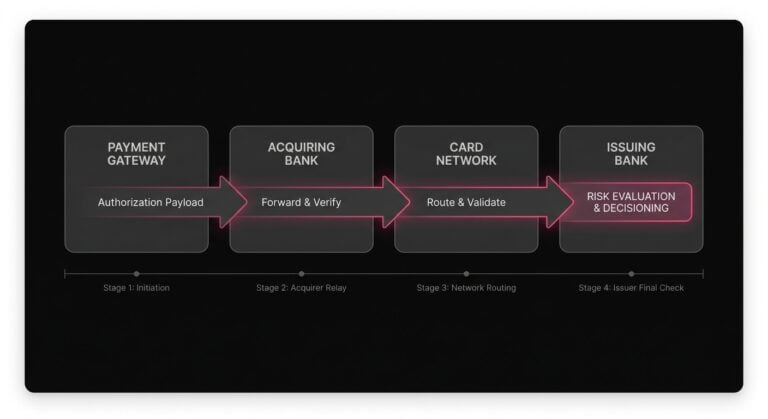
The issuing bank holds the ultimate authority. In a fraction of a second, the issuer’s risk models evaluate the transaction against dozens of variables, checking whether the account is active, whether there are sufficient funds, and whether the transaction matches the cardholder’s typical geographic and behavioral patterns. If the issuer’s algorithms sense an anomaly, or if a minor data mismatch occurs, they return a decline code.
This decision-making process is entirely automated and inherently risk-averse. Issuers bear the liability for fraud, so their systems are tuned to protect the account holder first and foremost. They do not have the context of the merchant’s relationship with the customer, only the data points presented in the authorization request. When those data points fail to align perfectly with their internal risk parameters, the default response is to reject the charge. In the U.S., overall card transaction approval rates have fallen below 87 percent according to VisaNet data (Source).
Hard Declines Versus Soft Declines
Not all rejections are created equal. The industry generally divides issuer responses into two categories: hard declines and soft declines. Treating them as the same thing is one of the most common operational mistakes a business can make.
A hard decline is a permanent roadblock. It occurs when the issuing bank determines that the transaction cannot and will not be approved, regardless of how many times it is attempted. Common reasons include a closed account, a reported lost or stolen card, or an invalid card number. When a merchant receives a hard decline, the only viable operational step is to stop trying to charge that specific payment method and ask the customer for an alternative. Continuing to submit a hard-declined card wastes processing resources and actively harms the merchant’s standing with the card networks.
Soft declines are entirely different. A soft decline indicates a temporary issue: the card is valid and the account is open, but a specific condition prevented the transaction from clearing at that exact moment. The most common culprit is insufficient funds, but soft declines can also be triggered by network timeouts, processing errors, or velocity limits, which occur when a card is used too many times in a short window. In fact, Mastercard reports that 15% of card declines happen due to technical issues and/or policy errors (Source).
The most notorious soft decline is the generic “Do Not Honor” code. Issuers often use this as a catch-all when their systems block a charge but don’t want to expose the specific reason to the merchant or the network. Because soft declines are temporary, they represent salvageable revenue. A card declined for insufficient funds on a Thursday might easily clear on a Friday after a payroll deposit hits the account.
The Hazard of Blind Retries
When faced with a soft decline, the natural reflex is to try again. If a transaction declined due to a temporary network timeout, submitting it a second time makes logical sense. However, relying on a static, brute-force retry strategy introduces severe risks to the merchant’s infrastructure and bottom line.
Card networks heavily monitor how merchants handle failed transactions. Over the past few years, major networks have introduced strict rules penalizing businesses that excessively retry failed payments. If a merchant’s systems blindly hammer the network with the same declined transaction dozens of times a day, the networks notice. This behavior incurs unnecessary authorization fees for every attempt, quickly inflating the overall cost of payment acceptance.
More importantly, excessive retries damage the merchant’s trust score with issuing banks. Issuers monitor retry velocity, and if they see a merchant continuously attempting to force a transaction through without adjusting the data or timing, their risk models may begin to flag that merchant’s broader processing traffic as suspicious. This can inadvertently degrade the merchant’s overall transaction approval rate, meaning even legitimate, first-time purchases from other customers might start getting caught in the crossfire.
Blindly retrying a payment without context is like knocking on a locked door repeatedly without trying to find the key. It consumes energy, annoys the entity on the other side, and rarely results in the door opening.
Building Context-Aware Retry Logic
To genuinely reduce payment declines, businesses must replace reactive retries with context-aware logic. This means analyzing the specific decline code, the time of the failure, the type of card, and the historical behavior of the issuing bank, then using that data to determine the optimal moment to reattempt the charge.
Timing is the foundational element of payment optimization. An intelligent retry strategy considers natural financial rhythms. If a transaction fails due to insufficient funds, attempting it again three hours later is unlikely to yield a different result. Instead, scheduling the retry for a specific day of the week, or aligning it with common payroll cycles, such as the first or fifteenth of the month, changes the probability of success.

Time of day also plays a subtle role. Many issuing banks run their batch processing and account reconciliations in the middle of the night. Attempting a retry during these heavy processing windows can sometimes result in automated soft declines simply due to system load or temporary holds. Spacing out retry attempts to align with the issuer’s local business hours can yield better outcomes.
Updating the payment credentials before the retry can also resolve underlying friction. Many payment gateways offer Account Updater services, which automatically fetch new expiration dates or replacement card numbers from the networks. In Latin America alone, Visa found that ensuring credentials are up to date has the potential to recapture over $1.3bn in lost revenue annually from out-of-date credentials (Source). If a card was softly declined because the expiration date rolled, checking the credential against an updater service before retrying the charge resolves the issue without ever needing to contact the customer.
The Subscription Churn Dilemma
While payment failures affect every type of business, they present a unique existential threat to recurring billing models. For subscription businesses, a single payment failure does not just mean the loss of one sale; it threatens the entire lifetime value of that customer.
When a subscription renewal fails, the business faces involuntary churn. The customer did not actively choose to cancel their service; their payment method simply experienced a hiccup. Perhaps their bank issued them a new card with a different CVV, or they temporarily locked their card via a mobile banking app and forgot to unlock it before the billing cycle hit.
Resolving subscription payment issues requires a delicate balance between automated backend recovery and customer outreach. Sending an immediate “payment failed” email to a customer can cause unnecessary friction. If the failure was a brief network timeout, an intelligent backend retry might resolve the issue a few hours later without the customer ever knowing there was a problem. Alerting the customer prematurely forces them to log in and manually update their billing preferences, which occasionally prompts them to reconsider the subscription entirely.
A mature recovery flow attempts to resolve the failure silently through intelligent retries first. Only after the backend optimization exhausts its logical attempts should the system trigger a dunning process, the sequence of emails and notifications asking the customer to intervene. By sequencing these steps carefully, businesses preserve the customer experience while systematically recovering recurring revenue.

Modern Infrastructure and Automated Recovery
Building and maintaining the logic required to parse decline codes, manage retry velocity, and align with global issuer schedules is a heavy engineering lift. Payment networks frequently update their rules, and issuing banks routinely adjust their risk algorithms. Hardcoding a retry schedule into a billing engine quickly leads to outdated logic and diminishing returns.
This is where purpose-built infrastructure becomes useful. Platforms like SmartRetry focus specifically on payment optimization and intelligent retries of declined transactions, helping merchants recover revenue and improve transaction approval rates without requiring constant manual adjustment. By delegating the complex decision-making to systems designed to analyze issuer behavior across millions of data points, engineering teams are freed from the burden of maintaining payment routing logic. Dedicated platforms understand the nuance of when to push a retry forward, when to hold back to respect network limits, and how to format the data to give the transaction the highest probability of clearing.
Integrating this type of capability allows the merchant to remain focused on their core product while ensuring that their checkout flow is resilient enough to handle the inevitable friction of global payment processing.
Treating Declines as Data
The most profound shift a business can make in its payment operations is changing how it views a rejected transaction. It is easy to view a decline purely as a loss, but in reality, a decline is a data point. It is feedback from the financial ecosystem about the health of the payment credentials, the timing of the request, and the merchant’s standing with the issuing bank.
By moving away from static billing attempts and embracing dynamic, data-driven payment recovery, businesses do more than just capture a few extra dollars. They build healthier, more compliant relationships with card networks. They protect their merchant accounts from unnecessary scrutiny, and most importantly, they provide a smoother, more invisible experience for their customers. When payment operations transition from a rigid administrative task into an optimized strategy, the entire business benefits from a more resilient revenue stream.



 Find me on Linkedin