

You spend weeks refining a product. You optimize the user journey. The customer finally clicks the buy button. Then the payment fails. A declined transaction is not just a frustrating end to a checkout experience, it represents a fundamental disconnect within the payment processing flow. For businesses operating at scale, unresolved payment issues quietly drain revenue and inflate customer acquisition costs, with research from Oxford Economics and Checkout.com showing businesses lose between 1.5% and 2.2% of their revenues due to suboptimal payments acceptance (Source). Addressing these checkout issues requires looking past surface-level error messages to understand exactly why banks reject transactions, turning what is often a blind spot into a well-calibrated engine for revenue recovery.
The Anatomy of a Payment Decline
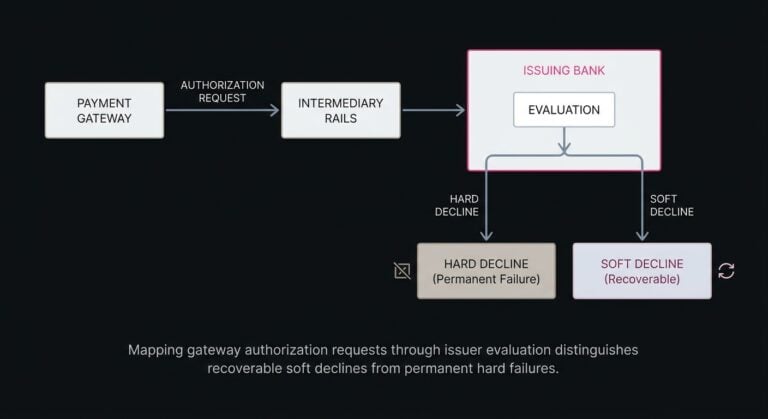
To understand how to fix payment failures, you first have to look at the lifecycle of a transaction. When a customer submits their payment details, that data embarks on a complex, milliseconds-long journey. It moves from the payment gateway to the acquiring bank, across the card networks, and finally lands at the issuing bank, the institution that provided the customer’s card.
The issuer acts as the ultimate gatekeeper. In a fraction of a second, its internal risk models evaluate dozens of data points. They check the account balance, assess the merchant’s category code (MCC), evaluate the transaction’s velocity, and cross-reference the purchase against the cardholder’s historical behavior. If any variable crosses the issuer’s risk threshold, a decline code comes back.
Payment declines generally fall into two categories: hard declines and soft declines. A hard decline indicates a permanent issue, such as a closed account or a reported stolen card. A soft decline suggests a temporary condition, such as insufficient funds, a momentary network timeout, or a conservatively tuned fraud filter. Distinguishing between the two is the foundational step in any payment optimization strategy. Treating a hard decline like a soft decline wastes time and resources, while treating a soft decline like a hard decline leaves recoverable revenue on the table.
Decoding the Issuer Response
The primary challenge in managing payment authorization is that issuers are notoriously opaque. When an issuer rejects a transaction, it returns a two-digit response code to the merchant. of these codes are straightforward. Many are frustratingly vague.
The Ambiguity of “Do Not Honor”
The most common and perplexing issuer response is Code 05, broadly defined as Do Not Honor, which can account for 10% to 60% of declined payments (Source). In the payments industry, this is essentially the equivalent of a vague breakup text: it tells the merchant that the transaction will not proceed but deliberately obscures the reason why.
An issuer might return a Do Not Honor code because of a suspected fraud anomaly, an unusual cross-border transaction, or even a mismatch in the billing zip code. Because the exact trigger stays hidden behind the bank’s proprietary risk models, merchants are left to infer the underlying cause based on historical patterns and transaction metadata.
Insufficient Funds and Velocity Limits
The cardholder simply does not have the available balance or credit line to cover the purchase at that exact moment. While this sounds like a terminal failure, NSF errors are highly temporal. Account balances fluctuate based on payroll cycles, direct deposits, and pending holds dropping off.
Velocity limits represent another common hurdle, particularly for high-growth merchants. If a merchant suddenly processes a high volume of transactions in a short period, or if a specific customer initiates multiple purchases back to back, the issuer’s fraud systems may interpret this as a card-testing attack. The resulting decline is a protective measure rather than a reflection of the customer’s ability to pay.
The False Comfort of Brute-Force Retries
Faced with a stack of declined transactions, a merchant’s first instinct is often to simply try again. If a payment failed on Tuesday, perhaps it will succeed on Wednesday.
While this brute-force approach may occasionally recover a lost transaction, it introduces entirely new risks into the payment ecosystem.
Every time you retry a failed payment, you send a new authorization request through the card networks. If you repeatedly submit the same card details for the same amount and keep getting declined, you begin to damage your merchant profile. Card networks and issuing banks monitor authorization ratios, the percentage of successful transactions compared to total attempts. A merchant that blindly hammers the network with doomed authorization requests signals a lack of operational sophistication, or worse, potential fraud.
As a merchant’s overall approval rate drops, issuers adjust their risk models accordingly. They begin to view traffic from that specific Merchant Identification Number (MID) with increased suspicion. Consequently, even legitimate, well-funded transactions from excellent customers may start getting caught in the crossfire. A naive retry strategy creates a negative feedback loop that actively harms the business’s baseline payment authorization performance.
The Nuance of Subscription Payment Issues
The stakes of payment failure change depending on the business model. In a traditional e-commerce setting, a declined card means a lost cart. The customer is present in the checkout flow and can immediately provide a different payment method.
For recurring revenue models, however, the customer is rarely present when the billing engine initiates the charge. This off-session processing makes subscription payment issues uniquely challenging. When a recurring charge fails, it leads directly to involuntary churn, the loss of a customer who actually intended to keep using the service but was derailed by a mechanical payment failure.
Involuntary churn distorts customer lifetime value (LTV) and forces marketing teams to spend acquisition budget replacing users who never actively chose to leave. Because the customer is not looking at a screen when the decline happens, the merchant must rely on a combination of backend recovery logic and asynchronous customer communication, often referred to as dunning.
Effective dunning balances urgency with customer experience. Bombarding a user with “payment failed” emails immediately after a soft decline creates unnecessary friction and anxiety. A more nuanced approach involves attempting silent, backend retries to clear temporary hurdles before escalating the issue to the customer’s inbox.

Architecting a Strategy to Reduce Payment Declines
Moving past basic, rigid retry schedules requires a shift toward systematic optimization. Rather than guessing when a card might work, operations teams look for ways to align their authorization requests with the known behaviors of the payment networks.
Leveraging Network Tokens
One of the most structural ways to reduce payment declines is to move from storing raw Primary Account Numbers (PANs) to using network tokens. Network tokens are unique digital identifiers issued directly by the card brands, such as Visa and Mastercard. Because the networks issue and map these tokens themselves, they inherently trust them more than raw card data stored in a merchant’s database.
Transactions processed via network tokens generally enjoy a higher baseline authorization rate, with Visa reporting a 4.6 percent lift in authorization rates globally compared to PAN (Source). They also update automatically when a cardholder receives a new physical card due to expiration or loss, effectively neutralizing a major source of hard declines without requiring the merchant to track down new details.
Timing and Behavioral Logic
For NSF declines, timing is a critical variable. Attempting to charge a consumer’s debit card at 3:00 AM on a Tuesday before payday is less likely to succeed than attempting the same charge on a Friday morning right after direct deposits typically clear.
Merchants who analyze their transaction data often find distinct temporal patterns. By mapping retry attempts to the specific day of the week, the time of the month, or even the issuing bank’s geographic location, merchants can align their authorization attempts with periods of high liquidity.
Utilizing Account Updater Services
For legacy card-on-file systems that do not yet use network tokenization, Account Updater services act as a vital safety net. These services ping the card networks to check for updated card details before a scheduled billing cycle. If the issuer has provided a new expiration date or a new PAN to the network, the updater service retrieves it, allowing the merchant to process the transaction with fresh credentials and avoid an unnecessary expiration decline.
Intelligent Retries and the Mechanics of Payment Recovery
To fully modernize payment recovery, the decision-making process must move from static rules to dynamic logic. It is not enough to apply a blanket rule to all transactions. The system must look at the specific context of each decline, including the code, the issuer, the transaction amount, and the customer’s history.
Modern organizations rely on specialized infrastructure to parse this data and make routing decisions in real time. Platforms like SmartRetry approach payment optimization by analyzing historical decline patterns and applying intelligent retries based on the exact conditions most likely to yield a successful authorization. Instead of relying on rigid, pre-defined schedules, this approach interprets issuer behavior and adapts the recovery attempt accordingly, helping merchants systematically recover revenue and protect their overall approval rates without requiring dedicated internal payment engineering teams.
Intelligent logic dictates that a hard decline for a reported lost card should never be retried on the backend, it requires immediate customer intervention. A soft decline triggered by a temporary network timeout, on the other hand, might be retried almost immediately. By applying the right logic to the right decline code, businesses can lift their recovery metrics while minimizing unnecessary network fees.
The Trade-Off Between Aggression and MID Health
Every decision in payment processing involves a trade-off. The pursuit of revenue recovery must be balanced against the cost of network fees and the long-term health of the merchant account.
Payment processors and acquirers charge fees for every authorization attempt, regardless of whether it succeeds or fails. An overly aggressive retry strategy can quickly incur processing costs that outpace the value of the recovered revenue, particularly for businesses with low average order values (AOV).
Maintaining a healthy relationship with your acquiring bank also requires keeping your decline rates within acceptable industry thresholds. Acquirers evaluate merchants based on risk, and excessive declines can trigger account reviews, higher reserve requirements, or elevated processing rates. A strategic approach to recovery acknowledges these boundaries. It focuses on high-probability retries and accepts that a small percentage of transactions are mathematically unrecoverable and better left alone.

Moving Toward a Resilient Checkout Experience
Payment failures are an inherent part of digital commerce. Issuers will always maintain stringent risk controls, consumers will occasionally overdraw their accounts, and network timeouts will inevitably occur. The objective is not to eliminate declines entirely, since a zero-percent decline rate would likely mean a merchant’s fraud filters are dangerously loose.
Instead, the goal is resilience. By moving away from blind retries and static billing schedules, operators can transform their payment stack into an adaptive system. Taking the time to understand the nuances of the issuer response, implementing modern data standards like network tokens, and applying intelligent logic to recovery efforts changes the nature of the problem.
Unresolved checkout issues cease to be an unavoidable cost of doing business. They become a measurable, manageable metric. When an organization treats its payment authorization flow as a strategic asset rather than an administrative hurdle, it builds a foundation that captures more revenue, retains more subscribers, and ultimately scales with a higher degree of financial efficiency.



 Find me on Linkedin