

A customer decides to buy your product, navigates your site, and enters their billing details. They press submit. The screen hangs, and a moment later, the payment fails.
Behind that generic error message lies a complex, split-second chain of events. For consumers, a declined card is a minor annoyance or a momentary source of confusion. For merchants, though, unresolved checkout issues represent a steady leak of revenue, customer goodwill, and marketing ROI, with research from Checkout.com revealing that 45% of consumers will not retry after one false decline (Source). When a legitimate transaction is blocked, the natural instinct is often to simply try the charge again. But in modern digital commerce, attempting to brute-force your way through a decline rarely works.
Addressing this problem requires looking past surface-level error codes to understand how issuing banks evaluate risk. The merchants who handle declines well don’t treat them as technical glitches. Instead, they view them as operational challenges that require a nuanced, data-driven approach. Navigating this landscape means understanding the payment processing flow, decoding vague bank responses, and learning when to push back and when to simply walk away.
The Complex Path of a Payment Authorization
To understand why a payment fails, it helps to look at what happens when it succeeds. In the time it takes a customer to blink, a transaction request travels across multiple distinct financial entities, any one of which can stop the process in its tracks.
When the checkout form is submitted, the merchant’s gateway securely packages the card data and sends it to an acquiring bank. The acquirer forwards this request through the relevant card network, such as Visa or Mastercard, which then routes the data to the customer’s issuing bank. This entire sequence is known as the payment authorization.
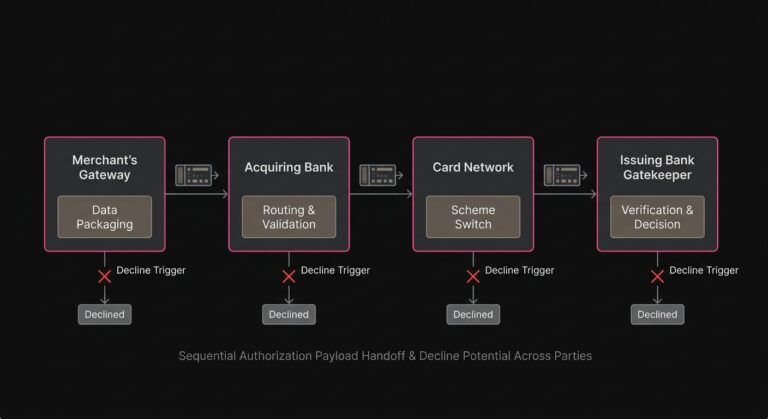
The issuing bank acts as the final gatekeeper. Its automated systems run a series of rapid checks: Does this account exist? Does it have sufficient funds or credit? Does the merchant category match the cardholder’s typical spending habits? Is the velocity of transactions on this card suspiciously high?
Based on these risk models, the issuer sends back a response code approving or declining the request. If the transaction is declined, the message travels back down the chain to the merchant. The challenge is that these risk models tend to be inherently conservative: issuers bear the liability for many types of fraud, so their systems are structurally biased toward caution. Research from Riskified shows that for the average merchant, issuers decline one in every 10 ecommerce dollars during payment authorization (Source).
Decoding the Ambiguous Issuer Response
When a decline happens, the issuing bank returns a two-digit code meant to explain the decision. In reality, the issuer response is often vague, overlapping, or deliberately opaque to prevent fraudsters from reverse-engineering the bank’s security parameters.
Broadly speaking, these codes fall into two categories: hard declines and soft declines. Treating them the same way is a common operational mistake.
The Hard Truth About Hard Declines
A hard decline indicates a permanent issue with the card or the account. The bank is explicitly stating that the transaction cannot be approved, no matter how many times you try.
Common hard decline triggers include lost or stolen cards, closed accounts, or invalid account numbers. When you encounter a hard decline, the relationship with that specific payment method is effectively. The only practical resolution is to ask the customer for a different payment method. Continuing to retry a hard decline is not just a waste of time. It can actively harm your reputation with the card networks, which monitor merchant retry behavior for signs of fraud or broken integrations.
Soft declines and the Revenue Purgatory
Soft declines are temporary blocks that occur when a card is valid but a specific condition prevents the transaction from going through at that exact moment.
Others include temporary velocity limits, unusually large transaction amounts, or cross-border processing flags.
Soft declines live in a gray area: because the block is temporary, the revenue is theoretically recoverable. However, successfully capturing that revenue requires understanding the underlying context of the transaction rather than blindly submitting the charge again.
The Trap of Aggressive Retries
When faced with a soft decline, many payment systems default to an aggressive, rules-based retry logic. While this might catch a few customers who just deposited their paychecks, it is generally an inefficient approach.
This dynamic is particularly noticeable when managing subscription payment issues. In a recurring billing model, a failed payment does not just mean a lost sale. It often triggers involuntary churn, where a perfectly satisfied customer loses access to a service simply because their card expired or their bank flagged a recurring charge as unusual.

However, hammering the payment gateway with automated daily retries creates secondary problems. Card networks enforce strict rules around how many times a single transaction can be retried within a specific window. Merchants who exceed these thresholds face increased processing fees, lower overall approval rates, and in severe cases, penalties or fines. Issuing banks monitor this behavior too, and if they see a merchant aggressively retrying a blocked transaction, their risk models may begin to view the merchant as a threat, leading to higher decline rates across the board.
Building a Smarter Payment Recovery Strategy
Moving away from blind retries requires adopting a more contextual approach to payment recovery. The goal is to align your retry attempts with the natural rhythms of the financial system and the specific circumstances of the decline.
Respecting Issuer Rhythms and Timing
Not all days and times are equal in the banking world. A transaction that fails due to insufficient funds on a Tuesday afternoon might easily clear on a Friday morning, aligning with standard payroll cycles.
Similarly, retrying a cross-border transaction during the middle of the night in the cardholder’s local time zone can sometimes trigger fraud algorithms. By analyzing historical decline data, merchants can often identify patterns in when transactions are most likely to be approved. Spacing out retry attempts and scheduling them during periods of high general liquidity, such as the 1st or 15th of the month, tends to yield better recovery outcomes than rigid daily schedules.
Leveraging Preventative Optimization
The most effective way to handle a declined payment is to prevent it from happening in the first place. Preventative optimization focuses on keeping payment data fresh and minimizing the friction of the authorization request.
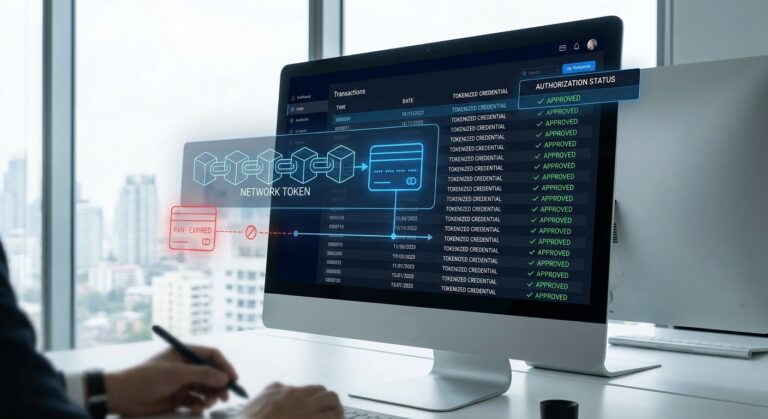
Many merchants rely on account updater services provided by card networks, which automatically refresh expired card details or updated account numbers before a recurring charge is processed. Adopting network tokenization is another method that often supports healthier approval rates, with Visa reporting a 4.6 percent lift in authorization rates globally for card-not-present token transactions compared to PAN (Source). By replacing raw Primary Account Numbers (PANs) with secure tokens issued directly by the card networks, merchants reduce the perceived risk of the transaction, which can encourage issuing banks to approve charges they might otherwise flag.
Where Specialized Tools Fit In
Developing the infrastructure to parse issuer codes, manage network retry rules, and schedule recovery attempts requires a mature engineering operation. Instead of building and maintaining custom logic in-house, some teams choose to offload this complexity to specialized platforms. A tool like SmartRetry approaches this by focusing on payment optimization and intelligent retries of declined payment transactions, helping merchants recover revenue and improve transaction approval rates. By automating the evaluation of decline codes and timing recovery attempts to avoid network penalties, these systems allow teams to focus on their core product rather than the nuances of payment gateway documentation.
Rethinking the Transaction Approval Rate
As teams optimize their payment flows, the way they measure success needs to evolve. Looking at a single, global transaction approval rate can be misleading.
Experienced payment operations teams break their approval metrics down into specific cohorts. They track authorization performance by issuing bank (BIN), by geographical region, and by specific decline codes. They separate first-time checkout approvals from recurring subscription billing cycles, as these two flows are treated differently by issuer risk models.
It is also vital to distinguish between a payment that failed because the user abandoned the checkout flow and a payment that failed because the bank actively declined it. Blurring these lines leads to misdiagnosed problems and misallocated engineering resources.
Moving Toward Resilient Operations
Payment failures are an unavoidable reality of operating a digital business, but they do not have to be a permanent drain on revenue. The difference between merchants who struggle with declines and those who manage them effectively comes down to how they interpret the friction in the system.
Issuing banks aren’t trying to block legitimate commerce. They’re operating complex, cautious systems designed to minimize systemic risk. When merchants align their operations with that reality, respecting decline codes, pacing their retry attempts, and keeping their payment data clean, they remove much of the friction from the process.
By replacing rigid, aggressive payment operations with a thoughtful, data-aware strategy, businesses can recover lost revenue, reduce involuntary churn, and build a more resilient foundation for growth. Optimizing payments is rarely about discovering a single, hidden trick. It is about consistently executing the fundamentals, paying attention to the context of every transaction, and respecting the underlying mechanics of the financial networks.



 Find me on Linkedin