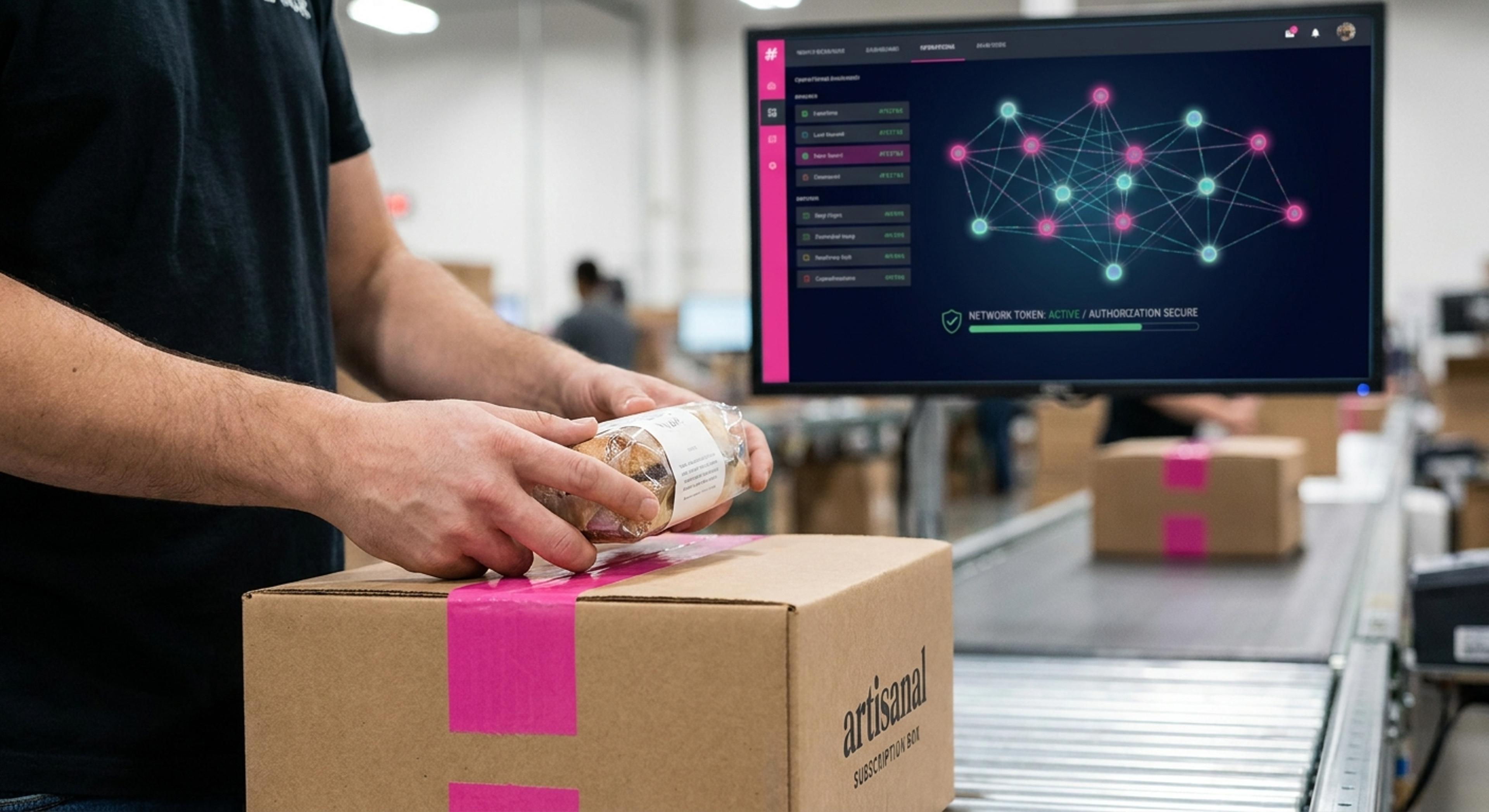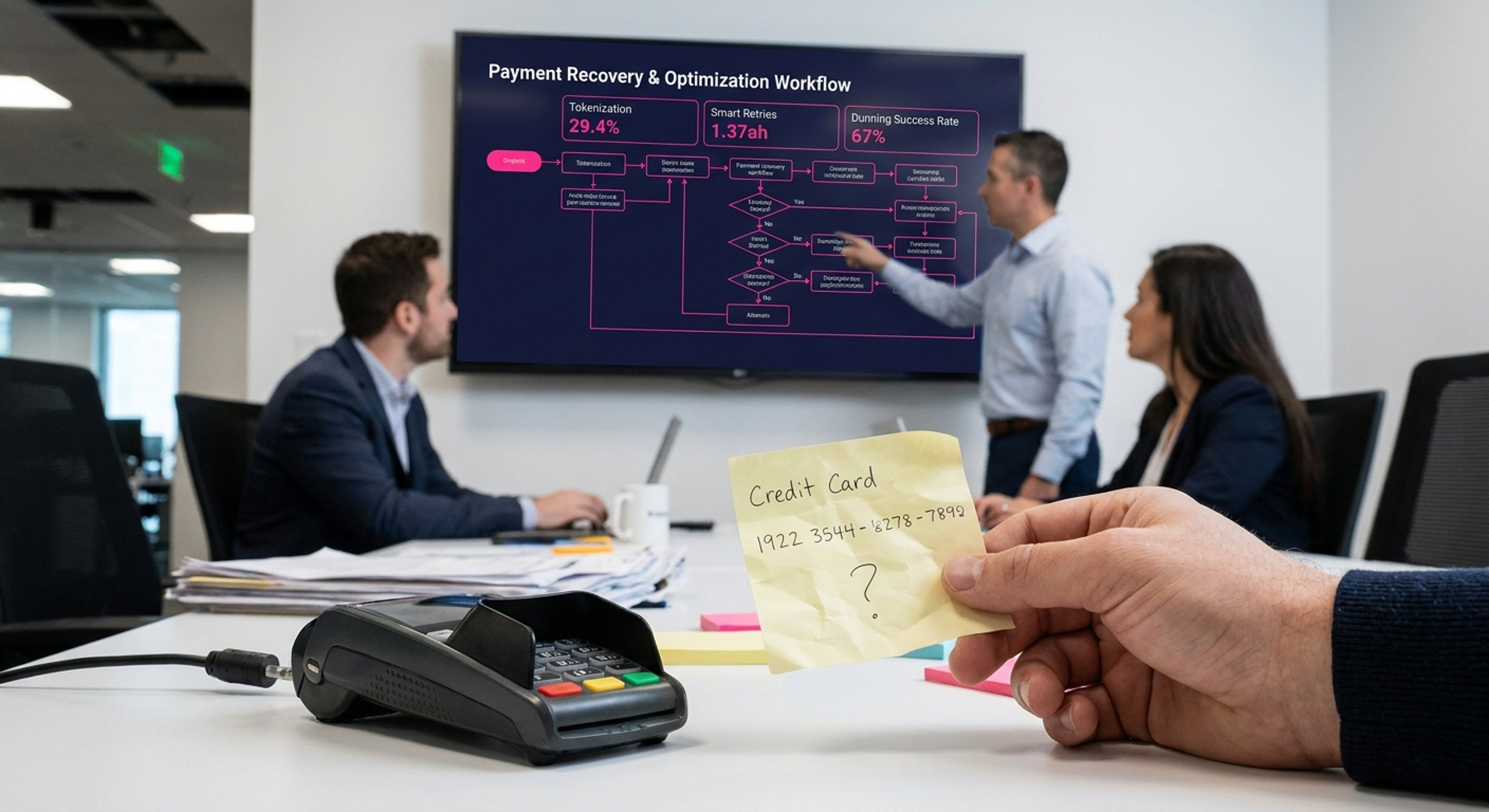

You have a sixteen-digit string of numbers that belongs to a customer, and you want to match that credit card number to a name to resolve a lingering issue. It sounds like a reasonable request. If you have the core account data, shouldn’t you be able to trace it back to the cardholder? The answer is a resounding no. Between strict privacy regulations, complex data encryption, and network rules, reverse-engineering a payment card to uncover an individual’s identity is intentionally impossible for everyday merchants. Yet the fact that operations teams still search for this capability points to a deeper operational challenge. When a transaction goes sideways, teams scramble for context. They want to know who is behind the card to fix broken subscriptions, investigate suspicious activity, or rescue lost revenue, but focusing on the cardholder is often the wrong approach to fixing the underlying problem.
The Reality of Reversing a Payment Credential
To understand why a credit card number cannot simply be typed into a search bar to yield a name, it helps to look at how account data is structured. The Primary Account Number, or PAN, is essentially a routing instruction rather than a public directory.
The first six to eight digits represent the Bank Identification Number (BIN) or Issuer Identification Number (IIN). This segment tells the payment processor which institution issued the card and details its specific attributes, like whether it is a debit, credit, corporate, or rewards product. The remaining digits act as an identifier for the specific account within that bank’s internal systems, except for the final mathematical checksum digit.
None of this mathematical structure includes alphabetic characters or personal identifiers. At the end of 2022, there were 12.8 billion EMV chip cards in global circulation (Source). Issuing banks treat their cardholder directories as highly classified information protected by global banking privacy laws and the Payment Card Industry Data Security Standard, or PCI-DSS. There is no central, searchable database that maps a raw PAN to a human being, and for good reason. If such a database existed, the entire digital economy would be fundamentally vulnerable to identity theft.

Why Operations Teams Search for Cardholder Identities
If the system is designed to prevent reverse-engineering, why do payment professionals still try to do it? When a payment processing flow breaks down, human instinct drives us to seek out a human solution. The desire to match a number to a name usually stems from a few specific operational bottlenecks.
Investigating Suspicious Activity
When a high-value order triggers a fraud alert, risk analysts often wish they could simply look up the cardholder’s name to verify it matches the shipping address provided at checkout. Fraud prevention involves piecing together fragmented digital clues, making a missing name feel like a critical gap in the investigation. Analysts want to confirm identity to prevent chargebacks, but without direct access to the issuer’s database they are left guessing based on secondary data.
Dispute Resolution and Chargebacks
A significant driver for manual sleuthing involves post-transaction dispute resolution. When a chargeback lands in a merchant’s dashboard, it occasionally arrives with limited identifying information. This is especially true if the transaction was processed through certain third-party aggregators or older payment gateways. The merchant sees the dispute amount, a reason code, and a masked card number. To fight the dispute, they must build a compelling representment package containing the original invoice, proof of delivery, and the customer’s communication history. If CRM data isn’t perfectly synced with the payment gateway, operations teams find themselves cross-referencing partial card numbers just to figure out who initiated the chargeback in the first place.
Managing Subscription Disruptions
The problem is equally pronounced in recurring revenue models. Subscription payment issues represent a constant drag on growth for SaaS companies and membership platforms. A customer signs up, enjoys the service for months, and then a standard monthly charge is suddenly returned as a payment decline. The support team looks at the error log, sees the failure, and wants to reach out to the customer to secure an updated payment method. If the billing system is disconnected from the main user database, the team might mistakenly believe that identifying the card owner is the fastest path to resolving the delinquent account.
The Cost of Manual Sleuthing
Treating payment failures as individual mysteries to be solved by human investigators introduces massive operational drag. Every minute a team member spends trying to match a declined card to a customer profile is a minute lost on higher-leverage activities. This manual approach to payment recovery scales poorly. In full year 2025, Mastercard and Visa branded purchase volume in the US reached 9.986 trillion US dollars (Source). As transaction volumes grow, the number of exceptions, declines, and disputes will naturally increase. Relying on manual cross-referencing practically ensures that a merchant’s operations team will eventually be overwhelmed by administrative overhead.
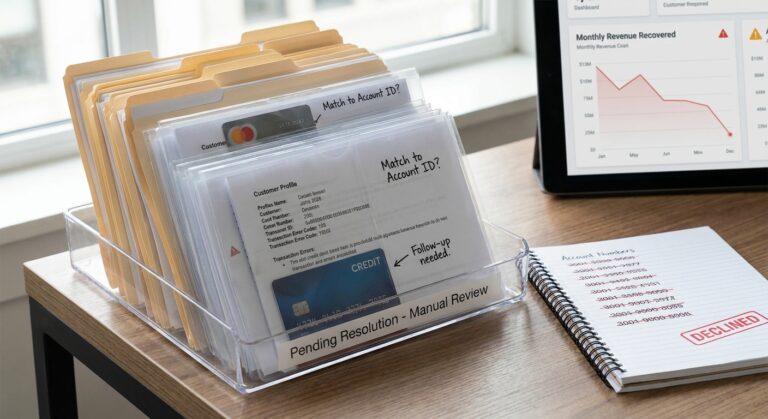
This reactive posture also directly impacts the bottom line. When payment issues are handled manually, time-to-resolution expands. In a subscription environment, a delay in contacting a customer about a failed payment frequently results in involuntary churn. The customer likely did not actively choose to cancel. Instead, their card simply expired, was replaced, or hit a temporary limit. By the time a support agent connects the dots and sends a manual outreach email, the customer may have already lost access to the service and decided not to bother updating their billing details.
Shifting from Identification to Payment Optimization
The payment industry has evolved significantly to ensure that merchants do not need to reverse-engineer cardholder data. Instead of trying to find a name to fix a broken transaction, sophisticated merchants optimize the front end of their operations so data is captured, verified, and updated seamlessly.
The Truth About Address Verification
To eliminate the need for manual identification after a transaction goes wrong, merchants must collect and utilize the right data during the initial payment authorization. This is where the Address Verification System, or AVS, comes into play, though it is often misunderstood.
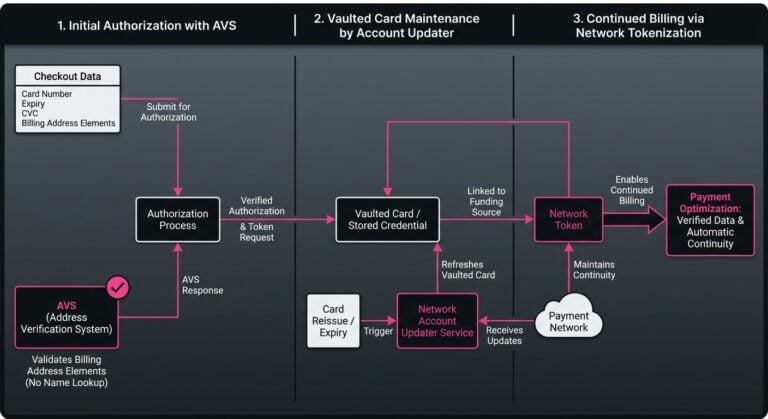
Many merchants assume a successful authorization means the gateway verified the customer’s name. In reality, standard AVS only checks the numeric values of the billing address against what the issuing bank has on file, specifically the street number and the zip code. The text of the name is generally not verified by the issuer during standard e-commerce processing. By requiring robust information at checkout and passing rich data to the payment gateway, merchants create a comprehensive and searchable internal database. If checkout issues occur later, the merchant relies on their own properly indexed gateway logs rather than trying to query external networks.
Keeping Data Fresh Without Customer Intervention
One of the most effective tools for maintaining billing continuity without manual intervention is the network Account Updater service. Offered by major card networks, this service monitors the vaulted cards in a merchant’s database. When an issuing bank issues a new card to a customer, the network automatically pushes the new credentials to the merchant’s payment environment. This eliminates the need to track down the customer for updated information. The transaction simply succeeds on the next cycle to preserve revenue quietly in the background.
Network tokenization builds upon this concept. Network tokens are inherently dynamic and remain securely linked to the underlying funding source, even if the physical card changes. Issuers tend to trust network tokens more than raw card data, which frequently results in fewer false declines. When a merchant uses tokenization, the identity of the cardholder becomes irrelevant to the mechanics of the transaction because the trust is baked into the token itself.
Decoding the Issuer Response
Of course, even with pristine data and tokenization, transactions will still fail. When a decline event happens, the key to recovering revenue is interpreting the issuer response rather than focusing on the individual behind the card. Issuers communicate the reason for a failure through standardized decline codes, and understanding these codes is the foundation of true payment optimization.
Declines generally fall into two broad categories of hard declines and soft declines. A hard decline indicates a permanent restriction, meaning the card might be reported stolen, the account could be closed, or the account number might be invalid. In these scenarios, attempting to retry failed payments is counterproductive and can harm a merchant’s standing with the card networks. Repeatedly submitting transactions against a closed account signals poor payment hygiene and can lead to increased processing fees. No amount of customer identification will save a hard decline. The only solution is to secure a completely new payment method.
Soft declines represent a temporary friction point. The customer might get paid on a Friday, but the subscription renewal triggered on a Wednesday. Other soft declines occur due to temporary network outages, overly aggressive fraud filters, or generic do not honor responses. These are the scenarios where merchants often panic and try to initiate manual outreach, but manual contact is rarely the most effective first step.
The Science of Retrying Transactions
Instead of manual investigation, the best approach is to retry soft declines programmatically. A thoughtful retry strategy does not involve blindly submitting the same transaction every twenty-four hours. It requires analyzing the specific decline code, understanding the nuances of how different issuers handle subsequent authorization attempts, and timing the retry to maximize the probability of success. For instance, retrying an insufficient funds decline on specific days of the month can align with typical payroll cycles to dramatically increase the likelihood of an approved authorization.
Platforms like SmartRetry address this exact friction by focusing on payment optimization and intelligent retries of declined transactions, helping merchants recover revenue automatically. In fiscal year 2025, transactions processed on Visa’s networks reached 233.8 billion transactions (Source). Instead of forcing support teams to cross-reference spreadsheets or chase down customers for updated details, machine learning models analyze the decline codes and optimal timeframes to attempt the charge again. This approach recovers lost revenue quietly in the background. It ultimately improves transaction approval rates without requiring manual administrative overhead or customer intervention.
Managing the Edge Cases: When to Involve the Customer
Even the most sophisticated automated systems have their limits. When intelligent retry logic exhausts its optimal attempts without securing an authorization, the merchant must eventually involve the customer. However, this process should still be entirely automated rather than reliant on manual detective work.
This is where automated dunning strategies take over. Dunning is the process of methodically communicating with customers regarding payment failures. Rather than trying to match a credit card number to a name to send a manual email, a mature billing system relies on the unique customer ID established at checkout. If a tokenized payment fails after strategic retries, the billing engine automatically triggers a sequence of localized and carefully crafted emails or SMS messages. These messages direct the customer to a secure portal where they can update their payment method. By the time human support teams need to get involved, it is usually only to assist a customer who has proactively responded to an automated prompt, rather than to initiate the search for a missing subscriber.
Building a Resilient Operations Architecture
The global payments ecosystem is deliberately designed to operate on secure, abstracted data rather than raw personal identities. The technical barriers preventing a merchant from reverse-engineering a credit card number are not flaws in the system. They are foundational privacy protections that make digital commerce viable and secure for consumers worldwide.
When operations teams find themselves frustrated by their inability to look up a cardholder, it frequently points to a localized process failure. It highlights a disconnect between the billing engine and the customer relationship management software, a lack of automated account updating, or an over-reliance on manual exception handling to reduce payment declines. The long-term solution is not to look for loopholes in banking privacy laws, but to upgrade the underlying payment infrastructure.
By embracing modern optimization strategies, from robust data capture at checkout and network tokenization to automated and intelligent retry engines, merchants effectively remove the human element from standard payment recovery. The operational focus shifts entirely from identifying the individual behind a failed charge to resolving the technical and timing friction that caused the failure in the first place. When a business stops trying to manage payments by chasing down names and starts managing them by interpreting data, they build a significantly more resilient and scalable operation. The ultimate goal is a frictionless environment where transactions succeed quietly, allowing teams to focus their energy on building exceptional products and driving growth.



 Find me on Linkedin