

The modern payment ecosystem relies heavily on a fundamentally static piece of data: the Primary Account Number, or PAN. But static data degrades over time. Physical cards expire, get lost in transit, or become compromised in data breaches. Merchants who rely on this deteriorating card information inevitably face the operational friction of payments declined by the issuing bank.
Network tokens were initially introduced to address the security vulnerabilities and PCI DSS compliance burdens of storing raw card data. They replace static PANs with dynamic, merchant-specific identifiers generated by the card networks. However, payment professionals quickly realized these tokens do much more than secure databases. They fundamentally alter how issuers evaluate risk and manage credentials over time, and understanding this structural shift is essential for any team focused on revenue realization and payment performance.
The Limitations of the Traditional Payment Processing Flow
To understand the value of network tokens, it helps to look at the baseline mechanics of a standard transaction. When a customer sets up a recurring billing profile or saves a card for future checkout, the merchant, or their payment gateway, has traditionally stored the PAN. That starts a clock ticking on the credential’s validity.
Every static credential eventually fails. Visa found that card expiration was the primary reason cited for changing a default payment card, with more than 40% of respondents removing their card due to expiration (Source). When a customer loses their wallet and requests a replacement card from their bank, the old PAN is invalidated. If a merchant then attempts to charge that stored PAN for a monthly service, the issuer response will likely indicate that the account is closed or the card is invalid. Historically, merchants mitigated these payment issues using account updater services offered by the card networks.
While account updater services are useful, they operate on a batch-processing model. The merchant sends a list of stored PANs to the network, the network checks with the issuers for updates, and a few days later, the merchant receives a file with the new card numbers. This reactive approach leaves a gap in time. If a recurring billing cycle lands squarely in the middle of that gap, the transaction is rejected. The merchant is then forced to reach out to the customer to manually update their billing information, which often introduces checkout issues or leads directly to involuntary churn. Data from the Merchant Risk Council indicates that once a customer is lost to a payment issue, only about 5% ever resubscribe.
Navigating the Token Lifecycle
Network tokens operate on an entirely different architectural premise. Instead of a merchant holding a PAN and occasionally checking whether it remains valid, network tokenization directly integrates the card network and the issuing bank into the credential’s ongoing existence.
This token is mathematically unrelated to the original PAN. More importantly, it is domain-restricted, meaning it is cryptographically bound to that specific merchant or payment requestor. If bad actors breach a merchant’s database and steal these tokens, they cannot use them to buy goods elsewhere.
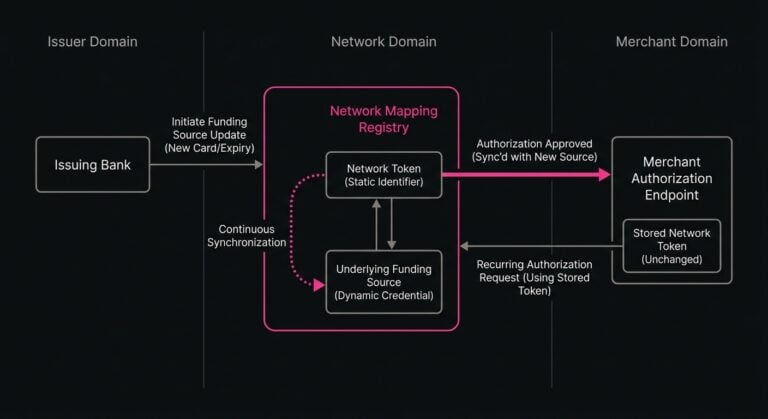
That leads to the real operational advantage of the token lifecycle. Because the issuer is actively involved in provisioning the token, the issuer and the network maintain a real-time link between the token and the underlying funding source. When a bank issues a new physical card to a customer, it updates the underlying PAN linked to the token on its end. The merchant does not need to download batch files or run proactive account updater checks. The token itself remains constant while the funding source mapped to it updates automatically in the background, so the next time the merchant routes a payment through the network using that token, the transaction reaches the active account. This continuous synchronization is one of the main ways tokens reduce payment declines tied to stale credentials. Supporting this scale, Mastercard reported processing over 4 billion tokenized transactions in a single month in 2024.
Issuer Psychology and the Cryptogram
While the auto-updating nature of network tokens solves credential decay, it only partially explains their effect on authorization performance. The second, perhaps more nuanced, factor is how issuers perceive risk during a transaction.
Every time a merchant submits an authorization request, the issuing bank’s risk engine evaluates dozens of data points in milliseconds. The bank must decide whether the person initiating the transaction is the legitimate cardholder. As a result, risk scoring is inherently defensive.
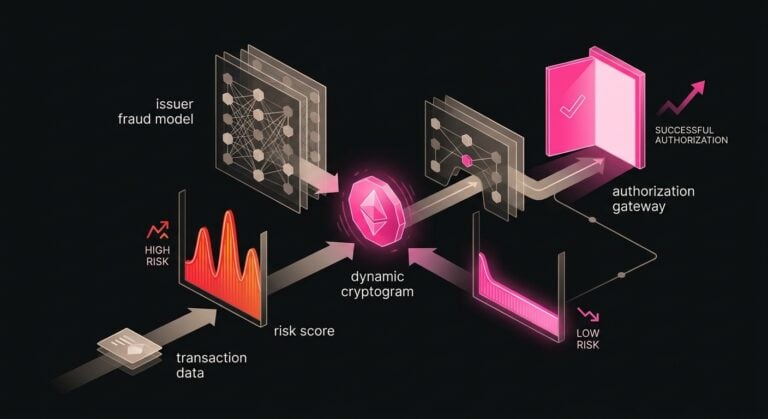
Network tokens change this dynamic by introducing a transaction-specific cryptogram. When a merchant initiates a tokenized payment, they request a unique cryptogram from the network to accompany the token. This cryptogram acts as a dynamic password that is only valid for that specific transaction.
For the issuer, a network token paired with a valid cryptogram is strong cryptographic proof of two things. First, the transaction genuinely originates from the merchant to whom the token was provisioned. Second, the credential could not have been passively intercepted and replayed, because the cryptogram is single-use. Since the issuer trusts the origin and integrity of the request, its fraud models assign a lower risk score to the transaction. Indeed, Visa reports that token-based transactions drive an average 30 percent reduction in online fraud compared to standard PAN credentials (Source). That trust tends to produce a higher card authorization rate than standard PAN transactions.
Measuring the Impact on Your Card Authorization Rate
When payment teams move from legacy PAN storage to network tokens, they generally observe a measurable shift in their metrics. The most immediate change is typically a reduction in declines associated with lifecycle events, specifically codes indicating an expired card or an invalid account number.
The secondary effect is a reduction in generic fraud declines. Issuers are less likely to flag a recurring transaction as suspicious when it is accompanied by network-verified cryptographic data. Together, these effects often lead to an observable lift in the overall transaction approval rate. On Visa’s network, token card-not-present transactions have demonstrated a 4.6 percent lift in authorization rates globally compared to PAN (Source).
Realizing these gains, however, requires a pragmatic approach to implementation. The payment ecosystem is vast, and technological parity does not exist across all issuing banks globally. Major financial institutions in North America and Europe have the modern infrastructure to parse and approve network tokens smoothly, but some smaller regional banks and credit unions still run on legacy core banking systems. In certain edge cases, a legacy issuer might fail to recognize a network token or mishandle the cryptogram, resulting in a transaction declined for technical reasons rather than financial ones.
Because of this variance in issuer readiness, experienced payment operations teams do not rely exclusively on tokens. Instead, they implement fallback logic. If a network token transaction fails due to an obscure processing error or a system timeout, the payment gateway can dynamically fall back to the raw PAN and retry the authorization. Maintaining this dual capability lets merchants capture the upside of network tokenization while insulating themselves against the uneven distribution of banking technology.
Handling Edge Cases and Payment Recovery
It is worth keeping realistic expectations about what credential optimization can actually achieve. A network token ensures that the payment credential is valid and securely transmitted, but it cannot manufacture money that does not exist.
A substantial portion of payment failures, particularly in recurring billing, stem from financial constraints rather than data decay. If a customer has insufficient funds in their checking account, or has exceeded their credit limit for the billing cycle, the issuer will reject the transaction regardless of whether it arrives via a static PAN or a highly secure network token. These soft declines require a completely different operational response.
With insufficient funds or velocity limits, the focus shifts from credential management to strategic retry logic. Blindly resubmitting a failed transaction every twenty-four hours is inefficient and risks triggering network penalties or artificially inflating decline ratios. According to the Merchant Risk Council, businesses relying strictly on standard email notifications and basic retry rules recover a mere 15% of failed payments (Source). Recovering these transactions instead requires analyzing the specific issuer response and introducing intentional delays. For instance, an insufficient funds decline is often more likely to succeed if retried on a common payday, such as the first or fifteenth of the month, or aligned with local banking hours when direct deposits typically clear.

This is where platforms like SmartRetry become relevant to a broader payment optimization strategy. Focused on intelligent retries of declined payment transactions, these systems help merchants recover revenue by treating soft declines as temporary states rather than final judgments. By parsing historical data, interpreting specific decline codes, and timing subsequent attempts based on issuer behavior, merchants can systematically retry failed payments and improve their transaction approval rates without running afoul of network retry limits.
The Broader Context of Payment Optimization
Network tokens should be viewed as one foundational layer within a comprehensive payment strategy, not a standalone cure for checkout friction. When a merchant relies on subscription models or frequent repeat purchases, the health of stored credentials directly influences customer lifetime value. Research cited by the Merchant Risk Council highlights that failed payments cost subscription businesses an average of 9% of their annual revenue. Subscription payment issues often trigger a cascade of negative effects: the payment fails, the service is paused, customer support gets involved, and the customer has to decide whether the service is worth the effort of digging out their wallet to update their card details.
By using the token lifecycle to automate credential maintenance, merchants remove a significant portion of this friction. The customer’s card expires, the bank issues a new one, the token maps to the new funding source, and the monthly billing cycle continues without interruption. The customer never even knows that a potential disruption was avoided.
For technical stakeholders and product managers, the shift toward network tokenization represents a move away from defensive payment management toward proactive revenue enablement. Instead of building complex internal logic to scrub databases and ping account updater APIs, engineering resources can be redirected toward analyzing authorization data and refining checkout experiences.
Moving Forward with Credential Strategy
As the major card networks continue to incentivize dynamic credentials through pricing structures and interchange fee adjustments, storing static PANs is shifting from standard practice to a legacy burden that complicates PCI compliance. Juniper Research forecasts that network tokenisation will secure 2.4 trillion global transactions between 2026 and 2030 (Source). Issuers are continually refining their fraud models to prioritize secure, authenticated traffic, so the performance gap between tokenized and non-tokenized transactions is likely to widen over time.
For merchants, the path forward involves auditing current credential storage methods, understanding the capabilities of their payment service providers, and mapping out a phased transition. It means balancing the immediate security benefits with the operational nuances of managing cryptograms and fallback routing.
Ultimately, navigating this transition requires looking beyond the basic mechanics of moving money. Teams also need to understand the incentive structures that govern issuing banks and card networks. By aligning merchant practices with the security preferences of the institutions holding the funds, payment teams can remove unnecessary friction from the system, minimize credential-related declines, and build a more resilient infrastructure for long-term revenue realization.



 Find me on Linkedin