

A four-digit number buried in your merchant account settings is quietly dictating your revenue, and most operators rarely think about it after onboarding. Yet this simple classification code acts as a gatekeeper for every purchase you process. When a customer clicks buy, the card issuer scrutinizes that code before deciding whether to grant payment authorization. If the code aligns with their internal risk models, the transaction flows smoothly. If it looks out of character or misaligned with the actual purchase behavior, you end up with a payment declined message. For finance and payment operations teams, a merchant code lookup is often the first step in diagnosing mysterious payment failures and auditing underlying processing costs.
Your Merchant Category Code (MCC) is more than an administrative tag. It is the lens through which the global financial system views your business, and understanding how these codes influence issuer behavior gives you a crucial lever for improving authorization rates and controlling operational costs.
The Mechanics of Merchant Classification
Merchant Category Codes are standard four-digit numbers that major card networks use to classify a business by the goods or services it provides. When a business applies for a merchant account, the acquiring bank or payment service provider assigns this code during underwriting, based on the company’s primary revenue stream.
Early on, this assignment is usually straightforward. A local grocery store gets a supermarket code, and a neighborhood restaurant gets a dining code. But as digital businesses scale, pivot, and introduce new product lines, their operational reality often drifts away from their original classification. A company that began by selling downloadable software might move to a software-as-a-service model, or a traditional retailer might launch a digital subscription box.
When a company’s operations diverge from its assigned category, friction enters the payment flow. Issuers rely on these categories to set a baseline expectation of normal transaction behavior, and when incoming transaction data contradicts that baseline, the entire system becomes wary.
The Intersection of Category Codes and Fraud Scoring
To understand why a misaligned category code depresses approval rates, it helps to look at the transaction from the perspective of the cardholder’s issuing bank. Issuers process thousands of transactions per second and rely on automated risk engines to separate legitimate purchases from fraudulent attempts.
These fraud scoring systems depend heavily on context. They evaluate the cardholder’s past behavior, transaction velocity, time of day, ticket size, and the MCC. The category code defines what a normal purchase looks like. A fast-food establishment, for example, is expected to process high volumes of low-ticket transactions, while a luxury travel agency is expected to process fewer, larger ones.
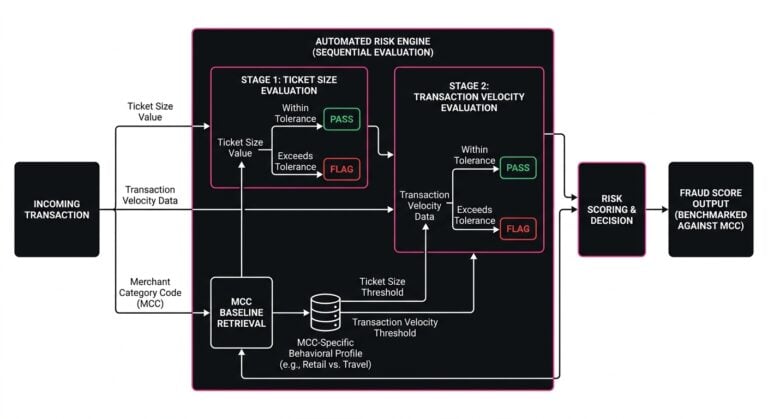
To the issuer, this mismatch looks like a compromised terminal or a merchant engaging in unauthorized activity. As a protective measure, the issuer intervenes and returns a card declined response.
This misalignment is a common culprit behind elevated false-positive declines. Legitimate customers try to make a purchase, but because the merchant’s category doesn’t logically match the transaction parameters, the issuer blocks the charge. Fixing this discrepancy is a foundational part of authorization optimization.
Translating Issuer Decline Codes Through a Classification Lens
When a transaction fails, merchants receive issuer decline codes intended to explain the rejection. In a perfect system, the issuer would return a specific code stating that the transaction conflicted with the merchant’s category code. In reality, the payment ecosystem is rarely that precise.
These opaque codes only communicate that the issuer is uncomfortable with the transaction’s risk profile. Because they offer so little actionable detail, merchants often assume the problem lies with the cardholder’s available credit or a temporary network glitch.
Looking at decline patterns through the lens of classification can reveal hidden operational issues. A persistent cluster of Do Not Honor codes on higher-ticket items or cross-border sales often indicates that the issuer’s rules for that specific MCC are filtering out the transactions. In one case involving Checkout.com and a major Saudi card issuer, removing legacy fraud rules on specific MCCs increased merchant approval rates by 5% within a month. That rate improvement translated to an extra SAR 15m in approved payments for the merchants involved (Source).
This dynamic is especially noticeable when a business introduces recurring billing. Subscription payment issues frequently arise when a merchant processes automated, recurring charges under a standard retail category code. Issuers generally expect recurring transactions to come from specific billing or subscription categories. When they see a recurring flag attached to a traditional retail MCC, their risk models often treat the sequence as suspicious, leading to consecutive payment failures on renewal dates.
The Hidden Cost: Interchange Fees and Processing Margins
Beyond risk assessment, your category code directly dictates your baseline processing costs. The fees for processing a credit card transaction consist primarily of interchange fees, which are set by the card networks and paid to the issuing banks.
Interchange pricing is highly complex, governed by extensive tables that set rates based on card type, transaction environment, and the merchant’s industry. Different MCCs carry different interchange rates. Charitable organizations, utility companies, and public transit systems often qualify for lower, negotiated network rates because their services are considered low risk. Higher-risk categories, such as travel, gambling, or digital goods, frequently carry higher base processing costs. For instance, Visa announced that effective October 2026, it will update the High Integrity Risk Fee of $0.10 for each card-not-present transaction processed under designated high-integrity risk MCC codes (Source). Under the same update, Visa will also assess an updated 0.10% fee on card-not-present volume processed within those high-risk categories (Source).

If your business was improperly classified during onboarding, or has shifted into a lower-risk category without a corresponding code update, you may be paying inflated interchange rates on every transaction. A routine merchant code lookup works as a financial audit, letting finance teams verify that they aren’t inadvertently absorbing B2B or high-risk processing rates for standard consumer transactions. On the other hand, intentionally misclassifying a business to secure lower rates violates network rules and can lead to heavy financial penalties or termination of the merchant account. Accuracy is the only sustainable approach.
Conducting an Operational Audit
Because MCCs are assigned at the network level by the acquiring bank, a merchant cannot simply log into a portal and edit their code. Discovering and correcting your classification requires a deliberate operational audit.
The first step in resolving misclassification issues is confirming your current setup. This information is sometimes visible in your payment processor’s merchant dashboard, but often it requires a direct inquiry to your account representative or acquiring bank.
Once you’ve identified the current code, evaluate it against your present-day revenue model. Key questions to ask during this review include:
- Does this code accurately reflect the primary goods or services we sell today?
- Have we introduced new billing models, such as subscriptions, that conflict with this standard category?
- Have our average order values shifted substantially since this code was assigned?
If the code no longer matches the business reality, request an MCC update formally through your payment provider. When a business runs multiple distinct product lines, for example physical retail goods alongside a digital software subscription, it often makes sense to establish multiple Merchant IDs (MIDs). Segmenting the traffic lets the merchant assign the proper MCC to each business line, keeping risk profiles clean and aligned with issuer expectations.
Bridging the Gap Between Classification and Recovery
Optimizing your category code creates a clean foundation for transaction processing, but it doesn’t eliminate all friction. Even with a perfectly aligned MCC, network timeouts, temporary issuer blocks, and insufficient funds will still cause soft declines. To truly minimize revenue leakage, businesses need to move beyond passive optimization and implement active recovery strategies.
This is where intelligent infrastructure bridges the gap between payment processing and automated recovery. Rather than treating every decline as final, forward-looking platforms analyze the context of the failure to determine the next best action. SmartRetry fits naturally into this ecosystem by pairing classification data with smart recovery logic to optimize transaction approvals. When a payment fails, the platform evaluates the issuer response, the timing of the decline, and the underlying merchant profile to find the optimal conditions for another attempt. By pacing retries based on data rather than aggressive, hardcoded schedules, businesses can retry failed payments effectively without tripping network velocity limits or aggravating issuer risk models.
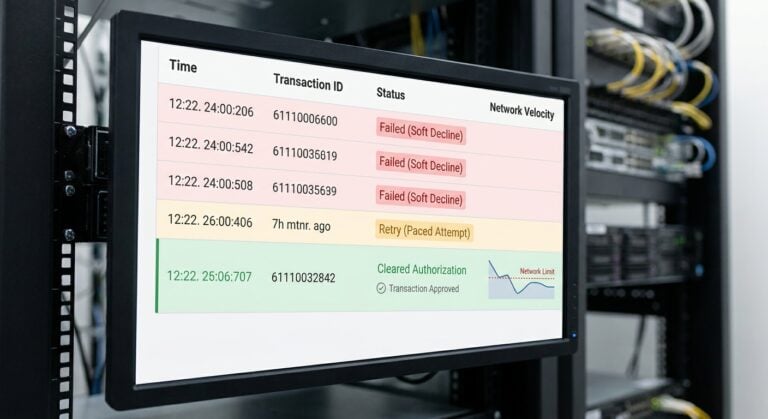
This measured approach to recovery also protects a merchant’s overall processing reputation. Issuers monitor how merchants handle declines. Repeatedly forcing a transaction through after a hard decline signals poor operational hygiene and can invite broader account scrutiny. Intelligent recovery respects the issuer’s initial decision while identifying the safest, most logical window to secure an approval.
Controlling the Levers of Payment Performance
Checkout issues and unexplained declines are rarely random. They result from complex, automated systems evaluating the context and risk of a specific digital event. Merchants can’t control the proprietary algorithms individual card issuers use, but they can control the data they present to those algorithms.
A thorough merchant code lookup is a straightforward, practical exercise that delivers immediate operational clarity. It ensures your business communicates its true nature to the financial networks, so issuers can evaluate your transactions accurately. By aligning your classification with your actual business model, auditing your interchange costs, and backing up your processing flows with intelligent retry logic, you turn a hidden administrative detail into a strategic lever for revenue retention.
Payment optimization is an ongoing process of aligning your infrastructure with the expectations of the broader financial ecosystem. Remove the friction caused by bad data and misaligned categories, and you clear the path for higher approval rates, more predictable processing costs, and a smoother experience for the end consumer.



 Find me on Linkedin