

The world of B2B commerce has historically been burdened by friction. Disjointed communication between buyers and suppliers also routinely disrupts cash flow. Even highly sophisticated enterprises often find themselves relying on outdated billing infrastructure. But the landscape is actively shifting. Consumer payments have become incredibly streamlined over the past decade, and commercial expectations are now following suit. A clear signal of this ongoing transformation occurred recently when Citi rolled out a digital invoice processing tool designed to bridge the gap between procurement and final settlement. This development is not just about a single financial institution launching a new feature. It reflects a much broader urgency within the industry to digitize the entire financial supply chain, eliminate manual bottlenecks, and ultimately reduce the payment issues that drag down enterprise revenue.
When a major bank introduces digital invoice tools, it signals a systemic move away from fragmented legacy processes toward integrated payment processing flow. For payment professionals, revenue operators, and fintech product managers, this shift represents both an opportunity and a significant operational challenge. Digitizing an invoice is only the first step, as ensuring the subsequent transaction successfully navigates the complex global financial system requires a deep understanding of payment authorization, network rules, and intelligent recovery strategies.
Understanding the Drive for Unified Payment Processing
At its core, a digital invoice is essentially a structured data payload requesting funds. In the past, the issuance of an invoice and the actual payment processing flow were two entirely disconnected events. This disconnect created a massive reconciliation headache and obscured visibility into cash flow.
The goal now is to weave the invoice directly into the payment rail. By embedding a digital payment link or standardized API call within the invoice itself, suppliers can capture rich transaction data from the moment the buyer clicks pay. However, as these systems become more interconnected, the complexity of managing the underlying data increases. It is no surprise that fintech leaders urge a unified payments push as AI grows, recognizing that artificial intelligence and machine learning models require clean, standardized data to function effectively. If a payment ecosystem is fragmented across a dozen disparate gateways, AI cannot accurately predict settlement times, flag fraudulent behavior, or optimize routing.
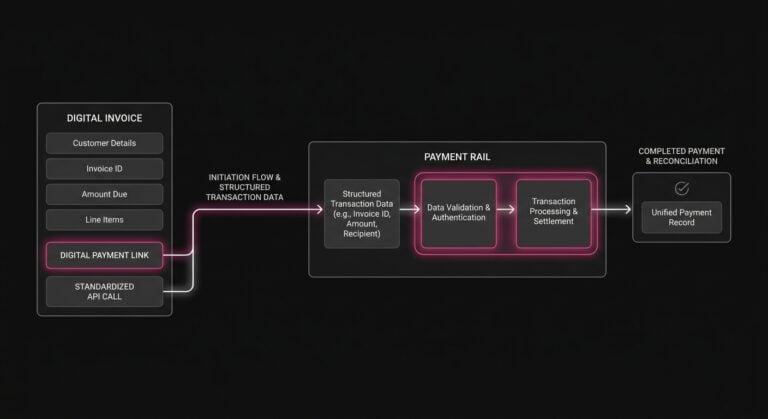
Integrating invoicing with processing ensures that vital data, such as purchase order numbers, line-item details, and buyer tax identifiers, travels seamlessly alongside the authorization request. For commercial transactions, passing this Level 2 and Level 3 data is often critical for securing lower interchange rates and improving the likelihood of a successful payment authorization.
The Expanding Complexity of Global Payment Rails
While digitizing the invoice solves the initial problem of data capture, the actual movement of money remains a deeply complex endeavor, particularly in cross-border payments. In fact, the average global straight-through processing rate for cross-border payments stands at only 26% (Source). As businesses expand internationally, they must accommodate regional payment preferences and connect with local clearing systems. A one-size-fits-all approach to international billing almost always results in a high rate of checkout issues and delayed settlements.
To capture revenue globally, payment infrastructure must adapt to local realities. For instance, the recent move by ACI Worldwide and dLocal to bring Latin American payment rails to global merchants highlights the necessity of localized processing. Latin America features a highly specific mix of alternative payment methods, domestic card schemes, and real-time payment networks like Brazil’s Pix. An international merchant attempting to settle a digital invoice in this region using only traditional cross-border wire transfers or foreign acquiring will face steep conversion hurdles and a high likelihood of a transaction declined by regional issuers.

Similarly, we are seeing a rapid diversification in how payments are structured and financed. The announcement that PayPal and Amazon launched BNPL payments for customers in Germany and Austria illustrates the growing demand for flexible payment modalities. While buy now, pay later originated in the B2C sector, variations of trade credit and embedded financing are rapidly entering the B2B invoice space. Offering flexible terms directly within a digital invoice improves conversion, but it introduces new variables into the payment processing flow, requiring sophisticated orchestration to ensure the merchant is funded promptly while the financing provider manages the risk.
Business Impact and the Cost of Operational Friction
The financial implications of modernizing your billing and payment architecture are profound. When an invoice system relies on manual intervention, businesses suffer from extended days sales outstanding and unpredictable cash flow. Manual invoice processing costs typically range from $10 to $22 per invoice, compared to under $1 for fully automated workflows (Source).
However, moving to a fully digital system exposes a business to the strict technical realities of modern payment networks. A beautifully designed digital invoice is entirely useless if the subsequent payment attempt fails. Currently, nearly 1 in 13 online payments fail across the industry (Source). When a B2B buyer attempts to settle a large invoice using a commercial credit card, they frequently encounter a payment decline. This can happen for various reasons, including velocity limits on the corporate card, mismatched Merchant Category Codes, or unexpected cross-border risk flags triggered by the issuing bank.
Every time a payment fails, it creates operational drag. The supplier must reach out to the buyer, the buyer must contact their procurement department or issuing bank, and the entire cycle is delayed. Furthermore, if the infrastructure supporting these transactions is poorly maintained or falls out of compliance, the consequences can be existential. The industry was recently reminded of the stakes when Paytm Payments Bank was wound up by a Delhi court after an eight-year KYC crisis. While this is an extreme example of regulatory failure, it underscores a fundamental truth. Financial technology must be built on a foundation of rigorous compliance, robust security, and reliable operational infrastructure. Failing to maintain this foundation doesn’t just result in payment failures. It threatens the viability of the business itself.

Actionable Recommendations for Payment Teams
As large institutions modernize their offerings and global rails become more accessible, merchant payment teams must proactively adapt their strategies to take advantage of these new capabilities while mitigating the associated risks. Transitioning from legacy billing to integrated digital invoicing requires a deliberate approach to payment optimization.
Unify and Enrich Your Transaction Data
To maximize the value of digital invoicing, ensure your systems are passing the richest possible data to your payment processor. If your buyers are paying via commercial cards, configure your gateway to support Level 2 and Level 3 processing. Providing the issuer with detailed line-item data, tax amounts, and purchase order numbers significantly increases trust in the transaction. This added transparency can positively influence the issuer response and result in lower interchange costs.
Optimize for Cross-Border Acceptance
If you are sending digital invoices to international clients, do not route all transactions through a single domestic acquirer. Cross-border transactions inherently carry a higher risk of being flagged for fraud. Utilize local acquiring partnerships or global payment service providers that can route transactions dynamically to the acquirer most likely to approve the payment. Familiarize your team with the specific decline codes prevalent in your target regions, as an issuer in Europe will evaluate a transaction differently than an issuer in Latin America.
Implement Intelligent Decline Management
Even with perfect data and localized routing, payment failures will occur. Corporate cards hit spending limits, network timeouts happen, and fraud filters occasionally trigger false positives. When a transaction is declined, the immediate reaction should not be to simply return an error to the buyer. Payment teams need a strategy to gracefully handle these scenarios. Analyze the specific decline codes returned by the issuer to determine if the failure is a hard decline, such as a lost or stolen card, or a soft decline caused by insufficient funds or a temporary network issue. Soft declines present an opportunity for recovery.
Address the Complexities of Recurring Billing
For businesses that rely on retainer models, software-as-a-service subscriptions, or installments, the challenge of payment recovery is amplified. Subscription payment issues are a primary driver of involuntary churn. When a scheduled digital invoice fails to clear, the business must initiate a sequence of retries. Hitting the payment network blindly with immediate, repeated authorization requests is a poor strategy. It will likely result in further declines, increased network fees, and potential penalties from the card brands. Instead, retry schedules should be timed thoughtfully, taking into account the time of day, the day of the month, and the specific nature of the original decline.
Where Intelligent Recovery Fits In
As the digitization of invoicing expands and merchants tap into increasingly diverse global rails, the resulting complexity inevitably leads to authorization failures. This makes a dedicated recovery strategy essential, which is where a platform like SmartRetry fits naturally into the payment optimization stack. By analyzing historical transaction data, issuer behaviors, and specific network decline codes, intelligent systems can programmatically determine the optimal time and method to retry failed payments. On average, automated smart retry solutions can recover 55% of lost revenue (Source). This approach helps merchants recover lost revenue and improve their overall transaction approval rate without requiring manual intervention from the finance team or adding unnecessary friction to the buyer’s payment experience.
The Path Forward for Revenue Operations
The rollout of digital invoice processing tools by major legacy banks marks an important milestone in the modernization of B2B commerce. It validates the idea that the entire lifecycle of a transaction, from the initial request for funds to the final settlement and reconciliation, must be treated as a single, cohesive workflow. As the barriers between invoicing and payments continue to dissolve, the companies that succeed will be those that treat their payment infrastructure not merely as a cost center but as a strategic asset.
Ultimately, the focus for payment professionals must shift from simple acceptance to holistic optimization. Offering the right payment methods in the right regions is critical, but it is only half the battle. True operational efficiency requires a meticulous approach to data hygiene, a deep understanding of network routing, and a systematic method for handling payment issues when they arise. By embracing integrated digital processing and implementing smart, data-driven recovery strategies, revenue teams can eliminate cash flow bottlenecks, reduce the operational burden on their staff, and build a more resilient financial foundation for their business.


 Find me on Linkedin