

You are looking at a wall of raw payment logs. The authorization responses are a mess of nested arrays, legacy data formats, and inconsistent strings. If you have ever written a script or queried an internal tool with a string like "merchant_descriptor_name" "mcc" "acquirer_country" "return _only valid json", you already know the operational headache of standardizing payment data. It is a common frustration for payment engineers and operations teams. Extracting the right variables from a gateway response is not just a logging exercise, it is the functional foundation of intelligent payment routing and retry logic. Strip away the complexity of modern payment infrastructure, and everything comes down to how accurately and quickly you can parse the conversation between the merchant, the acquirer, and the issuer.
Modern digital commerce requires systems to communicate flawlessly in milliseconds. When those systems fail to exchange well-structured data, transaction approval rates suffer, and payment issues cascade through the checkout experience. According to Worldpay, the average global card authorization rate is 85-90% (Source). Understanding how to parse, standardize, and leverage core transaction fields is a fundamental requirement for teams focused on payment optimization.
How Parsing Works in Practice
The lifecycle of a digital transaction is a complex orchestration of messages. When a customer initiates a purchase, the merchant payment gateway constructs an authorization request. The network then forwards this to the issuing bank, which evaluates the risk and returns an issuer response.
By the time the response makes its way back to the merchant’s server, it has passed through multiple legacy banking systems. The payment processing flow often returns a convoluted mix of XML, pipe-delimited strings, or deeply nested API responses. To trigger automated rules, such as routing a declined card to a different acquirer, the merchant’s infrastructure must extract specific data points and format them cleanly. Requesting that a system return only valid JSON ensures that automated retry engines and routing logic can ingest the data without breaking due to syntax errors.
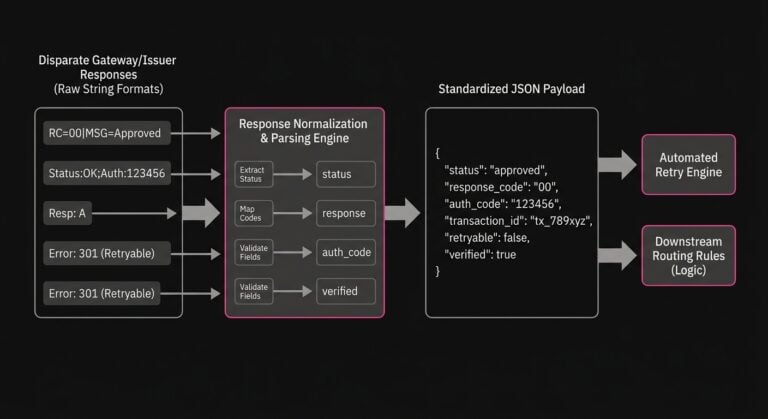
Three fields in this payload are particularly critical for diagnosing payment failures and optimizing routing: the Merchant Category Code (MCC), the acquirer country, and the merchant descriptor.
The Strategic Value of the MCC
The Merchant Category Code is a four-digit number used by bankcard networks to classify a business by the type of goods or services it provides. Issuing banks rely heavily on the MCC to evaluate transaction risk. If a merchant processes a transaction under an MCC that does not accurately reflect their business model, or if the issuing bank has a low risk tolerance for that specific category, the transaction is likely to be declined. Extracting the MCC from the payment payload allows engineering teams to verify that transactions are being classified correctly by their payment service provider, and to route specific categories of transactions through the acquirer with the highest historical approval rates for that MCC.
The Role of the Acquirer Country
The acquirer country indicates the jurisdiction where the acquiring bank is domiciled. For global merchants, parsing the acquirer country from the payment data is essential for local acquiring strategies. If a European customer attempts to check out and the transaction is routed through a US-based acquirer, the European issuer may decline it. Mastercard notes that establishing local acquirer connections across the globe is one of the most impactful optimization strategies (Source).
The Impact of the Merchant Descriptor
The merchant descriptor is the text that appears on the cardholder’s bank statement. While it may seem like a purely cosmetic field, it plays a vital role in preventing chargebacks and maintaining issuer trust. If a descriptor is vague, truncated, or mismatched against the storefront name, customers may not recognize the charge and initiate a friendly fraud dispute. Some issuing banks also apply automated risk filters based on descriptor formatting. Validating the merchant_descriptor_name in the payload ensures that the acquirer is passing the correct information to the network, reducing unnecessary payment declines and post-transaction disputes.
Failure Points & Optimization in Payload Processing
Extracting and acting upon this transaction data is rarely straightforward. Translating legacy banking responses into structured JSON introduces several failure points that can negatively impact the checkout experience and depress revenue.
One common failure point occurs at the parsing layer. When a gateway receives a response from an acquiring bank, the data may be malformed or missing key fields. If a merchant’s internal routing system expects a strictly typed JSON object containing the MCC and acquirer country, an unexpected null value or an XML-wrapped string can cause the parser to fail. This results in a silent failure or a generic “payment declined” error, leaving the customer unable to complete their purchase and the merchant blind to the underlying cause.
Latency is another critical consideration. Payment gateways operate under strict timing windows. If a merchant’s system takes too long to parse the incoming data, standardize it into JSON, and evaluate routing rules, the transaction may time out. Issuer systems typically expect an authorization response within a few seconds, and any delay introduced by inefficient logging, complex data extraction, or poorly optimized webhook infrastructure increases the risk of a timeout, which often registers simply as a card declined error.

Optimization opportunities in this domain focus on standardizing data ingestion and building resilient fallback mechanisms. By ensuring that all incoming payment data is immediately converted into a unified, valid JSON schema, merchants can create a standardized foundation for analysis. Once the data is clean and structured, teams can begin optimizing their payment authorization rates by identifying patterns. For example, if structured logs reveal that a specific acquirer country consistently returns a high volume of “do not honor” decline codes for a particular MCC, the merchant can adjust routing logic to bypass that acquirer for similar transactions going forward.
SmartRetry’s Role in Data-Driven Payment Recovery
When a transaction fails, the speed and intelligence of the subsequent response determine whether the revenue is lost or recovered. Relying on manual data parsing or brittle scripts to evaluate declined payments is inefficient and difficult to scale. Intelligent recovery requires a system that can instantly interpret the issuer response and apply contextual rules without developer intervention.
This is where a dedicated platform becomes valuable. SmartRetry focuses on payment optimization and intelligent retries of declined payment transactions, helping merchants recover revenue and improve transaction approval rates. Across industry benchmarks, Stripe reports that its Authorization Boost feature increases acceptance rates by 3.8% on average (Source). Instead of forcing internal engineering teams to build custom parsers to extract the descriptor, MCC, and acquirer country, SmartRetry integrates directly with the payment stack to ingest and standardize this data automatically. By evaluating these structured fields in real time, the platform identifies the precise reason for a decline and triggers cascade routing or delayed retries under optimized conditions, maximizing the likelihood of a successful authorization on the next attempt.

Automated retry engines rely heavily on the integrity of this structured data. If a subscription payment declines due to insufficient funds, the optimal retry strategy might involve waiting for a specific day of the month based on the acquirer country’s typical payroll cycles. If the decline is due to a suspected cross-border risk, the engine can route the retry through a domestic acquirer instead. Clean, valid JSON data serves as the fuel for these intelligent decisions, enabling systems to recover failed payments smoothly.
Implementation & Monitoring Guide for Engineering Teams
Implementing a robust system for parsing payment data and managing retries requires careful architectural planning. Payment operations and engineering teams should focus on building resilient integrations that can handle the unpredictability of legacy financial data while maintaining strict security and performance standards.
Technical Setup and Validation
The first step in building a reliable data pipeline is implementing strict schema validation at the ingestion point. When your system requests transaction details, it must enforce the requirement to return only valid JSON. If the payload fails schema validation, perhaps because the acquirer country is returned as an integer instead of a string, or the merchant descriptor contains unescaped special characters, the system should immediately route the payload to a dead-letter queue for inspection rather than allowing it to crash the primary routing engine.
Engineers should also implement robust fallback routing. If a primary gateway API experiences downtime or begins returning malformed data, the system should automatically fail over to a secondary provider. This helps keep checkout issues to a minimum even during provider outages. This helps identify structural issues with your current gateway configuration.
- Retry Success Rate: Measure how many failed payments are successfully recovered through automated retries. This indicates the effectiveness of your decline handling logic.
- Parser Latency: Monitor the time it takes your system to ingest an issuer response, extract the required fields, and format the JSON. High latency here directly correlates with increased checkout abandonment.
- Webhook Delivery Failure Rate: Track how often payment notifications from your gateway fail to reach your internal systems.
Alerting and Incident Response
Payment systems operate continuously, meaning issues can arise at any hour. Effective monitoring requires automated alerting configured to detect anomalies in the parsed data.
Teams should set up alerts for sudden shifts in data quality. For instance, if the system detects that the merchant_descriptor_name field is suddenly returning empty across multiple transactions, an alert should trigger immediately, since this often signals a configuration change at the gateway level that could soon lead to an increase in chargebacks. Similarly, a sudden spike in payment declines from a specific acquirer country should generate an operational alert, allowing the payment team to pause routing to that acquirer and investigate the root cause before significant revenue is lost.
Mastering the complexities of payment processing requires moving beyond basic API integrations. By treating the extraction and standardization of core fields as a strategic priority, merchants can transform chaotic gateway responses into actionable intelligence. When every system communicates seamlessly through clean, structured data, the focus can shift from troubleshooting checkout errors to driving sustainable revenue growth.



 Find me on Linkedin