

Every declined transaction represents a leak in the revenue bucket. Sometimes a payment fails due to a simple typographical error at the checkout screen. Often, it stems from a complex, split-second miscommunication between an issuing bank, a payment gateway, and an acquirer. For growth leaders and operations teams, accepting a baseline level of payment failures is no longer standard practice. Instead, the focus has shifted toward actively managing the payment processing flow to salvage these interactions. This is the foundation of payment performance optimization: the systematic practice of adjusting how, when, and where a transaction is routed to maximize the likelihood of approval. When applied methodically, it reduces operational costs and recovers revenue that would otherwise be lost to the void of network declines. For a merchant processing €10 million in card volume per month, a 3% increase in approvals translates to €300,000 in recovered revenue each month (Source).
The Anatomy of a Transaction Decline
To understand how to improve approval rates, it helps to look at what actually happens when a merchant attempts to capture funds. The journey from checkout to settlement is fraught with potential friction points, each governed by different risk models, legacy banking infrastructure, and network rules.
When a transaction is submitted, the acquiring bank sends a request through the card networks to the customer’s issuing bank. The issuer then decides whether to approve or decline the charge based on a variety of data points, including the customer’s balance, past purchasing behavior, the merchant’s category code, and the geographic location of the request.
If the issuer senses something out of the ordinary, it returns a decline code. The problem for merchants is that these codes are rarely explicit. An issuer response like “Do Not Honor” or “Generic Decline” provides very little actionable information, leaving the merchant to guess whether the failure was due to insufficient funds, a suspected fraud attempt, or simply a temporary network timeout. Understanding the root cause of these payment issues is the first step in formulating a response strategy, since treating every decline identically usually leads to wasted processing fees and frustrated customers. Riskified and ClearSale data shows that 27% to 33% of customers never return after a false decline (Source).
Navigating the Nuances of Enterprise and B2B Payments
As transaction volumes scale, the complexity of managing these declines multiplies. Enterprise payments optimization requires a broader view of the payment stack, moving beyond a single payment service provider to a multi-processor or orchestrated environment. Large organizations often process cross-border transactions, recurring subscriptions, and varied product lines, meaning a single, rigid payment setup is rarely sufficient to maintain high approval rates across the board.
The landscape gets particularly intricate when it comes to b2b payment optimization. Unlike consumer retail transactions, B2B purchases frequently involve corporate cards, purchasing cards (P-cards), and virtual credit cards. Each of these payment methods carries its own set of constraints. Corporate cards often have strict daily limits, velocity caps, or restrictions on specific Merchant Category Codes (MCCs).
Furthermore, processing B2B transactions efficiently often requires submitting Level 2 and Level 3 data, additional line-item details like tax amounts, invoice numbers, and freight charges. Issuing banks tend to look favorably on transactions accompanied by rich data, since it signals a legitimate corporate purchase rather than a fraudulent charge. Incorporating this data transmission into the checkout flow is a foundational element for teams looking to refine their B2B payment acceptance.

Core Strategies to Optimize Payments Processes
Improving transaction approval rates requires moving away from a passive approach to payments. Rather than sending a charge and hoping for the best, modern payment teams actively structure their requests to align with the preferences of acquiring and issuing banks.
Implementing Intelligent Routing Strategies
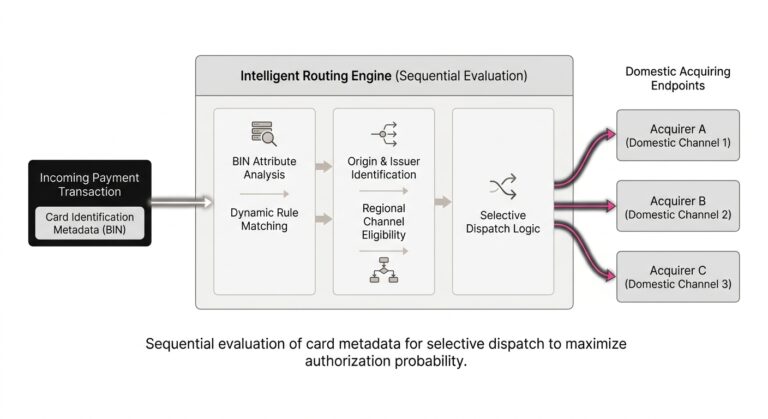
One of the most practical levers available to merchants is payment routing. In a multi-processor setup, a merchant isn’t bound to send every transaction through a single acquiring bank. Instead, transactions can be dynamically routed to the acquirer statistically most likely to approve it.
For example, cross-border transactions frequently face higher decline rates when processed by a domestic acquirer, since the issuing bank may flag an out-of-country request as suspicious. By using local acquiring, routing a transaction from a European customer through a European acquiring bank, merchants can present the transaction as a local charge. This alignment between issuer and acquirer generally reduces friction and supports a healthier transaction success rate.
Routing logic can also be built around card types, transaction sizes, or specific issuing bank behaviors. If a payment team notices that a particular processor struggles with virtual cards, it can configure its systems to route those specific BINs (Bank Identification Numbers) to an alternative provider that handles them more reliably.
Tuning Authentication and Risk Parameters
Authentication is another area where optimization plays a vital role. The introduction of Strong Customer Authentication (SCA) and the widespread adoption of 3D Secure (3DS) have fundamentally altered the payment authorization landscape. While 3DS helps shift liability for fraud away from the merchant, applying it indiscriminately adds friction to the checkout experience and can lead to cart abandonment.
Payment teams must balance security with convenience. This involves using authentication exemptions where card networks allow them, such as for low-value transactions or low-risk recurring billing. By selectively applying 3DS only when necessary, or when mandated by the issuer, merchants can streamline the buying process.
Additionally, adopting network tokens in place of primary account numbers (PANs) can yield noticeable authorization rate improvement-according to Visa, network tokens lift authorization rates on card-not-present (CNP) transactions by 4.6% compared to raw card numbers (Source). Network tokens are cryptographic identifiers provided directly by the card networks. Because they’re automatically updated by the network when a card expires or is replaced, they drastically reduce declines related to expired cards, which makes them particularly useful for recurring billing models.
Managing Retries and Resolving Soft Declines
Even with optimal routing and authentication, some transactions will inevitably fail. The differentiator for sophisticated payment operations is how they handle a transaction declined status.
Declines generally fall into two categories: hard declines and soft declines. A hard decline occurs for permanent reasons, such as a closed account or a stolen card. Retrying a hard decline isn’t just futile, it can also harm a merchant’s standing with the card networks, potentially leading to processing penalties or higher baseline decline rates.
A soft decline, however, is temporary. It might result from a momentary lack of funds, a brief network outage, or a daily velocity limit being reached. These are the transactions that can often be salvaged, though the challenge lies in knowing when and how to attempt the charge again. Blindly retrying a failed transaction every few hours is an inefficient strategy that drives up authorization costs and increases the risk of being flagged by the issuer for aggressive behavior.

The Operational Trade-Offs of Payment Strategy Optimization
Building a strategy to handle these nuances requires balancing competing priorities. Payment strategy optimization is rarely about flipping a single switch to achieve perfect authorization rates. It’s about navigating operational trade-offs.
For instance, implementing a multi-processor routing system introduces integration and reconciliation complexity. Finance teams must consolidate reporting across different gateways, and engineering teams must maintain the routing logic as processor APIs evolve. Similarly, relaxing fraud parameters might slightly boost approval rates, but it also increases the risk of chargebacks. Chargebacks not only carry direct financial penalties but also require dedicated resources for evidence preparation and dispute management. If a merchant’s chargeback ratio climbs too high, acquiring banks may place them in monitoring programs or withhold funds.
Another crucial trade-off involves subscription payment issues. In recurring revenue models, a declined payment doesn’t just mean a lost sale, it often leads to involuntary churn. While a merchant wants to preserve the subscriber, aggressively dunning the customer or retrying the card too frequently can trigger complaints or permanent blocks from the issuing bank. Payment teams must design retry schedules that respect the customer’s billing cycle, perhaps timing a retry attempt to coincide with standard payroll dates when account balances are more likely to be sufficient.
Structuring the Recovery Workflow
Given the complexities of network rules, decline codes, and retry timing, many teams look for specialized tools to manage the recovery phase of the payment lifecycle. Instead of building complex logic internally to parse every variation of an issuer’s decline response, merchants often turn to platforms designed specifically for this purpose.
SmartRetry operates precisely within this area of payment recovery, offering solutions focused on the intelligent handling of declined payment transactions. By analyzing the underlying reasons for a payment failure and determining the optimal timing and conditions for a retry attempt, SmartRetry helps merchants recover revenue and improve transaction approval rates. This approach allows enterprise teams to implement sophisticated retry logic without diverting core engineering resources away from the primary product.
Moving from Passive Processing to Active Orchestration
Ultimately, optimizing the payment flow requires a shift in perspective. Payments can no longer be viewed as a commoditized utility where a merchant simply connects to a gateway and expects seamless execution. The infrastructure linking merchants, processors, networks, and issuers is vast and inherently conservative, designed primarily to mitigate risk rather than to maximize merchant revenue.
To operate effectively within this environment, companies must actively manage their transactions. This means analyzing decline data to understand why issuing banks are rejecting charges, structuring data payloads to build trust with the networks, and employing measured, intelligent routing to present transactions in the most favorable light. It also means recognizing that a decline isn’t always the end of the customer interaction.
By applying deliberate strategies to authentication, routing, and soft decline recovery, payment teams can exert a greater degree of control over their authorization rates. While no system can eliminate payment failures entirely, a structured approach to optimization ensures that fewer legitimate transactions are lost to the intricacies of the banking network. The result is a more resilient payment operation that reliably supports revenue retention and scales smoothly alongside the business.


 Find me on Linkedin