

Subscription models are built on a simple premise. Customers sign up, and you bill them on a regular schedule. It works beautifully until the infrastructure stumbles. Credit cards expire, issuing banks tighten their risk models, and temporary network timeouts disrupt the flow. In fact, 15-30% of recurring payments fail on the first attempt (Source). Suddenly, a perfectly good customer generates a transaction declined status. If your billing stack lacks a reliable mechanism to manage these events, you are steadily leaking revenue. Finding the right software to manage this friction is a structural requirement for any recurring revenue business.
Every time a scheduled transaction fails, it starts a clock. The merchant has a limited window to secure the funds before the customer’s subscription is paused or canceled. This specific type of churn, where a customer is lost not because they wanted to leave but because their payment mechanism failed, is one of the most frustrating inefficiencies in digital commerce. Addressing it requires more than simply running the card again the next day. It requires a systemic approach to decline management, network rules, and customer communication.
The Mechanics of Involuntary Churn
To understand why specialized software is necessary, it helps to look at how subscription payment issues actually occur. When a merchant initiates a recurring charge, the transaction data travels through a complex payment processing flow involving the payment gateway, the acquiring bank, the card network, and finally the issuing bank.
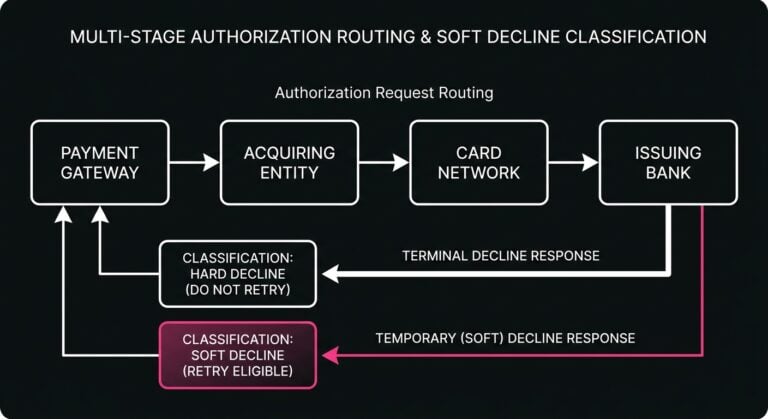
At the end of this chain, the issuer evaluates the authorization request. If the issuer’s risk models, balance checks, or network connections flag an issue, they return a response code indicating a decline. These codes generally fall into two categories. Hard declines indicate a permanent issue, such as a closed account or a card reported stolen. Soft declines suggest a temporary condition, such as insufficient funds, a generic “do not honor” message, or a processing timeout.
When a soft decline occurs, the customer is usually entirely unaware. They haven’t decided to cancel their service; their payment instrument has simply hit a temporary roadblock. If the merchant cannot recover that transaction, the resulting cancellation is classified as involuntary churn. In fact, involuntary churn accounts for an estimated 20% – 40% of total churn across subscription businesses (Source). Unlike voluntary churn, which requires product improvements or better marketing to solve, involuntary churn is an operational failure. You’ve already done the hard work of acquiring and retaining the customer, and you’re losing them solely due to payment friction.
Moving Beyond Basic Retry Logic
Historically, merchants handled payment failures by configuring simple, time-based retry schedules within their billing engines.
While this basic approach can recover a portion of failed transactions, it’s fundamentally flawed for modern payment environments. Blindly hitting the card networks with identical authorization requests, without analyzing the initial issuer response, often yields diminishing returns. Worse, excessive retrying of failed transactions can trigger network penalties. Card brands like Visa and Mastercard maintain strict rules regarding how many times a single transaction can be retried, especially for specific decline codes. Violating these rules not only incurs fees but can degrade a merchant’s overall authorization trust score, leading to even more declines down the road.
This operational reality is why dedicated failed payment recovery solutions have become standard infrastructure for mature scaling businesses. Rather than relying on rigid schedules, modern software interprets the nuances of the payment ecosystem, adjusting its strategy based on the specific variables of each transaction.
Core Payment Recovery Services Comparison Criteria
Selecting a vendor in this space requires cutting through software marketing and evaluating how a platform actually interacts with payment networks and customer data. When establishing your payment recovery services comparison criteria, it helps to evaluate vendors across three primary capabilities: pre-authorization data hygiene, intelligent retry execution, and post-failure customer outreach.
Intelligent Automated Retries
The foundation of any capable recovery system is its automated retries engine. Instead of a static schedule, intelligent retry logic uses historical data, network patterns, and machine learning models to determine the most favorable conditions for a subsequent authorization attempt.
For example, a platform might analyze the specific issuer response code and delay a retry for an insufficient funds decline until a Friday, which traditionally aligns with common payroll cycles. Alternatively, if a decline is flagged as a generic network timeout, the system might attempt to retry the payment within a few hours, on the assumption that the connectivity issue has already resolved.
By varying the time of day, day of the week, and even the specific data payload sent in the retry request, intelligent systems can optimize the payment authorization process. In fact, decline-code-aware scheduling typically recovers 15-30% more than fixed-interval retries with the same attempt budget (Source). This selective approach preserves the merchant’s standing with card networks while aiming to improve the overall transaction approval rate over time.
Native Account Updater Integrations
The most efficient way to handle a declined payment is to prevent it from happening in the first place. A significant portion of payment issues stem from cards that have expired, been reissued due to a loss, or been upgraded by the issuing bank.
An account updater is a service that interfaces directly with the card networks, such as Visa Account Updater or Mastercard Automatic Billing Updater, to proactively check for changes to a customer’s Primary Account Number (PAN) or expiration date. When evaluating software, look for solutions that integrate account updater capabilities seamlessly into the recovery flow.

If a system can ping the card networks to fetch fresh credentials immediately after a decline, or better yet, just before the billing cycle runs, it bypasses the need for further retries entirely. This quiet, behind-the-scenes updating is one of the most reliable methods to reduce payment declines without requiring any effort from the customer.
Configurable Dunning Software
Modern dunning software should allow merchants to build highly configurable communication workflows. The goal is to prompt the customer to update their billing details with as little friction as possible. Overall, a disciplined dunning process recovers 50-70% of failed payments. That means sending targeted, well-timed emails or SMS messages that link directly to a secure, pre-authenticated hosted payment page.
When evaluating dunning features, look for the ability to customize the cadence and tone of the messaging. A customer who has been with your service for three years might warrant a different communication strategy than someone on their first billing cycle. Dunning outreach should also automatically halt the moment a silent retry succeeds, so you never bother a customer about a bill that’s already been settled.
Granular Analytics and Reporting
A recovery system is a black box without proper visibility. Payment operations teams need to understand exactly why transactions are failing and how they’re being recovered.
Effective reporting should break down the recovery funnel by decline code, card type, issuing bank, and customer cohort. If a merchant notices a spike in generic declines from a specific region or bank, they can use that data to investigate potential gateway routing issues or adjust their fraud tolerance settings. Understanding the true source of your payment failures is a prerequisite for broader payment optimization efforts.
The Operational Trade-Offs of Recovery Strategies
Implementing a recovery system involves balancing aggression with caution. On one hand, you want to recover as much revenue as possible. On the other, aggressive retry strategies incur higher processing costs and risk alienating customers.
Every authorization attempt, whether successful or declined, typically carries a small gateway or processing fee. If a system mindlessly retries a card that’s fundamentally unrecoverable, the merchant is essentially paying for the privilege of being declined. An intelligent system mitigates this by recognizing terminal decline codes, such as an account being closed or a card flagged for fraud, and immediately suppressing any further automated attempts.
The transition between silent retries and visible dunning also requires a thoughtful approach. Engaging a customer too early with an aggressive “payment failed” email can cause unnecessary alarm, especially if the issue was merely a temporary network timeout that might have resolved itself a few hours later. The ideal system sequences these actions logically, keeping friction as low as possible for as long as possible.
Finding the Right Architecture for Your Stack
Integrating a recovery solution requires understanding how it will sit alongside your existing billing engine, payment gateway, and CRM. Some merchants prefer all-in-one billing platforms that include basic recovery features natively. However, as transaction volumes scale and the cost of involuntary churn becomes more pronounced, businesses often transition to specialized, gateway-agnostic recovery layers.
A system designed specifically for payment optimization and intelligent retries of declined transactions, such as SmartRetry, helps merchants recover revenue and improve transaction approval rates by managing these network variables automatically. By layering specialized logic over your existing payment infrastructure, you can decouple the complexity of decline management from your core billing operations. This allows your engineering and product teams to focus on building your actual service, rather than maintaining custom retry scripts and studying network compliance rules.

The Final Takeaway on Payment Resiliency
Addressing failed payments is an ongoing operational discipline, not a one-time setup task. As consumer banking behaviors shift and card networks update their processing rules, the tactics required to recover revenue will continue to evolve.
Choosing the right software to manage this process comes down to looking beyond the surface level of automated emails and rigid retry schedules. The most capable platforms treat every decline as a data point, leveraging intelligent timing, native credential updates, and low-friction customer outreach to salvage the transaction. By taking a thoughtful, data-driven approach to payment recovery, businesses can seal the leaks in their recurring revenue streams and ensure that the customers they work so hard to acquire remain active, satisfied, and subscribed.


 Find me on Linkedin