
The architecture of global commerce is fundamentally shifting. Merchants want predictability, and consumers expect frictionless experiences. This dynamic has made recurring revenue the holy grail of modern business. But maintaining that revenue stream is surprisingly difficult.
Recently, the blockchain ecosystem took a significant step toward mirroring traditional finance capabilities. Solana brought subscription billing to mainnet, a development heavily discussed in startup and Fortune circles as a way to bridge the gap between Web3 rails and everyday utility. Yet regardless of whether a transaction flows through a decentralized smart contract or a traditional acquiring bank, the underlying challenge remains identical. Subscriptions rely on asynchronous authorization, and when a customer isn’t actively present at a checkout screen to authenticate a transaction, friction multiplies. As network rules evolve and cross-border commerce expands, managing subscription payment issues has become one of the most critical operational hurdles for finance and product teams.
The Revenue Impact
For a business operating on a recurring revenue model, a declined payment is not just a temporary operational hiccup. It is an immediate threat to the customer’s lifetime value. When a subscription fails to renew due to a payment authorization error, it often leads directly to involuntary churn. The customer did not actively decide to cancel the service, but the underlying system failed to collect the funds and terminated the relationship by default.

The financial bleeding caused by these subscription payment issues is substantial across the digital economy. We can see the industry’s focus on preserving these recurring relationships reflected in how major platforms prioritize retention tools, such as the upcoming features outlined in discussions around ecommerce subscription management software for 2026 by Shopify.
To understand the true scale of the problem, one must calculate the impact conceptually. If a merchant processes tens of thousands of renewals monthly and experiences a baseline rate of payment failures, the compounding effect of those lost cohorts is devastating. A customer lost in month three silently forfeits months four through twelve of projected revenue. Consequently, the marketing and sales resources spent acquiring that customer yield a significantly lower return on investment. The overarching revenue impact extends far beyond a single declined transaction. It artificially inflates customer acquisition costs, disrupts cash flow forecasting, and degrades overall enterprise valuation.
Root Causes of Subscription Payment Failures
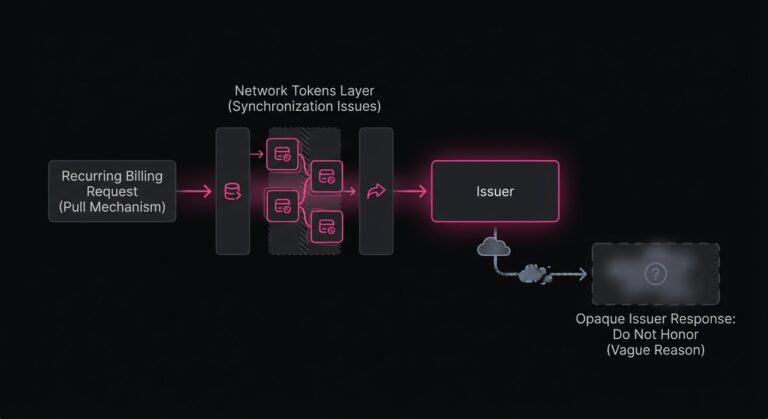
To effectively reduce payment declines, operations teams must first dissect the anatomy of a failure. Traditional fiat networks operate on a pull mechanism, where the merchant formally requests funds from the issuer. This differs fundamentally from the standard crypto push model. That difference explains why the news of new mainnet subscription capabilities is technically fascinating, as it requires building allowance-based pull mechanics on-chain. However, in the traditional payment processing flow, this pull request must navigate a gauntlet of risk checks and systemic friction points.
The root causes of revenue leakage in recurring billing typically fall into three distinct operational buckets:
- Customer Behavior and Credential Decay: Cards expire, get lost, or are replaced by banks due to suspected fraud. If the merchant continues to bill the old credential without updating it, the issuer inevitably responds with a hard decline.
- Financial Constraints: Insufficient funds remain a primary driver of soft declines. This cause is highly dependent on the billing date relative to the customer’s personal cash flow and regional payroll cycles.
- Systemic Risk and Velocity Checks: Issuing banks employ aggressive, often opaque, machine learning models to detect fraud. A perfectly legitimate subscription renewal might be flagged because the issuer’s model noticed an unusual velocity of transactions on the cardholder’s account that day, or because the merchant’s category code triggered a conservative regional risk rule.
The ongoing shift from static Primary Account Numbers to network tokens is also complicating the landscape. While tokens are designed to improve security and automatically update when a card is replaced, a poorly implemented tokenization strategy can lead to unexpected checkout issues if the acquirer and issuer are out of sync. Furthermore, the resulting issuer response is often intentionally vague. A generic Do Not Honor code leaves the merchant to guess the actual underlying issue. Without a clear understanding of whether a card declined due to a temporary lack of funds or a permanently closed account, subsequent recovery efforts are essentially flying blind.
The Complexity of Global Payment Processing Flows
Understanding these root causes requires acknowledging the sheer fragmentation of the global financial system. The payment processing flow is rarely a simple, direct line between a merchant and a local bank. Instead, it is an increasingly complex web of cross-border relationships, alternative payment methods, and evolving regulatory frameworks.
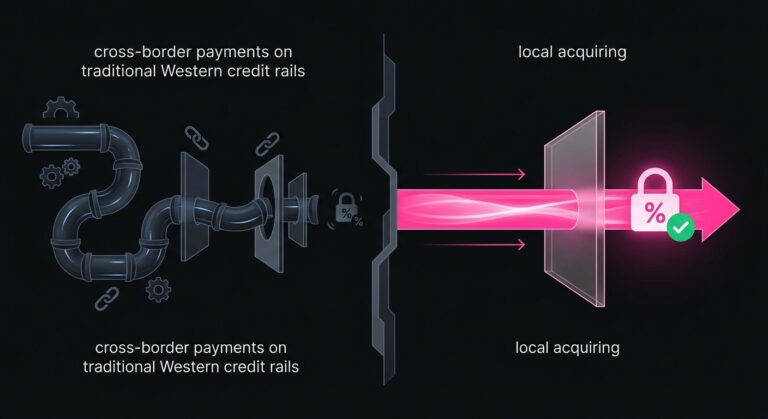
Consider the operational friction inherently found in emerging markets. As the CEO of Pouchers recently observed, cross-border payments should reflect how Africans actually live and work, highlighting the profound disconnect between legacy banking infrastructure and real-world economic realities. When merchants attempt to pull subscription payments across these borders using traditional Western credit rails, authorization rates predictably suffer due to mismatched risk appetites and foreign exchange constraints.
To combat this fragmentation, the industry is seeing a massive push toward localized and interoperable solutions. Alternative networks like Alipay+ are enabling QR code payments for travelers to Argentina, bypassing traditional card networks entirely to ensure higher success rates for specific consumer bases. In the B2B sector, where transaction values are higher and failures more costly, payment fintech Pliant is targeting the US market via a Coastal partnership to establish local acquiring. They recognize that domestic transactions are treated much more favorably by issuers than cross-border attempts.
Even the deepest legacy institutions are overhauling their infrastructure to improve these flows, evidenced by BBVA becoming the first Spanish bank to launch Swift’s new global retail payments scheme. Every new scheme, partnership, and localized rail is an attempt to grease the wheels of commerce and improve the overall transaction approval rate. For the modern merchant, this means the processing environment is constantly shifting. An optimization strategy that works flawlessly in North America using standard credit rails might fail entirely when applied to a European or Latin American customer base.
Proven Recovery Strategies
When facing a steady barrage of payment failures, merchants have several proven recovery strategies at their disposal. The goal is to maximize payment recovery without alienating the consumer or incurring excessive penalty fees from the card networks.
The most foundational approach involves proactive credential maintenance. Utilizing Account Updater services provided by major card networks allows merchants to automatically refresh expired or replaced card details in the background before the billing cycle even begins. By pre-empting the failure, merchants entirely avoid the friction of a declined card.
For transactions that do fail, intelligent retry timing is critical. A naive approach is to simply retry failed payments every twenty-four hours. However, hammering an issuer with repeated requests for an account with insufficient funds is highly counterproductive. It not only guarantees subsequent declines but also damages the merchant’s overall trust score with that specific issuer. This can depress the transaction approval rate for entirely healthy subscriptions across the merchant’s portfolio. Instead, sophisticated operations teams analyze historical data to schedule retries around optimal windows, such as specific days of the month when payroll deposits typically clear for a given demographic.
Cascade routing offers another highly effective layer of defense. If a payment is declined by one payment processor due to a gateway timeout or a localized risk rule, cascading the transaction dynamically to a secondary acquirer can sometimes yield a successful authorization.
Finally, when technical and systemic retries are fully exhausted, the strategy must shift to direct customer communication. Dunning campaigns, which are automated sequences of emails or in-app messages alerting the customer to the checkout issues, are necessary for resolving hard declines. However, dunning should always be treated as a last resort and utilized only when silent, backend payment optimization has reached its limits.
SmartRetry’s Recovery Engine
Managing these intersecting variables requires specialized infrastructure, which is where a dedicated recovery engine proves invaluable for growing merchants. SmartRetry acts as an intelligent orchestration layer focused specifically on payment optimization and the intelligent retries of declined transactions. Rather than relying on static rules or arbitrary daily schedules, SmartRetry analyzes the specific decline code, the nuanced issuer response, and historical transaction data to dynamically determine the most mathematically favorable moment to re-attempt the charge.
By automating this complex decision-making process, the platform helps merchants recover revenue and improve transaction approval rates seamlessly in the background. It effectively transforms a chaotic operational headache into a predictable, data-driven revenue stream. This ensures that valid recurring customers remain active without requiring continuous manual intervention from the finance team.
ROI & Business Case
The business case for implementing robust payment recovery mechanisms is fundamentally an exercise in unit economics. When evaluating the return on investment for revenue recovery technology, the focal point is the preservation of Customer Lifetime Value and the reduction of payback periods.
Every subscription payment saved is not merely a single recovered invoice. It represents the continuation of a recurring revenue annuity. If a merchant spends heavily on marketing to acquire a user, losing that account in the second month to a preventable declined payment means the acquisition cost is never fully amortized. By implementing intelligent retry systems and proactive credential management, businesses effectively plug the silent leaks in their subscription buckets.
The ROI calculations in this domain are generally straightforward and highly favorable. The cost of integrating a specialized optimization layer is typically a fraction of the raw revenue it pulls back from the brink of churn. Furthermore, successful revenue recovery removes a massive operational burden from customer support teams, who otherwise spend countless hours manually chasing down failed payments and answering basic billing inquiries. By improving the baseline transaction approval rate, merchants also negotiate from a stronger position with their payment service providers and can potentially lower their blended processing rates over time.
Ultimately, the ability to effortlessly handle checkout issues and backend declines provides a durable competitive advantage. Because consumer attention is fleeting and acquisition costs are continually rising, retaining the revenue you have already earned is the most capital-efficient growth strategy available. Whether the industry is adapting to new paradigms like blockchain networks bridging the gap to mainnet billing or navigating the highly localized nuances of traditional fiat infrastructure, the underlying mandate remains unchanged. Mastering the mechanics of authorization, deeply understanding issuer logic, and executing a disciplined, automated recovery strategy are the hallmarks of a resilient digital business.


 Find me on Linkedin