
This massive capital injection is more than just a headline, signaling a dramatic acceleration in cross-border commerce and digital financial infrastructure. But expanding into international markets brings hidden operational complexities. The moment transactions cross borders, payment issues multiply exponentially. Merchants face a steep rise in payment declines as unfamiliar issuer risk models reject perfectly valid transactions. Understanding this dynamic is no longer optional for growth-focused payment teams, as it has become the defining challenge of international revenue optimization.
As digital commerce erases geographical boundaries, the underlying plumbing of the financial system is being forced to adapt. For merchants, navigating this space requires a deep understanding of how money moves, why it occasionally stops, and what can be done to keep the payment processing flow running smoothly.
Understanding the Cross-Border Payment Surge
To understand why Ant International raised such staggering amounts of capital, you have to look at the friction inherent in global money movement. Historically, processing a payment across borders meant relying on a fragmented web of correspondent banks, localized processors, and disparate regulatory environments. Every hop in that chain introduced latency, cost, and the potential for a declined transaction.
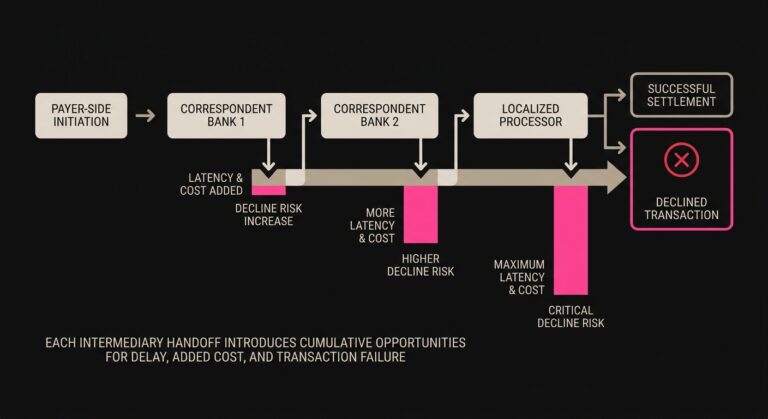
The industry is now witnessing a concerted effort to bypass legacy hurdles and build faster, more resilient payment networks. This infrastructure overhaul is happening from multiple angles simultaneously. For instance, TP Bank recently selected terraPay for real-time cross-border payments. This highlights a growing demand from financial institutions to settle transactions instantaneously rather than waiting days for traditional clearing.
Alternative rails are also gaining serious traction as a way to circumvent traditional fiat bottlenecks. We can see this as LemFi taps BVNK to move cross-border payments onto stablecoin rails, effectively using digital assets to settle transactions faster and with lower overhead. These developments reflect a shared industry consensus that the future of international commerce relies on removing friction from the underlying payment flow.
For payment professionals, a billion-dollar series funding round in this sector is a clear indicator that the tooling for global expansion is maturing. However, until these modernized rails become ubiquitous, merchants are still largely reliant on traditional card networks and acquiring systems. This means dealing with the realities of cross-border authorizations and the inevitable spike in payment failures that accompany them.
The Business Impact of Borderless Ambition
When a merchant successfully scales their marketing and customer acquisition into a new country, the celebration is often cut short by a harsh reality. A business that enjoys a high approval rate in its home market might see a sudden influx of card declines when processing transactions from overseas buyers.
The business impact of these payment declines is profound. Every failed transaction represents not just a lost immediate sale, but wasted customer acquisition costs and potentially lost lifetime value. If a customer encounters checkout issues due to an unexplained payment failure, they rarely blame their issuing bank. Instead, they blame the merchant.
Why do these cross-border payments fail so frequently? The primary culprit is the issuer response to perceived risk. An issuing bank in London evaluating a transaction from a newly established merchant acquired in Tokyo lacks the historical data to confidently approve the charge. In the absence of trust, the issuer’s automated risk models default to declining the transaction.

This cautious approach from issuers is not entirely unwarranted. The global digital economy is facing an unprecedented wave of sophisticated fraud. As highlighted in a recent ChurchLeaders article detailing how churches can prevent AI scams, impersonation, and payment fraud, bad actors are leveraging advanced technologies to exploit vulnerabilities across all sectors, from e-commerce to non-profits. Issuing banks are acutely aware of these threats and have subsequently tightened their fraud filters. Unfortunately, this heightened security inevitably catches legitimate transactions in its net, leading to frustrating payment issues for honest consumers.
Furthermore, the complexity of international payments is not limited to consumer transactions. B2B commerce is also evolving rapidly, with companies increasingly demanding consumer-like flexibility in their purchasing workflows. A prime example is Affirm moving to provide installment payments for Amazon Business customers. This push for flexible payment optionality in B2B environments adds another layer of complexity to the payment processing flow. Merchants must now support diverse payment methods, and each comes with its own specific authorization quirks, risk profiles, and decline behaviors.
Actionable Recommendations for Payment Teams
For payment operations teams, growth leaders, and product managers, sitting back and accepting high rates of international payment failures is not a viable strategy. Payment optimization requires a proactive, multi-layered approach that addresses the root causes of friction in the payment authorization process.
Implement Local Acquiring Where It Makes Sense
The single most effective way to boost authorization rates in a foreign market is to process transactions locally. When a merchant uses an acquiring bank located in the same region as the customer’s issuing bank, the transaction is treated as domestic. This drastically reduces the perceived risk, leading to fewer false positive fraud flags and a higher transaction approval rate.
However, setting up local acquiring entities in every market is expensive, time-consuming, and legally complex. Payment teams must weigh the cost of establishing a local corporate entity against the potential revenue recovered from improved authorization rates. For top-tier markets where the volume justifies the investment, local acquiring is a strategic necessity. For emerging or secondary markets, merchants may need to rely on cross-border optimization techniques instead.

Decode the Issuer Response
When a payment is declined, the issuing bank sends back a decline code. Unfortunately, these codes are notoriously opaque. While a code indicating insufficient funds or an expired card is straightforward, the vast majority of cross-border payment declines fall into the dreaded do not honor or generic decline categories.
Payment teams must move beyond simply looking at top-level decline codes and start analyzing the underlying metadata. What time of day do these declines occur? Are they concentrated within specific Bank Identification Number ranges? Does the decline happen on the initial purchase or during recurring subscription payments? By identifying patterns in the issuer response, merchants can tailor their checkout flows. This might involve prompting the user for a different payment method or routing the transaction through an alternative payment service provider that has better historical success with that specific issuer.
Optimize the Retry Strategy
A common yet deeply flawed approach to handling payment failures is to simply retry the transaction repeatedly in hopes that it will eventually go through. This brute force approach to retrying failed payments is dangerous because issuing banks monitor merchant retry behavior closely. If a merchant aggressively retries transactions that have been hard-declined, like those associated with a lost or stolen card, the issuer will penalize the merchant by lowering their overall authorization trust score. This inevitably leads to even more declines in the future.
Payment optimization requires a nuanced approach to retries. Teams must differentiate between hard declines that should never be retried and soft declines, like temporary system downtime or momentary insufficient funds, which can be salvaged. The timing of the retry is also critical. Retrying a subscription payment at 2:00 AM local time on a Sunday is far less likely to succeed than retrying it on a Friday morning right after typical payroll deposits clear.
Leverage Network Tokens and Account Updater Services
As physical cards are replaced and expire, merchants relying on stored credentials face a steady stream of avoidable declines. Implementing network tokenization ensures that the merchant always has the most up-to-date payment credential. In this process, the primary account number is replaced with a secure token generated by the card network. Network tokens are inherently trusted by issuers, often resulting in a measurable uplift in authorization rates. Coupled with account updater services that automatically refresh expired card details, merchants can proactively eliminate a significant source of friction before a decline ever happens.
SmartRetry’s Solution for Payment Recovery
Managing the intricacies of decline codes, optimal time-of-day routing, and issuer-specific rules is a heavy lift for any internal engineering team, which is exactly where specialized infrastructure becomes valuable. SmartRetry addresses this complexity by offering a platform focused entirely on payment optimization and intelligent retries of declined transactions. Instead of relying on static rules or blind retry attempts, SmartRetry analyzes the context of the payment failure to determine the optimal moment to re-engage the authorization network. By gracefully handling soft declines and avoiding the aggressive retry behaviors that damage merchant reputation, the platform helps businesses seamlessly recover revenue and improve transaction approval rates. This allows internal teams to focus on core product growth rather than chasing lost transactions.
The Future of Global Authorization
The billion-dollar investments pouring into entities like Ant International are building the foundation for a more interconnected financial future. As alternative rails mature and cross-border settlement becomes faster and more transparent, the structural friction that causes so many international declines will gradually diminish. We are moving toward an ecosystem where the origin and destination of a digital payment matter less than the verified identity and intent of the transacting parties.
This vision of frictionless global commerce is still years away from full realization. In the interim, the gap between a successful international expansion and a stalled one will be determined by how well a company manages the granular details of its payment operations. It requires acknowledging that the payment processing flow is not a static utility, but a dynamic system demanding constant monitoring and refinement.
The businesses that thrive on the global stage will be those that treat every declined payment not as a final verdict, but as a valuable data point. By analyzing issuer behavior, strategically deploying local acquiring, implementing network tokens, and utilizing intelligent retry strategies, merchants can systematically dismantle the barriers to cross-border conversion. Ultimately, mastering international payments is not just about moving money. It is about building a resilient revenue engine capable of capturing the full value of a borderless digital economy.


 Find me on Linkedin