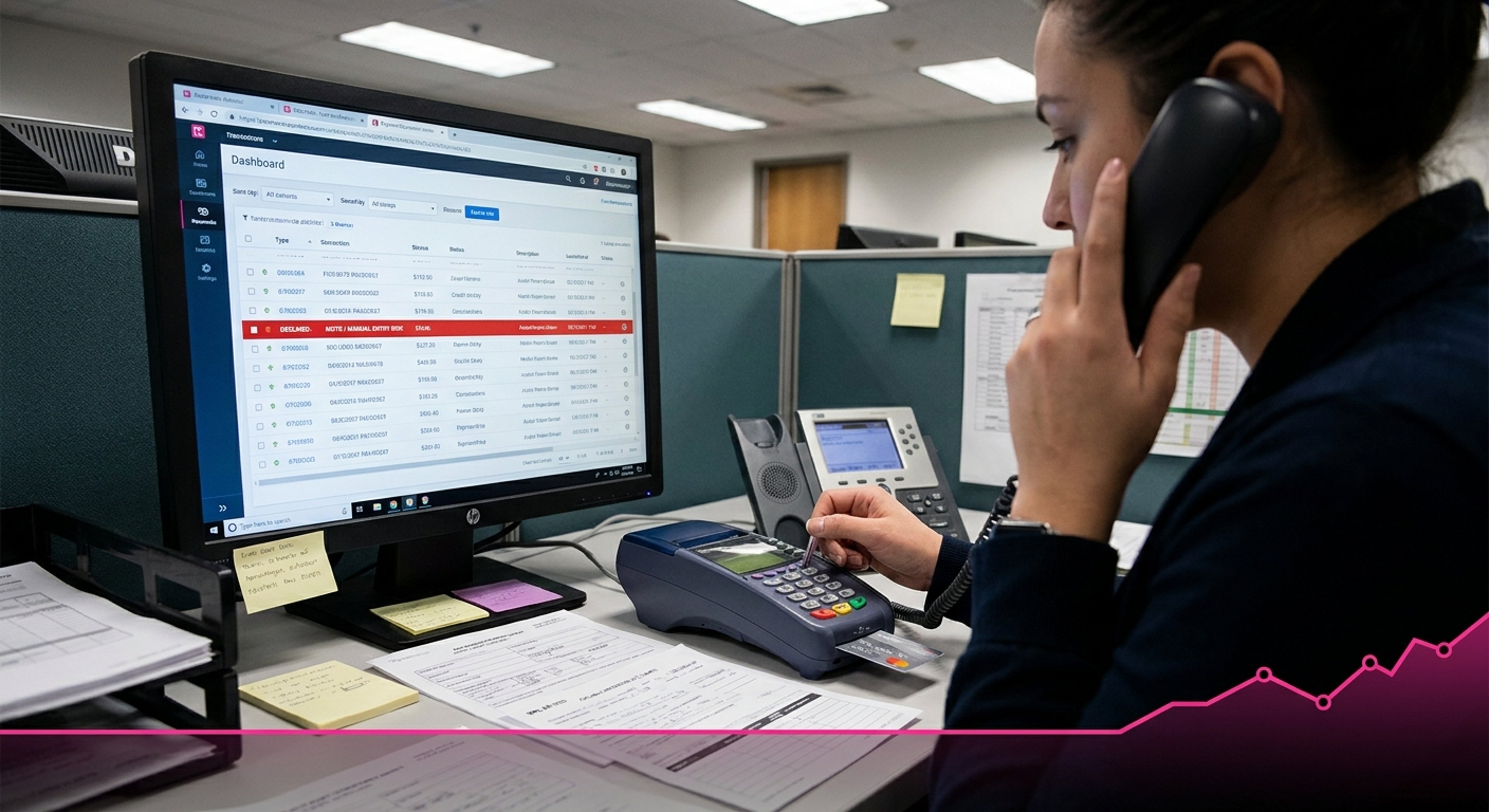

The digital economy is largely built on seamless, invisible transactions. The modern checkout experience gets most of the attention, with one-click buttons, biometric authentication, and frictionless digital wallets dominating the conversation. Yet, behind this polished veneer, a significant volume of global commerce still relies on an older, more manual method: MOTO payments. Whether it is a B2B client paying a large invoice over the phone, a specialized retailer taking a custom order, or a hospitality desk securing a reservation, these manually keyed transactions remain a resilient and necessary pillar of business.
However, accepting card details over the phone or via secure mail introduces an entirely different card-not-present risk profile. When you strip away the digital signals of an online checkout, such as IP addresses, device fingerprinting, and 3D Secure authentication, you are left with a raw exchange of data that card networks and issuing banks view with high scrutiny. Understanding the hidden mechanics of MOTO payment environments is not merely a matter of operational trivia. It is a critical requirement for payment teams, revenue leaders, and financial operators looking to protect their margins, reduce unnecessary payment issues, and keep legitimate transactions flowing smoothly.
The Unique Architecture of Manually Keyed Transactions
To understand why MOTO, or Mail Order and Telephone Order, transactions behave differently, we have to look at how payment networks categorize risk. In the payment industry, every transaction is flagged with specific indicators that tell the issuing bank exactly how the payment was captured.
When a customer taps a physical card at a terminal, the transaction is flagged as Card-Present because the physical microchip proves the card is real. When a customer buys something on a website, it is flagged as an e-commerce transaction, often accompanied by rich fraud-prevention data like behavioral analytics and location tracking.
MOTO transactions fall into a distinct category within the Card-Not-Present, or CNP, ecosystem. Through Point of Sale Entry Mode codes and Electronic Commerce Indicators, the payment gateway explicitly informs the acquiring bank, and subsequently the issuing bank, that the merchant possesses the card details but not the physical card. It also signals that the transaction did not occur over a standard digital storefront.
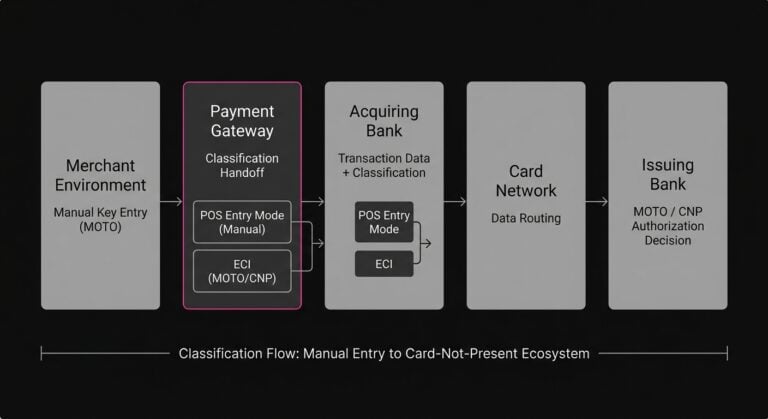
Because the issuing bank receives significantly less contextual data with a MOTO request, its risk engines must rely almost entirely on basic verification tools. These include the Primary Account Number, the expiration date, the Card Verification Value, and the Address Verification System. If any of these elements mismatch, or if the transaction velocity appears unusual for the merchant’s historical profile, the likelihood of seeing a hard decline spikes dramatically.
The Business Impact: Revenue Leaks in Plain Sight
When MOTO processing is not optimized, the financial impact extends far beyond the occasional frustrated customer. The hidden mechanics of these transactions can quietly erode a company’s bottom line in two primary ways: elevated processing costs and lost revenue from false declines.
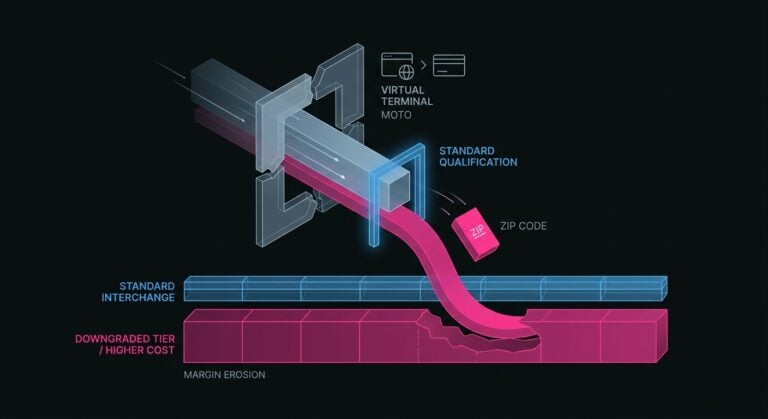
First, consider the cost of processing. Card networks like Visa and Mastercard publish complex interchange fee schedules that dictate how much a merchant pays to process a transaction. Because MOTO transactions carry a higher inherent risk of fraud and chargebacks, they are subject to higher base interchange rates than in-person payments. However, the real danger lies in interchange downgrades. If a merchant’s virtual terminal is not configured correctly, or if front-line staff skip entering the customer’s billing zip code during a telephone order, the transaction fails to meet the network’s criteria for a standard MOTO rate. As a result, the transaction is penalized and downgraded to a standard or non-qualified pricing tier, which costs significantly more. For a B2B company processing high-ticket invoices, these downgrades can represent a substantial loss in gross margin over a fiscal year. According to the Federal Reserve Bank of New York, the average credit card interchange fee accounts for 1.82% (Source) of the purchase price.
Second, there is the immediate revenue loss associated with a transaction declined at the point of entry. Unlike an online shopper who might quietly try a different card if their first one fails, a MOTO decline happens in real-time, often while the customer is on the phone. This creates an uncomfortable customer service interaction and introduces immediate operational friction. Sales representatives are forced to act as impromptu payment support agents, attempting to parse generic decline codes while the customer insists the card has sufficient funds.
Decoding the Issuer Response
To protect revenue, payment operations teams must deeply understand how issuing banks evaluate manually keyed transactions. When an issuer evaluates a MOTO authorization request, they are balancing the desire to approve their cardholder’s purchase against the liability of authorizing a fraudulent charge.
In a standard e-commerce transaction, if the CVV is missing, the transaction might still be approved if the user is logging in from a known IP address and device. In a MOTO environment, the absence of a CVV or an AVS mismatch is heavily weighted, making the issuer response far more rigid. If a sales representative accidentally transposes two numbers in the billing zip code while typing into a virtual terminal, the AVS check returns a mismatch. While the card network itself does not decline the transaction based on an AVS mismatch, many merchant payment gateways are hard-coded to reject the authorization automatically to prevent fraud.
Even if the gateway allows it through, the issuing bank’s risk engine might issue a generic “Do Not Honor” code. This code is the bane of payment professionals everywhere, as it provides no specific guidance on what went wrong. In the context of MOTO, a “Do Not Honor” code is frequently triggered by velocity limits, meaning the card has been used too many times in a short window, or because a corporate card has strict Merchant Category Code restrictions that the issuing bank feels are being circumvented by a manual entry. In France, a velocity limit applies to almost all sectors for remote card payments outside 3-D Secure.
The Human Element in Payment Failures
We cannot discuss the mechanics of MOTO without addressing the most unpredictable variable in the payment processing flow: the human element. By definition, manual entry involves human hands typing numbers into a system.
Whether it is a call center agent trying to wrap up a call quickly, or a distracted account manager taking a card number over a spotty phone connection, data entry errors are inevitable. A simple typo in the expiration date or a misheard digit in the CVV guarantees a payment failure. Furthermore, many businesses that rely on MOTO transactions suffer from poor internal protocols. Staff may write card numbers down on sticky notes before keying them into the terminal, a serious PCI compliance violation, or they may attempt to process the card days after the phone call, by which time the cardholder may have locked the card or exceeded their credit limit.

Mitigating these errors requires a combination of strict operational protocols and smart software design. Virtual terminals should be configured to validate card number length and Luhn algorithm parity in real-time, preventing staff from attempting to authorize a transaction if the card number is mathematically invalid.
Bridging Initial Orders to Ongoing Billing
A significant nuance of MOTO processing is how it bridges into recurring revenue models. Many B2B contracts, wholesale orders, and professional service retainers begin with a telephone conversation where the client agrees to the terms and reads their corporate card number over the phone for the initial deposit.
Once that first MOTO transaction is successful, the merchant typically saves the card on file for future billing. This transition from a manually keyed MOTO transaction to an automated recurring transaction is where many businesses experience subscription payment issues.
When a merchant initiates a subsequent charge using a saved card, the transaction must be flagged correctly as a Continuous Authority or Card-on-File transaction, referencing the original authorization. If the billing system incorrectly submits the recurring charge using the same MOTO indicators as the first transaction, issuing banks are likely to decline it. Issuers expect MOTO transactions to be singular, human-driven events, so if they see a rapid succession of MOTO-flagged charges hitting a card automatically every 30 days, their fraud algorithms will flag the activity as highly suspicious. Proper payment optimization requires tokenizing the card data immediately after the first successful manual entry and using network tokens for all subsequent billing cycles.
Actionable Recommendations for Payment Optimization
Protecting revenue in a manually keyed environment requires moving away from a passive acceptance of declines and adopting a proactive optimization strategy. Payment and finance teams should implement the following structural improvements:
Enforce Data Hygiene and AVS Rules: Train all customer-facing staff on the importance of capturing full billing addresses. Configure your payment gateway to require AVS fields, such as street address and zip code, for all virtual terminal transactions. While it takes an extra few seconds on the phone, capturing this data validates the transaction for the issuing bank and protects against interchange downgrades.
Audit Your Gateway Configurations: Ensure that your payment processor is passing the correct POS Entry Mode and ECI flags for MOTO. Do not route telephone orders through your standard website checkout page on behalf of the customer. E-commerce gateways expect different data inputs, like the customer’s IP address, and passing your office’s IP for hundreds of different customer orders will quickly trigger fraud filters and mass declines. Use a dedicated virtual terminal designed specifically for manual entry. For those managing online storefronts, it’s important to compare revenue and recovery platforms for ecommerce to assess tools that help recover failed transactions and optimize approval rates.
Decipher and Map Decline Codes: Stop treating all payment failures as equal. Build a mapping system that categorizes issuer responses. Distinguish between hard declines, such as a lost card or invalid account number, and soft declines, which include insufficient funds, processor timeouts, or generic risk flags. Hard declines require immediate outreach to the customer for new payment details, whereas soft declines can often be salvaged.
The Role of Intelligent Recovery and Retries
When dealing with the subsequent recurring charges that originated from a MOTO interaction, handling soft declines manually is operationally impossible at scale. If a B2B client’s card on file is declined for insufficient funds or a temporary hold, having a sales rep call them back immediately creates unnecessary friction and often leads to churn. This is where automated recovery strategies become essential to any payment stack.
For merchants managing complex billing operations, navigating these subsequent declines requires precision. This is exactly where platforms like SmartRetry provide immense value. By analyzing historical decline codes, issuer behaviors, and optimal timeframes, SmartRetry intelligently determines the best moment to retry failed payments. Instead of aggressively hitting the card network with uniform retry attempts, which can lead to higher processing fees and permanent blocks from the issuer, SmartRetry orchestrates the recovery process dynamically. This measured, data-driven approach effectively lifts the overall transaction approval rate and recovers revenue that would otherwise be lost to the void of generic decline codes, all without requiring manual intervention from a billing team. In fact, automated smart retries recover 57% (Source) of failed recurring payments.
Protecting Revenue in a Hybrid Payment World
The mechanics of payment processing are continually evolving, favoring environments where rich data can be passed seamlessly from the merchant to the bank. Yet, the reality of global commerce is that businesses must meet their customers where they are, and frequently, that means taking an order over the phone or processing an invoice manually.
MOTO transactions are not inherently flawed, but they are unforgiving. They strip away the protective layers of digital authentication, leaving merchants exposed to higher costs, stricter issuer scrutiny, and the inevitability of human error. Protecting your revenue in this environment means acknowledging these hidden mechanics and configuring your systems to account for them.
By ensuring precise gateway configurations, enforcing strict data capture protocols on the front lines, correctly mapping the transition from one-off manual entries to recurring tokens, and employing intelligent recovery strategies for failed authorizations, businesses can turn a historically leaky payment channel into a reliable, optimized revenue stream. Mastering the nuances of manually keyed transactions is no longer just a back-office processing task. It is a vital component of a resilient financial strategy.



 Find me on Linkedin