

Knowing whether your business is compliant with the Payment Card Industry Data Security Standard largely comes down to one piece of documentation: a current, signed Attestation of Compliance on file, backed by passing quarterly network scans if your environment requires them. Many merchants assume their payment service provider handles everything automatically, and that assumption is where trouble usually starts. Outsourcing card collection shifts most of the heavy lifting, but it rarely eliminates your obligations entirely. True PCI DSS compliance requires understanding exactly how cardholder data moves through your payment processing flow and verifying that your annual validation matches your current technical architecture. If you cannot point to the specific validation document you signed within the last twelve months, or if your checkout architecture has changed since then, your payment authorization pipeline may be exposed to unnecessary operational risk.
For product managers, payment operations teams, and technical stakeholders, verifying security posture is not just an exercise in checking boxes for legal teams. It sits at the foundation of your entire revenue infrastructure. How you handle card data dictates how you integrate with acquirers, how you manage stored credentials for recurring billing, and how much flexibility you have when optimizing your checkout experience.
Understanding the Fraud and Security Challenge
Before you can verify your standing, it helps to examine what the payment networks are actually trying to protect. When teams ask what is pci compliance, the functional answer is a shared defense model against data compromises across the global payment ecosystem. The threat model focuses on any point where a primary account number, expiration date, or security code is captured, transmitted, or stored.
In e-commerce, the primary attack vectors rarely involve someone breaking into a physical server room-a shift underscored by card-present fraud rates decreasing about 85 percent over the last two years while card-not-present fraud continues to rise (Source). Attackers target the edges of the payment flow instead. Browser-based skimming scripts, often referred to as Magecart attacks, inject malicious code into the checkout page through compromised third-party libraries-and Mastercard notes that cards that transacted at infected merchants are 31% more likely to report subsequent fraud (Source). API manipulation, credential stuffing against customer accounts, and misconfigured cloud storage buckets that inadvertently log raw request payloads are also common threat vectors.
The business impact of failing to secure these vectors extends far beyond the immediate cost of a data breach, even as the Merchant Risk Council reports that 3.2% of total annual eCommerce revenue is lost to payment fraud globally (Source). If an acquiring bank discovers that a merchant is out of step with pci dss standards, the financial penalties can accumulate monthly. More importantly for growth teams, a compromised environment degrades trust with issuing banks. When card networks associate a merchant identifier with a potential compromise or high fraud rates, issuers adjust their risk scoring models, and the result is an increase in generic do-not-honor responses and a steady decline in your overall transaction approval rate.
Even merchants who believe they never touch card data are affected. Every business that accepts card payments falls within the scope of these standards, regardless of transaction volume or whether a third-party gateway processes the payload.
Navigating PCI Compliance Requirements by Validation Level
To determine if your current documentation is actually valid, you have to match your operational footprint against two scales: transaction volume, which determines your level, and technical integration method, which determines your validation type.
Merchant levels from Level 1 to Level 4 are dictated by the total number of Visa, Mastercard, or other network transactions processed annually. Level 1 merchants, those processing over six million transactions per year across major networks, face the most scrutiny, while smaller volumes fall into Levels 2 through 4. For most digital businesses, though, the more practical distinction lies in the Self-Assessment Questionnaire (SAQ) types:
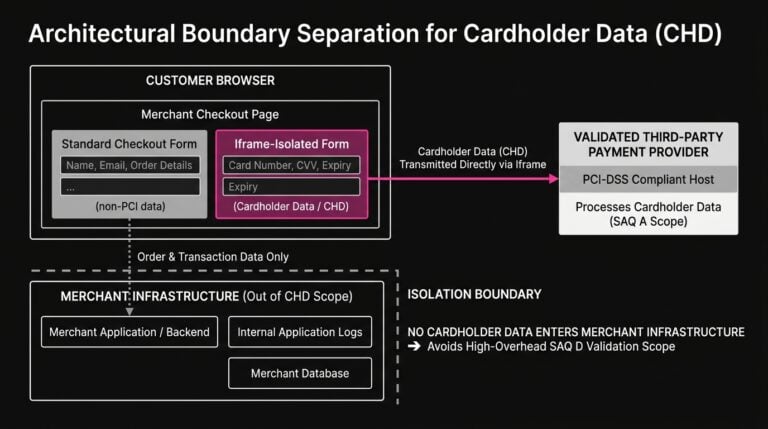
- SAQ A: Designed for card-not-present merchants who have completely outsourced all cardholder data functions to validated third-party service providers. The payment fields are delivered entirely through isolated iframes or redirects, and no card data ever touches your servers.
- SAQ A-EP: Applies to e-commerce merchants who outsource payment processing to a third party but control how the payment page or form is delivered to the consumer’s browser, such as through direct JavaScript API integrations or by hosting the checkout page elements that govern the payment redirect.
- SAQ D: The most comprehensive assessment, applying to any merchant that stores, processes, or transmits cardholder data directly on their own infrastructure, or that cannot meet the strict isolation criteria of the lighter questionnaires.
Knowing if you are compliant means verifying that your engineering team has not accidentally bumped you from SAQ A to SAQ D during a routine checkout redesign. If a developer logs full request bodies during a debugging session and those bodies contain raw card numbers, your entire logging infrastructure immediately enters scope.
Preparing for a PCI Compliance Assessment or Audit
How you prove your standing depends on where you fall in the matrix above. For most growth-stage and mid-market merchants, verifying status involves completing an internal pci compliance assessment through the appropriate SAQ, alongside quarterly vulnerability scans conducted by an Approved Scanning Vendor (ASV).
If you have scaled past the six-million-transaction threshold, or have suffered a data compromise in the past, self-assessment is no longer an option. At that stage, you must undergo a formal pci compliance audit conducted by an independent Qualified Security Assessor (QSA). The QSA will examine your network architecture diagrams, inspect your encryption key management protocols, interview engineering stakeholders, and issue a formal Report on Compliance (RoC).
To know right now if you are covered, ask your payment operations or security lead for three specific artifacts:
1.
- Passing ASV scan reports for the last four consecutive quarters (if required by your SAQ type or QSA).
- A current data flow diagram that accurately reflects how your live production checkout handles payment tokens today, not how it looked two years ago.
The Security vs. Experience Trade-off
Security standards and conversion optimization often pull product teams in opposite directions. From a pure compliance standpoint, the simplest path is to redirect the customer entirely away from your website to a hosted payment page run by your gateway. Your exposure drops to a minimum, and your paperwork stays brief.
Growth leaders rarely favor full redirects, however. Taking a customer off your domain introduces visual friction, slows page load times, and often leads customers to abandon the cart. To maintain control over the user experience, product managers prefer seamless embedded checkout flows, one-click purchasing, and multi-acquirer routing setups that require storing tokens across different providers.
This tension also plays out in how merchants handle transaction authentication and fraud prevention. Network security standards focus on protecting data at rest and in transit, but operational security also requires verifying that the person using the card is the legitimate cardholder. Tools like 3D Secure (3DS), Address Verification Service (AVS), and Card Verification Value (CVV) checks are standard defenses against fraud, and they help keep chargeback ratios below network monitoring thresholds, even in an environment where Visa observed card-not-present approval rates 6% lower than card-present approval rates in Q4 2023 (Source).
Yet applying these authentication tools with a heavy hand creates a different revenue problem: false declines, which Datos Insights projects will cost merchants US$264 billion globally by 2027 (Source). If your fraud filter rejects a transaction because a customer’s billing address slightly mismatches their shipping address, or a mandatory 3DS challenge fails to load properly on a mobile browser, a legitimate sale is lost. And when an issuer sees repeated failed authentication attempts or improperly formatted cryptograms, a card declined response on an otherwise valid card is practically inevitable. Balancing security and experience means treating compliance and authentication not as blunt walls, but as precision instruments that adapt to the risk profile of each transaction-a balance reflected in Visa data showing a 280bps increase in authorization rates with enhanced data compared to non-authenticated ecommerce across active U.S. merchants (Source).

Merchant Best Practices
Maintaining your compliance status while protecting your authorization rates requires ongoing operational hygiene. Experienced payment teams rely on several practical strategies to keep their security posture tight without degrading the customer experience.
- Isolate card capture with network tokens and iframes: Payment orchestration platforms and gateways offer hosted fields, which are individual iframes for just the card number, expiration, and CVV inputs. This lets you style the checkout page natively while keeping your environment eligible for lighter validation requirements. Pairing this with network tokenization replaces the sensitive primary account number with a non-sensitive token that works across the ecosystem, reducing the risk of storing raw credentials for subscription billing, with Checkout.com merchants using network tokens seeing a 10.3 ppt increase in approval rates in FY 2025 (Source).
Maintain an inventory of every analytics tool, marketing pixel, and chat widget loaded during checkout, and use Content Security Policies (CSP) and Subresource Integrity (SRI) checks to prevent unauthorized script behavior. - Apply dynamic risk rules and 3DS exemptions: Rather than forcing every customer through a friction-heavy authentication step, configure your fraud engine to evaluate risk contextually. For low-risk returning customers or low-value baskets, use Transaction Risk Analysis (TRA) exemptions where regional regulations permit. Trigger step-up 3DS challenges only when velocity rules, device fingerprinting, or IP anomalies indicate elevated risk.
- Monitor issuer response codes alongside security logs: Payment operations should not sit in a silo separate from security. A sudden spike in specific decline codes, such as invalid card number or security violation responses, can be the earliest sign that a botnet is using your checkout flow for card testing attacks. Velocity limits and automated bot detection on your payment endpoints protect both your infrastructure and your standing with acquiring banks.
SmartRetry’s Security-Aware Recovery
When a legitimate payment declined event occurs, how you respond to that failure is closely tied to both your compliance architecture and your risk management strategy. Blindly hammering an issuer’s endpoint with repeated authorization attempts is not only ineffective for subscription payment issues. It can also trigger network fraud alarms and violate card brand retry mandates. SmartRetry operates as an intelligent layer within this recovery process, helping merchants retry failed payments by analyzing rich transaction metadata and issuer response signals without expanding the merchant’s compliance scope. Because recovery platforms can work directly with existing gateway tokens rather than ingesting raw card numbers, teams can deploy payment optimization strategies without triggering a heavier SAQ classification. More importantly, security-aware payment recovery respects fraud and authentication signals. It automatically filters out hard declines, stolen card flags, and high-risk velocity patterns, so merchants only attempt to recover legitimate transactions, at intervals when the issuer is most likely to approve them.

Treating Compliance as an Operational Advantage
Asking how you know if you are compliant is the right starting point, but the most resilient payment teams treat that verification as a continuous operational habit rather than an annual scramble for signatures. When your tokenization strategy is clean, your checkout scripts are monitored, and your validation documents match reality, compliance stops being a bottleneck for product releases.
Instead, a well-architected security posture gives you the freedom to optimize. Once you are confident that raw cardholder data is properly isolated from your core application servers, you can experiment with multi-acquirer routing, refine your checkout design, and implement intelligent recovery workflows to reduce payment declines without putting the business at risk. Check your Attestation of Compliance, verify your integration scope with your engineering lead, and make sure your payment infrastructure is built to capture every legitimate dollar securely.



 Find me on Linkedin