

Unlocking the Black Box of Travel Virtual Card Declines
The travel industry runs on invisible money. Booking platforms send vast sums to hotels every single day, mostly behind the scenes. The primary vehicle for these transfers is the virtual credit card. It is secure, traceable, and theoretically foolproof, but in practice, things get complicated fast. A reservation is made and a digital card is generated. When the guest arrives at the property and the front desk attempts to process the payment, the system throws an error. The dreaded payment declined message flashes on the screen, creating immediate friction for everyone involved.
Understanding why virtual card declines in travel occur requires a deep dive into the mechanics of B2B payment flows. Unlike standard consumer transactions, where a user inputs their own credit card on a checkout page, travel payments involve multiple intermediaries, strict authorization controls, and a significant time delay between the moment of booking and the actual delivery of the service. When a transaction goes wrong, it is rarely a simple case of a typo. It is usually a structural clash between the rigid security rules of the payment issuer and the highly fragmented, unpredictable reality of hotel billing systems. For teams working to resolve these issues, the interplay between strict industry regulations is an essential aspect of minimizing false declines and revenue loss.
The Unique Architecture of Travel Payments
To grasp the complexity of these payment issues, it helps to look at how the funds actually move. When travelers book a room through an Online Travel Agency, often called an OTA, or a corporate travel management platform, they pay the booking platform directly. The platform then owes the hotel for that stay. To settle this debt, the OTA generates a single-use virtual credit card, or VCC. By the end of 2022, 40 percent of OTA payments to hotels were made using virtual cards (Source).
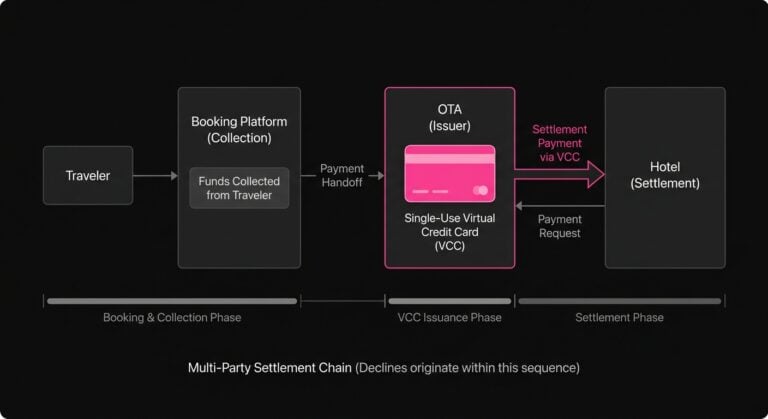
This virtual card is not a traditional line of credit, but rather a highly engineered financial instrument. The platform funds the card for the exact expected cost of the room and taxes, locks its usage to a specific merchant category, and restricts its active window to the guest’s check-in or check-out dates.
These controls are designed to prevent fraud and ensure the platform only pays for agreed-upon services. However, this exactness is a double-edged sword. A typical consumer credit card will approve a transaction as long as the account has sufficient credit and is not flagged for fraud. A travel VCC, by contrast, will trigger a card declined error if the transaction deviates from its pre-programmed parameters by even a single penny or a single minute. This hypersensitivity severely impacts the cardholder identity, turning what should be a seamless digital handover into a recurring operational headache.
Deconstructing the Causes of Payment Failures
When a hotel attempts a payment authorization and the issuer rejects it, the resulting decline code rarely tells the whole story. Payment operations teams have to look past generic codes to understand the real-world scenarios causing the friction. Several common culprits routinely disrupt the payment authorization process.
The Pre-Authorization Trap
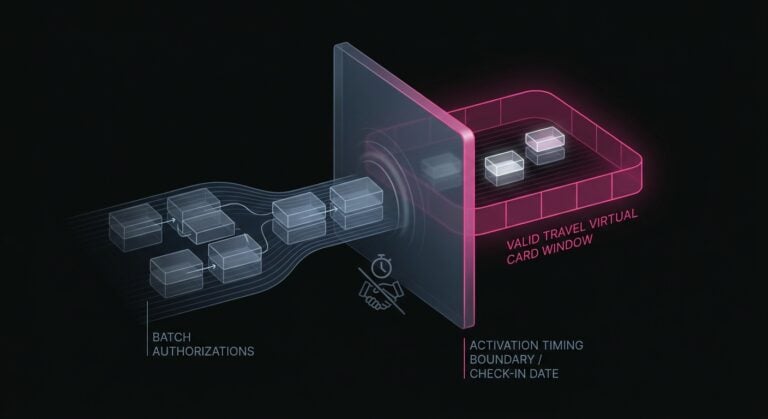
One of the most frequent reasons a transaction declined message appears is a timing mismatch. To protect themselves from no-shows, many properties run batch authorizations on incoming reservations days or even weeks before the guest is scheduled to arrive. Research indicates that 74 percent of hotels accept virtual cards (Source).
However, the OTA has intentionally locked the virtual card so it cannot be charged until the check-in date. When the hotel’s property management system pings the card early, the issuer’s systems see an unauthorized attempt outside the valid time window. The issuer responds with an immediate rejection. The hotel assumes the card is invalid, leaving the OTA’s support team to deal with an urgent escalation that was entirely preventable.
Dynamic Currency Conversion and Incidental Creep
Virtual cards are generally funded for a highly specific amount, so if a room costs a certain rate plus local taxes, the card is loaded with exactly that sum. But hospitality billing is rarely clean.
Often, the acquiring terminal at the front desk will recognize that the virtual card operates on a foreign Bank Identification Number, or BIN. The terminal software then automatically attempts to apply dynamic currency conversion, offering to charge the card in the issuer’s home currency. While intended as a convenience for consumers, this conversion applies a markup and an unfavorable exchange rate. Because the virtual card has zero tolerance for over-authorization, this slight increase in the total amount triggers an automatic decline for international transactions. Similarly, if a front desk agent accidentally includes a mandatory resort fee or a deposit for room incidentals in the authorization request, the payment will fail.
The MCC Identity Crisis
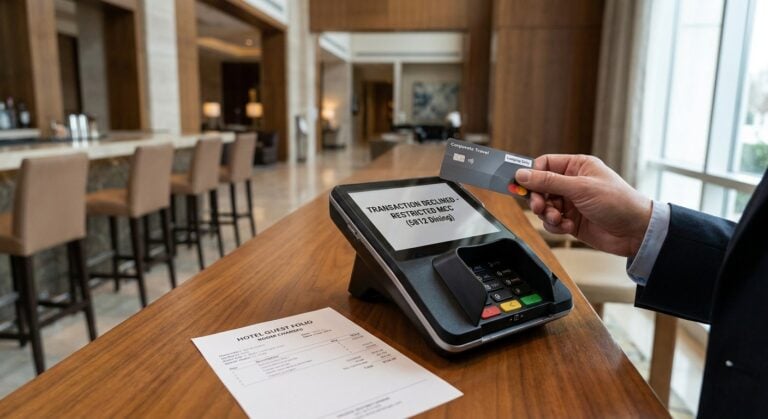
To prevent margin leakage, platforms restrict travel VCCs to specific Merchant Category Codes, or MCCs, usually limiting them strictly to lodging or hotels. But large resort properties operate multiple business units under one roof.
If the main front desk terminal is offline and the clerk decides to run the virtual card through the lobby restaurant’s terminal, the transaction will be coded for dining rather than lodging. The issuer’s rules engine instantly spots the discrepancy and halts the transaction. The resulting checkout issues are particularly frustrating because the payment is entirely legitimate, but the technical routing violates the card’s security constraints.
The Operational Cost of Disrupted Flows
When a payment fails in this environment, the fallout is immediate and costly. Without straight-through processing, where the card is securely transmitted and charged automatically without human intervention, the resolution process becomes manual.
The guest is often standing at the check-in counter, tired from travel, while the front desk agent awkwardly asks for a personal credit card to cover a room that was supposedly prepaid. Meanwhile, an automated alert is generated on the OTA’s end, prompting a customer support agent to open a ticket, review the issuer response, and determine why the card failed.
This manual intervention destroys the profitability of the booking. The margins in online travel are already thin. If a support agent has to spend twenty minutes on the phone with a hotel’s finance department to explain why an authorization failed and how to correctly process the card, the profit on that specific reservation is entirely wiped out. Scaling a travel business requires minimizing this operational bloat. Automating B2B payments with virtual cards can reduce manual work and processing costs by up to 70 percent (Source).
How Payment Teams Engineer Higher Approval Rates
Experienced payment operations teams do not view declines as an inevitable cost of doing business. Instead, they actively optimize their issuing and routing logic to reduce payment declines and build resilience into their architecture. This requires carefully balancing authorization success against the risk of financial leakage.
Calibrating Funding Buffers
To combat the exact-amount problem, many teams utilize dynamic funding buffers. Rather than funding a card to the exact penny, they might programmatically add a tiny percentage buffer to account for fluctuating local tax rates or minor currency discrepancies. This payment optimization technique absorbs the shock of slight billing variations. The trade-off is that it slightly increases the platform’s financial exposure if a hotel mistakenly charges for a small incidental, but teams often find that the reduction in manual support tickets far outweighs the cost of the buffer.
Managing Activation Windows and MCCs
Payment teams also use historical decline data to adjust their security parameters on a per-merchant basis.
Similarly, if data shows a high volume of declines due to MCC mismatches at certain resorts, the team might expand the allowed MCC list for those specific properties. By tailoring the card’s restrictions to match the known behavior of the acquiring merchants, platforms can significantly improve their overall transaction approval rate.
The Logic Behind Intelligent Payment Recovery
Even with perfect funding logic and accurately mapped merchant categories, payment failures will still occur. Network timeouts, transient gateway errors, or temporary issuer outages can ruin a perfectly valid authorization attempt. This is where a sophisticated strategy for automated payment recovery becomes essential.
Not all declines are permanent. If a transaction fails due to a temporary hold or a generic system timeout, it can often be recovered simply by attempting it again later. However, blindly retrying transactions can lead to higher processing fees and potential penalties from the card networks. Implementing smarter retry logic based on issuer decline codes means evaluating the specific issuer response, the time of the attempt, and the merchant’s profile before deciding whether to attempt the charge again. Platforms like SmartRetry specialize in this exact layer of payment optimization, automatically applying algorithmic retries to declined payment transactions. By parsing the underlying reasons for a decline, SmartRetry helps merchants recover revenue seamlessly, improving the overall transaction approval rate without requiring a human agent to intervene. Optimizing authorization through smart routing, retry logic, and fraud controls can deliver a potential increase in authorization rates of 5–10 percentage points (Source).
Contrasting Travel with Other Billing Models
To fully appreciate the difficulty of travel payments, it is helpful to compare them to other digital business models. When managing subscription payment issues in a standard Software-as-a-Service environment, businesses rely heavily on gradual dunning campaigns. If a monthly charge fails, the software simply downgrades the user’s access and sends a series of automated emails over the next few weeks, prompting the user to update their billing details.
Travel payments do not offer this luxury of time. When a hotel payment authorization fails, the guest is already at the destination. The timeframe to retry failed payments is measured in minutes, not days. This immediacy makes the payment processing flow in travel distinctly less forgiving. A failure to resolve the issue quickly doesn’t just mean a lost billing cycle. It means a ruined vacation or a disrupted business trip, leading to severe reputational damage for the booking platform.
The Path to Seamless Financial Operations
Ultimately, the goal of any travel payment team is operational invisibility. When the architecture functions correctly, nobody notices it, allowing the guest to check in smoothly, the hotel to receive its funds on time, and the booking platform to capture its margin without spending it on costly manual support interventions.
Achieving this frictionless state requires a shift from reactive troubleshooting to proactive optimization. It means moving away from simply reacting to a declined card notification and instead deeply understanding the nuances of hotel billing systems. By managing currency complexities, adjusting authorization windows, and employing intelligent systems to seamlessly recover transactions that shouldn’t have failed in the first place, payment teams can turn a fragile digital transaction into a highly resilient driver of revenue.


 Find me on Linkedin