

Configuring a Payment Gateway to Minimize Subscription Churn
Subscription churn often happens quietly, draining revenue month over month. Customers do not always leave because they dislike a product. Often, they leave because a routine payment authorization fails in the background. For operators managing subscription models, the challenge is clear: capture revenue without accidentally pushing active users out the door. The baseline settings of your payment infrastructure sit at the center of this problem, and relying on default configurations often results in lost accounts and artificial churn, with 54% of enterprise subscription businesses reporting that involuntary churn exceeds 20% of their total churn (Source). Addressing this requires moving beyond basic setups to understand the underlying mechanics of transaction processing and recovery.
Recurring billing presents a distinct set of operational realities compared to traditional retail checkouts. When a customer’s card is declined at a digital checkout counter, they are present to resolve the issue. They can simply reach into their wallet, pull out another card, and try again. In a subscription environment, the transaction is merchant-initiated, and the customer is rarely present when the renewal triggers. If the payment fails, the system must act as a proxy for the customer, determining the next best step without immediate human input.
This is where standard gateway configurations often fall short. Most gateways are designed to move funds immediately, not to serve as nuanced retention engines. When tasked with recurring billing management, a gateway out of the box will typically default to a rigid, rules-based approach to failed transactions. Understanding the limitations of this approach is the first step toward building a more resilient billing infrastructure.
Decoding the Issuer Response
To manage involuntary churn effectively, operators must look closely at the payment processing flow, specifically at the moment a transaction is denied. When a merchant submits a recurring charge, the acquiring bank routes the request through the card network to the customer’s issuing bank. The issuer evaluates the request and responds with a specific code indicating approval or decline.
The most critical distinction in this flow is separating soft vs hard declines. A hard decline indicates a permanent issue with the payment method. The issuing bank is stating that the account is closed, the card has been reported stolen, or the payment method is otherwise invalid. Retrying a hard decline is functionally useless.
A soft decline, however, indicates a temporary condition. The account may have insufficient funds, the card might be temporarily restricted due to a suspected anomaly, or there may simply be a transient network timeout somewhere in the routing chain. Soft declines represent recoverable revenue, and they are the primary battleground for retention in any subscription business, as they make up between 80% to 90% of all declines (Source).
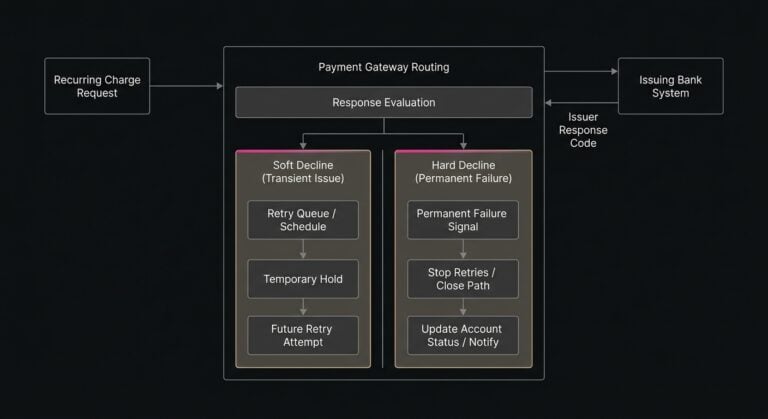
When a gateway treats all declined transactions identically, structural inefficiencies arise. If an operator configures their system to repeatedly charge a closed account, they waste processing cycles and risk triggering penalties from the card networks. On the other hand, if the system gives up after a single network timeout, the business loses a viable subscriber over a momentary technical glitch.
The Limitations of Static Dunning Workflows
To address failed payments, merchants typically rely on dunning workflows, the sequence of backend retries and customer-facing communications triggered after an initial decline. In a default setup, this workflow is often highly static. A common configuration might attempt the card on the day of the failure, try again three days later, and make a final attempt five days after that.
This time-based approach is easy to configure, but it ignores the context of the failure. An insufficient funds response on a Tuesday afternoon is unlikely to resolve itself by Thursday morning if the customer gets paid on Friday. Static schedules apply the same blunt logic to every situation, regardless of why the decline happened or how the issuing bank has behaved historically.
Static dunning workflows also tend to move too quickly to customer communication. When a system automatically sends a failure notification email after the first or second soft decline, it shifts the burden of resolution onto the customer. Asking a user to log in and update their billing information for a temporary network issue creates unnecessary friction. Worse, it turns a passive subscriber into an active decision-maker.
When forced to confront their billing details, some customers will inevitably use the opportunity to reconsider whether they still want the subscription at all. What began as a routine technical hurdle quickly turns into voluntary churn. Resolving subscription payment issues silently on the backend tends to preserve accounts far more effectively than relying on customers to fix the problem themselves.
The Cost of Inefficient Recovery
The financial impact of a poorly configured gateway extends far beyond the immediate missed payment. In recurring revenue models, the true metric of success is customer lifetime value (CLV). When an account churns involuntarily because of a mishandled soft decline, the business does not merely lose that month’s fee. It loses all the future months the customer would otherwise have stayed active, which for a recovered monthly subscription averages an additional seven months according to Stripe.
Aggressive or poorly targeted retries can also degrade the overall health of your payment infrastructure. Card networks monitor merchant behavior closely. If an issuing bank sees a merchant repeatedly submitting authorization requests for hard declines, or hammering a soft decline multiple times a day, it may begin to view that merchant’s traffic as high-risk or poorly managed.

This perception directly impacts the transaction approval rate. Issuers may start declining otherwise valid, marginal transactions simply because the merchant has a history of messy retry logic. A drop in overall approval rates compresses revenue across the entire business, affecting both new customer acquisition and existing renewals. Protecting your standing with issuers requires discipline about how and when failed transactions are re-submitted.
Transitioning to Algorithmic Retry Strategies
To mitigate these risks and capture more revenue, growth leaders and payment operations teams often move away from static rules and toward dynamic payment optimization. Rather than asking how many days to wait, algorithmic strategies ask when a specific transaction is most likely to be approved.
This shift involves analyzing historical decline data, understanding issuer patterns, and applying logic that adapts to the nature of the failure.
Platforms like SmartRetry operate directly within this optimization layer, replacing rigid gateway schedules with intelligent retry logic. By analyzing the nuances of each declined transaction, SmartRetry determines the best timing and conditions for the next attempt. This helps merchants recover lost revenue and naturally improves transaction approval rates by cutting down on blind, non-viable authorization requests sent to the networks.
With a more measured, data-informed strategy for failed transactions, operators can significantly reduce involuntary churn without manual intervention from their billing teams.
Structuring a Resilient Configuration
Building a highly optimized billing operation does not require overhauling your entire infrastructure overnight. Meaningful improvements often come from adjusting how your current systems interact and communicate. Operators looking to refine their setup should take a structured approach to gateway configurations.
First, establish clear segmentation for decline codes within your billing engine. The system should be able to categorize incoming issuer responses immediately, and hard declines must be isolated. Once a hard decline comes in, the system should halt all further automated attempts to authorize the card. In these cases, the only viable path to recovery is contacting the customer directly to secure a new payment method.
Second, map your retry cadences to logical temporal patterns rather than arbitrary countdowns. If your system allows custom scheduling, align retry attempts with common cash flow events, such as the 1st and 15th of the month, or with standard business hours when banking systems typically process batch updates.

Third, delay customer-facing friction for as long as your billing terms allow. If your service agreement includes a seven-day grace period before a subscription is suspended, use the first five days strictly for silent backend retries. Only send an email notification once backend recovery has been thoroughly exhausted and the account is genuinely at risk of suspension. This minimizes the risk of prompting a cancellation over an issue that could have resolved itself.
Monitoring the Right Operational Metrics
Optimization is an ongoing process of observation and adjustment. To understand how well your gateway configuration is working, payment operations teams must monitor the right baseline metrics.
The overall authorization rate gives a high-level view of your transaction flow’s health, but it can mask underlying issues in recurring billing. Across the industry, the average global card authorization rate is 85-90% (Source). It is often more useful to track the initial authorization rate alongside the ultimate recovery rate. The initial rate tells you how many payments succeed on the first attempt, while the recovery rate shows how effectively your dunning logic rescues the failures.
Cohort analysis is also highly valuable here. By comparing the retention of accounts that experience a soft decline with those that process cleanly, teams can identify long-term friction points. If accounts recovered through email dunning tend to churn voluntarily within the next three months, that reinforces the case for better silent, backend recovery.
Finally, keep a close watch on your retry-to-approval ratio. If it takes five retry attempts to recover a single payment, your logic is likely too aggressive and may be creating unnecessary network noise. A well-optimized system delivers a high recovery rate with relatively few retry attempts per transaction.
The Operational Takeaway
Managing subscription revenue at scale requires recognizing that a payment decline is not a definitive end state. It is an operational data point, and the way a merchant’s infrastructure responds to it determines whether a customer relationship continues or ends prematurely.
Default gateway settings provide a necessary baseline for moving money, but they are rarely equipped to handle the complex behavioral and technical realities of recurring billing. By understanding the distinctions in issuer responses, managing customer communication carefully, and moving toward smarter, data-driven retry strategies, merchants can close the quiet leak of involuntary churn.
Treating failed payments as an optimization challenge rather than an administrative burden allows payment operations teams to protect customer lifetime value, maintain high approval rates, and build a more resilient foundation for continuous revenue growth.



 Find me on Linkedin