

Fine-Tuning Stripe for Subscriptions: How to Stop Losing Customers to Failed Payments
Setting up a recurring revenue engine on Stripe is famously straightforward. Keeping that revenue from quietly leaking out through the back door is another story entirely. Subscription businesses often treat their gateway as a static utility, assuming that once the initial checkout succeeds, the recurring charges will largely take care of themselves. Yet a noticeable share of subscription cancellations does not come from unhappy customers clicking the cancel button. It comes from payment failures that happen behind the scenes, turning loyal users into lost revenue through passive, mechanical friction. In fact, involuntary churn from failed payments costs subscription businesses an average of 9% of their annual revenue (Source).
Maximizing transaction success on Stripe requires moving beyond default settings. It means treating the payment processing flow as an active, configurable layer of the product. To improve authorization rates and keep subscribers active, payment teams need to align three distinct areas: how transaction data is formatted and presented to issuing banks, how card credentials are maintained over time, and how the system responds when a transaction is declined.
When a recurring charge fails, the root cause usually sits with the issuing bank’s risk models or the state of the customer’s account at that specific hour. By tuning Stripe billing configurations, adopting modern credential standards, and applying more nuanced logic to retry failed payments, merchants can steadily reduce payment declines and protect their recurring baseline.
Why Default Stripe Billing Setups Leave Revenue on the Table
Stripe is built to serve millions of businesses right out of the box, from local bakeries to global software platforms. Because of this broad mandate, its default configurations are designed to be safe, compliant, and broadly functional across many business models. But what works as a sensible baseline for a one-time retail purchase does not always fit the specific mechanics of recurring subscriptions.
In a subscription model, the merchant and the customer have an ongoing relationship, yet the issuing bank evaluates each recurring charge as an isolated risk event unless told otherwise. When a payment authorization request travels from Stripe through the card networks to the issuer, the bank’s automated algorithms have mere milliseconds to approve or decline the charge. If the payload lacks clear context, or if the card details have grown stale since sign-up, the issuer’s risk engine may err on the side of caution and return a decline. These false declines can permanently damage customer relationships, as more than four in 10 consumers say they would never shop with a business again after a false decline (Source).
Default setups often treat all declines with a broad brush. When a card declined message comes back from the issuer, the standard response is to enter a pre-set dunning cycle: wait a few days, try again, send an email, and eventually cancel the subscription if the charge keeps failing. This approach overlooks the rich diagnostic data hidden inside the issuer response. A decline due to an expired card calls for completely different handling than one caused by temporary insufficient funds or a brief network timeout. Leave these nuances unaddressed, and the system will routinely retry unrecoverable cards while giving up too quickly on recoverable ones, or retrying them at the wrong times.
Tuning the Engine: Essential Configurations to Improve Authorization Rates
Improving the transaction approval rate starts with the data sent alongside the charge request. Issuing banks rely on metadata to separate legitimate recurring billing from fraudulent activity. If a merchant’s Stripe configuration omits key parameters, or passes them inconsistently, the issuer has less reason to trust the transaction.
Several foundational configurations within Stripe directly influence how issuing banks view and score incoming subscription charges:
- Merchant Initiated Transactions (MIT) and Stored Credential Flags: When a customer signs up for a subscription, they are present at checkout. Every subsequent renewal, however, happens while the customer is away. Passing the correct stored credential indicators tells the issuer that the cardholder previously authorized these recurring charges. Stripe handles much of this automatically when you use its native subscription objects, but businesses that build custom billing engines on top of Stripe’s core PaymentIntents API must carefully configure the
off_sessionandsetup_future_usageparameters. If a recurring charge is accidentally flagged as a customer-initiated transaction without the security code (CVV) present, the issuer is much more likely to reject it. - Statement Descriptors: Dynamic statement descriptors mainly help prevent friendly fraud and disputes after a charge succeeds, but consistency here also plays a subtle role in authorization health. Issuers track dispute ratios at the descriptor and Merchant Category Code (MCC) level. A clear, recognizable descriptor keeps dispute rates down, which protects the merchant’s standing with issuer risk algorithms over the long run. Clear descriptors are especially critical given that 29% of global consumers have disputed a recurring payment they believed was fraudulent (Source).
- Radar Rules for Recurring Charges: Fraud prevention tools are vital at the front door, where bad actors test stolen cards. Applying aggressive Stripe Radar rules to renewing subscriptions, however, can create false positives. If a long-time subscriber travels abroad or changes their billing address, an overly strict rule might block their renewal before it even reaches the card network. Payment teams often find value in separating their fraud logic: keeping tight controls on the initial checkout while relaxing velocity and location rules for verified, recurring renewals.
- Local Acquiring and Multi-Currency Routing: If a US-based subscription business charges a customer in Europe using a US merchant account, the transaction is flagged as cross-border. Issuers generally view cross-border transactions as higher risk, subjecting them to stricter scrutiny and higher interchange fees. Configuring Stripe to route transactions through local entities, or presenting prices in the customer’s local currency, removes this friction and makes the charge look like a standard domestic transaction to the issuing bank.
How Network Tokens and Account Updaters Support Involuntary Churn Prevention
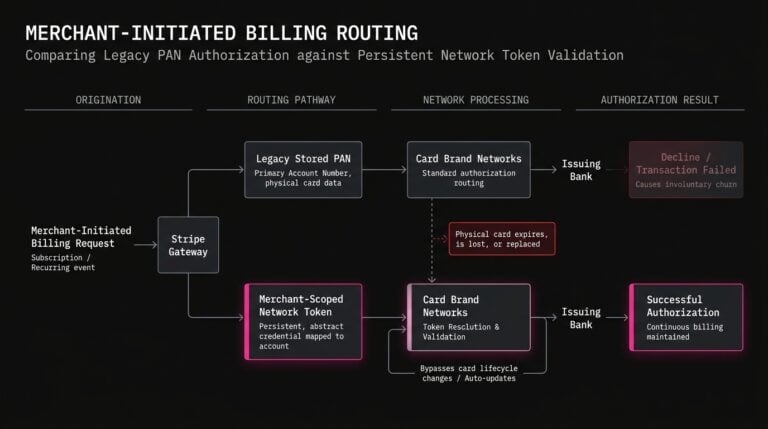
Even the cleanest transaction payload will fail if the underlying card number is no longer valid. Physical credit and debit cards are surprisingly fragile instruments for long-term relationships. They expire every few years, get lost in taxi cabs, or get replaced in bulk when a retail breach occurs somewhere in the ecosystem. In the past, any of these events meant the subscription would hit a wall on the next billing cycle, forcing the merchant to send frantic emails asking the customer to log in and update their payment method.
Modern payment processing relies on two distinct but complementary tools to keep credentials alive without bothering the customer: Card Account Updaters (CAU) and network tokens.
Stripe’s automatic card updater works by checking stored Primary Account Numbers (PANs) against databases maintained by the major card networks. When a bank issues a new card due to expiration or loss, it reports that change to the network. Stripe queries these updates in the background and swaps the old details for the new ones before the next billing cycle runs. This handles a substantial portion of routine card lifecycle changes. It does operate on batch schedules, though, so if a card is replaced just days before a billing run, the update may not have propagated yet.
A more durable shift in credential management comes from network tokens. Global penetration of network tokenisation is projected to reach 96.8% by 2031 (Source).
Network tokens offer subscription businesses two main operational advantages:
- Persistent Credentials: Because the token is linked directly to the customer’s underlying bank account at the network level, it stays valid even if the physical card is lost, stolen, or expired. There is no need to wait for a batch file update. The link remains unbroken in real time.
- Issuer Trust and Uplift: Card networks and issuing banks prefer tokenized transactions because the token itself is restricted to a specific merchant or context, making it useless if intercepted by fraudsters. To encourage adoption, issuers tend to approve tokenized transactions at a higher rate than traditional PAN-based charges, and some networks even apply slightly lower interchange rates to tokenized volume. For example, Visa credit and debit global card-not-present transactions saw a 4.3% increase in successful transactions when using network tokens over non-tokenized credentials (Source).
For teams using Stripe, enabling network tokens and making sure the account updater is active across all supported card brands is one of the most reliable ways to support involuntary churn prevention without writing a single line of retry logic.
Navigating the Grey Area: Soft Declines, Hard Declines, and Issuer Responses
Once the gateway is configured and tokens are in place, the focus shifts to what happens when a payment declined message still comes back. Payment optimization divides declines into two broad categories: hard declines and soft declines.
Hard declines represent permanent failures. Codes like stolen_card, invalid_account, or pickup_card mean the issuing bank has shut down the payment method for good. Retrying a hard decline is not only pointless but actively harmful, because card networks monitor merchant retry behavior closely. Repeatedly hammering the network with retries on a closed account triggers compliance penalties, racks up unnecessary processing fees, and signals to issuers that the merchant has poor operational hygiene. That can drag down authorization rates across the board.
Soft declines, on the other hand, are temporary roadblocks. They indicate that the card itself is valid, but something prevented the charge from clearing at that specific moment. Common examples include insufficient_funds, exceeds_withdrawal_limit, issuer_not_available, or the frustratingly vague do_not_honor.
The challenge with Stripe, and with payment gateways in general, is that the raw decline codes coming back from thousands of issuing banks worldwide are not always standardized. One bank might return do_not_honor because the customer’s paycheck hasn’t cleared yet, while another uses the exact same code because its fraud engine flagged the time of day the charge was submitted.
Treating every soft decline the same way misses how consumers and banks actually behave. A decline for insufficient funds on a debit card on a Tuesday afternoon is very unlikely to succeed if retried on Wednesday morning. But if the system waits until Friday morning, when direct deposits commonly hit checking accounts, the likelihood of a successful payment recovery goes up considerably. A decline caused by a temporary system timeout at the issuer (processing_error), by contrast, might succeed if retried just a few hours later.

Rethinking Retry Strategies: Beyond Native Automation
To handle soft declines, Stripe Billing includes a feature called Smart Retries. Instead of relying on a rigid calendar schedule, such as retrying every three days, Stripe uses machine learning models trained on aggregate network data to pick better times to retry a failed charge within a window the merchant defines. Stripe reports that automated tools like Smart Retries and card account updater help businesses recover an average of 55% of failed payments (Source).
For many growing subscription businesses, this native automation is a solid step up from manual rules. As transaction volume scales, though, payment operations teams often run into the structural trade-offs of a generalized gateway retry tool.
Stripe’s native retry logic operates within fixed boundaries. Merchants typically configure a maximum number of retries over a set duration, for instance up to four retries within a two- or three-week window. Because the model is built to serve the entire Stripe ecosystem safely, it has to balance recovery attempts against general network limits. Native retries are also tightly coupled to the subscription lifecycle within Stripe Billing. If a business uses an external subscription management platform or a custom homegrown ledger, or wants to hold off on dunning emails until specific retry conditions are met, the out-of-the-box workflow can feel restrictive.
Experienced teams looking to squeeze more performance out of their payment recovery flows usually weigh passive dunning against active, data-driven retries:
- The Dunning Trap: Sending an automated email the moment a customer’s card fails is a double-edged sword. Some customers will dutifully log in and update their card. Others will look at the email, realize they haven’t used the subscription much lately, and simply let it lapse. In effect, an aggressive dunning email can turn an involuntary payment failure into a voluntary cancellation.
- **Timing vs. The goal is not to retry more often but to make each attempt count by aligning with issuer behavior, local time zones, and regional payday cycles.
- Granular Decline Mapping: Moving beyond the basic four-to-ten-word decline codes that Stripe surfaces in the dashboard means looking at the deeper raw response codes and Merchant Advice Codes (MAC) passed by the networks.
For teams that want to push recovery further without building and maintaining their own machine learning infrastructure, specialized third-party layers can bridge the gap. SmartRetry, for example, acts as an optimization layer focused on intelligent retries of declined payment transactions. It sits alongside the gateway to analyze granular transaction data, tailor retry timing to specific issuer behaviors, and help merchants recover revenue and improve transaction approval rates without triggering customer-facing friction too early. Businesses experience an average 0.76% increase in success rates when applying recovery strategies effectively (Source). For a side-by-side view, see SmartRetry vs Stripe Smart Retries.
Measuring What Matters: The Operational Metrics of Payment Recovery
When optimizing a Stripe setup for subscription payment issues, it is easy to get lost in vanity metrics. The overall gateway approval rate on its own can be misleading, because it blends initial checkouts, one-time add-on purchases, and recurring renewals together. A viral marketing campaign that brings in lower-intent users with higher checkout decline rates can mask steady improvements in recurring billing performance.
To get a clear picture of how well optimization efforts are working, payment teams typically segment their reporting into specific operational views:
- First-Attempt Renewal Approval Rate: What share of recurring subscription charges succeed on the very first try when the billing cycle hits? This metric reflects the health of your stored credentials, your network token adoption, and the cleanliness of your MIT transaction payloads. If it is trending up, your foundational gateway configurations are doing their job.
- Recovery Rate by Decline Code: When a renewal fails on the first attempt, how often is it eventually recovered before the subscription is canceled? Breaking this down by specific decline codes (such as
insufficient_fundsvs.do_not_honor) shows whether your retry timing actually matches real-world banking patterns. - Silent Recovery vs. Customer-Assisted Recovery: Of the failed payments you recover, how many were resolved silently in the background through automated retries, and how many required the customer to click a dunning email and type in a new card? A healthier system leans heavily toward silent recovery, preserving the customer experience and keeping billing errands out of the subscriber’s inbox.
- Net Revenue Retention (NRR) Impact: Ultimately, every recovered transaction is more than a single saved invoice. It preserves the future lifetime value of that subscriber. When a payment is saved silently in month three, that customer stays on the rails for month four, five, and beyond.

Payment optimization on Stripe is rarely about finding a single hidden toggle in the dashboard that fixes everything overnight. It is an ongoing operational discipline. By making sure the right metadata reaches the issuer, letting network tokens and account updaters keep card details fresh in the background, and treating soft declines with timing that respects how banks actually process money, subscription businesses can turn their payment gateway from a passive utility into a quiet driver of retention.



 Find me on Linkedin