

How to Build a Customer Payment Center That Keeps Subscribers on Board
Most subscription companies treat their payment portal as an administrative checklist item. A customer logs in, downloads an invoice for their accounting team, or maybe clicks a button to cancel. In fact, half of Gen Z say they block payments to cancel a subscription. That approach overlooks the main value of a self-service hub. When subscription payment issues arise, a well-designed payment center acts as a direct line of defense against passive cancellations. It gives subscribers an immediate, low-friction way to act on a payment declined notice before their account lapses. Building this experience requires connecting backend payment processing logic directly to the user interface.
When a recurring charge fails, the clock starts ticking on customer retention, with failed transactions projected to cost subscription companies $129 billion in lost revenue in 2025 (Source). Many businesses rely on either automated retries or email requests alone, treating them as separate worlds. The real progress in involuntary churn reduction happens when those two paths merge. If a transaction fails for a reason no algorithm can fix, like a stolen card the bank has deactivated, the subscriber needs a clear, painless way to step in and provide fresh credentials.
Designing a customer billing portal around recovery rather than mere administration shifts the focus from static account management to active retention. It means rethinking how users authenticate, what payment methods they see, and how their actions immediately trigger the underlying billing engine.
Why Do Traditional Billing Portals Contribute to Passive Churn?
The typical billing settings page is buried four clicks deep inside an application dashboard. For an active user already logged in at their desk, finding it is mildly annoying. For a subscriber who just received a payment failure notice on their phone while waiting for coffee, that navigation maze is a wall.
When a card declined event occurs, the subscriber is usually not trying to leave the service. Their card expired, their bank flagged an unfamiliar recurring charge, or they hit a temporary credit limit. Yet the standard recovery flow treats them like an active administrator and sends an email with a generic link. The user clicks it, hits a login screen, realizes they can’t remember their password, triggers a password reset email, and promptly gives up to do something else. That is how an unintended billing hiccup turns into a lost customer, particularly since 53% of subscribers say they would likely unsubscribe if a billing or payment issue disrupted their service (Source).
From an operational perspective, this friction compounds the original billing challenge. Subscription models depend on predictable recurring revenue, and passive churn quietly erodes the base without the clear feedback signal of an active cancellation. Platforms stand to regain 1% to 2% of ARR by reducing involuntary billing churn and recovering failed payments (Source). The user did not choose a competitor. They simply bounced off a clunky form.
A recovery-focused payment center removes the administrative hurdles between the initial alert and the updated credential. It treats the billing update page with the same design discipline usually reserved for the acquisition checkout flow.
Designing Card Update Workflows That Users Actually Complete
If the goal is to get a subscriber to replace a dead payment method, the path from notification to completion needs to be as short as possible. Effective card update workflows start by removing the login wall while maintaining security.
When an automated email or SMS alerts a user to a billing problem, the link should lead directly to a dedicated recovery view within the customer billing portal. Teams often embed cryptographically signed, time-limited tokens in the URL. These magic links authenticate the user for one specific task: updating their payment method. Because this scoped session does not expose sensitive profile data, order history, or account controls, it reduces security exposure while dropping the subscriber right onto the update form.
Once the user lands on the page, several practical design choices influence whether they finish the update:
- Mobile-First Input Controls: Most dunning emails are opened on mobile devices. The payment center should trigger the numeric keypad automatically for card numbers, support native browser autofill, and allow camera scanning for physical cards.
- Alternative Payment Methods and Wallets: Typing sixteen digits on a glass screen is tedious. Offering Apple Pay, Google Pay, or local bank debit options lets the user swap a failed credit card for a funded digital wallet with a biometric tap. Wallet credentials also tend to stay current even when the underlying physical cards are replaced.
- Contextual Clarity: The interface should clearly show what failed and what happens next. Displaying the last four digits of the problem card, the exact amount due, and the service being preserved reassures the user that they are fixing an existing subscription, not accidentally buying a duplicate plan, especially given that 25% of global consumers have blocked a payment they believed was fraudulent (Source).
- Immediate Verification: Submitting the form should trigger a real-time payment authorization check or an immediate charge attempt for the past-due balance, rather than passively saving the card to a database to wait for a nightly batch job.
If the updated card also fails during that live check, the portal needs to tell the user right there on the screen. A vague system error leaves them guessing. Translating the issuer response into plain language, such as asking them to try a different card or check with their bank, keeps them engaged in solving the problem while their wallet is still open.
How to Coordinate Self-Service Portals with Failed Payment Recovery
A payment center does not exist in a vacuum. It sits at the end of an automated decision tree. When the payment processor returns a transaction declined response on a recurring charge, the merchant’s system has to decide whether to ask the customer for help or handle the issue quietly in the background.
Bothering a subscriber every time a transaction falters is counterproductive. Many payment failures are temporary: network timeouts, brief issuer outages, or insufficient funds on a Thursday before a Friday payday. Emailing a customer to ask for a new card when their current one simply needs to be retried forty-eight hours later creates unnecessary anxiety. It can even prompt them to reconsider whether they want the subscription at all, turning a solvable technical decline into a voluntary cancellation.
Smart failed payment recovery separates declines into two operational tracks based on the response codes returned by the issuing bank:
- Soft Declines: The card is valid and the account is open, but the specific transaction could not be approved at that moment. The system should hold off on alerting the user and instead rely on background payment optimization to retry failed payments when approval conditions are more favorable.
- Hard Declines: The account is closed, the card was reported lost, or the issuer permanently blocks the recurring billing token. Retrying these transactions wastes processing fees and can hurt a merchant’s standing with card networks. Here, the system should skip further retries and trigger the self-service flow immediately.
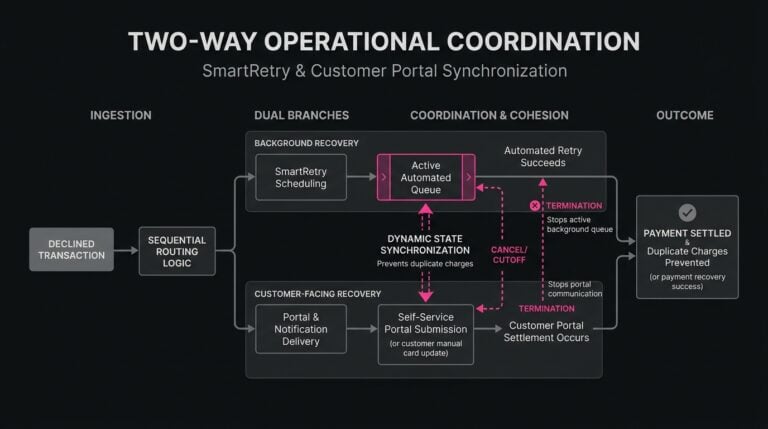
This is where a platform like SmartRetry fits into the architecture. By analyzing the granular issuer response and historical transaction patterns, SmartRetry manages the background attempts to recover revenue and improve the overall transaction approval rate on soft declines. Only when an intelligent retry sequence determines that a payment cannot be recovered automatically, or when a hard decline appears on the first attempt, does the system pass the baton to the customer communication layer and direct the user to the payment center.
Coordinating these two tracks prevents overlap. If a background retry succeeds on day three, the system must immediately cancel any scheduled emails and revoke the active magic link to the payment portal. Conversely, if a customer visits the payment center and enters a new card on day two, the automated retry queue for the old card must be terminated instantly to avoid double-charging the account.
Aligning Dunning Management with Real-Time Billing Events
Effective dunning management is less about clever email copy and more about timing and state management. The payment center acts as the landing zone for every outreach attempt, whether that outreach happens via email, SMS, or an in-app banner.
When a user with an unresolved billing issue logs into the product normally, the application itself should bridge the gap to the payment center. An in-app banner that drops the user directly into the card update modal captures their attention when they are actively trying to get value from the software or service.
Once the user updates their credentials in the portal, the system needs to handle the state transition smoothly. If the account was placed in a restricted grace-period state or temporarily paused for non-payment, a successful authorization in the payment center should restore full access within seconds via webhook notifications. Making a customer wait until the next morning’s billing run to regain access to a tool they just paid for undermines the goodwill earned by a smooth portal experience.

Architectural Details Behind a Resilient Payment Center
Beneath the user interface, the engineering team has to make several structural choices about how the payment center interacts with payment service providers (PSPs), card networks, and internal subscription ledgers.
Leveraging Network Tokens and Account Updaters Before Asking the User
The most convenient payment center visit is the one the customer never has to make. Before routing a subscriber to a self-service form for an expired card, the backend should lean on network tokenization and Card Account Updater (CAU) services.
When a merchant stores a network token rather than a static Primary Account Number (PAN), card networks can automatically push updated expiration dates and replacement card numbers to the payment vault when a bank reissues a card. If the update lands before the billing date, the charge clears and the customer never hears about it. The payment center then serves as the fallback for cases where the customer switched banks entirely or the issuing bank does not participate in real-time updater programs.
Handling Zero-Dollar Authorizations Versus Immediate Captures
When a customer enters a new payment method into the billing portal, the backend has to decide how to validate it. That decision depends on the current state of the customer’s billing cycle:
- Proactive Updates (No Balance Due): If a conscientious customer visits the portal mid-month just to swap out an expiring card, the system should run a zero-dollar (or low-value) payment authorization to verify with the issuer that the card is active and passes security checks like CVV and AVS.
- Reactive Recovery (Past-Due Balance): If the user is in the portal because a renewal charge failed, a simple verification check is only half the battle. A card might pass a zero-dollar check and still fail when the actual subscription fee is presented, due to credit limits or velocity filters. In a recovery scenario, submitting the form should trigger an immediate authorization and capture for the outstanding invoice amount.
Managing SCA and 3D Secure in the Portal
In regions governed by Strong Customer Authentication (SCA), such as Europe under PSD2, background recurring charges occasionally get rejected with a soft decline code requesting customer authentication. Automated retry engines cannot satisfy an authentication mandate on their own because the bank wants to verify the human cardholder.
A modern payment center must be wired to support 3D Secure (3DS) challenges dynamically. When the subscriber clicks through from a dunning notification to resolve the charge, the portal can initiate the transaction as a Customer-Initiated Transaction (CIT), present the bank’s biometric or one-time-passcode prompt right inside the payment center frame, and simultaneously register a fresh mandate for future Merchant-Initiated Transactions (MIT).
Measuring Whether Your Payment Center Is Actually Working
Building or overhauling a payment center takes engineering hours, so payment operations and product teams need clear metrics to evaluate its contribution to involuntary churn reduction. The top-line churn rate is too broad on its own because it blends voluntary cancellations, automated recovery, and self-service updates into a single noisy number, even though top performers like Netflix maintain monthly churn at 2% to 3% through sophisticated payment recovery models (Source).
To see how the portal performs, teams typically track a more focused set of operational indicators:
- Portal Conversion Rate on Recovery Sessions: Of the subscribers who click a dunning link and land on the payment center, what fraction successfully complete the card update workflows? A high click-through rate from emails paired with a low completion rate in the portal points to friction on the page, such as a frustrating login prompt, broken mobile styling, or limited payment options.
- First-Attempt Approval Rate on Updated Credentials: When users submit a new card in the portal, how often does the immediate settlement attempt succeed? If users keep entering cards that decline right away, the portal may benefit from offering alternative payment rails like digital wallets or direct debit.
- Share of Recovery by Channel: Tracking how much past-due revenue is recovered silently through background retries versus actively through the customer payment center helps teams calibrate their dunning management timing. If many users are updating cards within the first few hours of a soft decline, the system may be sending dunning emails too aggressively instead of letting background retry logic handle temporary bank issues first.
- Time-to-Recovery: Measuring the elapsed time between the initial failed renewal and the successful portal update helps teams refine their grace-period policies and notification schedules.
Treating the payment center as a core product surface rather than an administrative afterthought changes how a subscription business handles billing friction. Automated background retries and self-service portals are not competing strategies. They are two halves of a complete payment recovery system. When intelligent retry logic quietly handles temporary banking glitches and a frictionless portal catches the hard declines that need human help, subscribers stay active and revenue stays on the books.


 Find me on Linkedin