

Digital commerce has long treated risk control and customer experience as a zero-sum game. When merchants tighten screening to block bad actors, checkout issues multiply for good buyers. Loosen the reins to boost the transaction approval rate, and disputes climb. Gift card marketplace Raise recently showed a way out of this trap. By pairing tuned rules with custom machine learning models, the company cut its dispute rate nearly in half while eliminating almost all human transaction checks. For payment operations teams, this shift shows how modern risk orchestration directly supports broader payment optimization goals.
Understanding how a high-risk digital goods platform achieved this balance requires a close look at the mechanics of modern risk screening, the hidden operational toll of manual intervention, and the way upstream risk decisions influence downstream authorization and recovery flows. Notably, fraud transactions that exceed per-card chargeback limits account approximately 20% of digital goods fraud, leaving issuers to absorb the loss (Source).
What Just Happened
Because digital gift cards can be bought, transferred, and redeemed before a disputed payment is flagged, marketplaces like Raise face relentless pressure from bad actors using stolen credentials. As Doriel Abrahams, head of risk at Forter, previously told PYMNTS, gift cards act like digital cash. Across retail more broadly, 14% of respondents cite gift card fraud as one of their most common attack types (Source). Raise saw the same dynamic, with scammers purchasing cards, spending the balances, and initiating disputes before human reviewers could intervene.
Before the overhaul, Raise relied on in-house controls that were struggling to keep pace with sophisticated evasion tactics like IP masking, proxy routing, and location spoofing.

By refining Raise’s existing rule sets and training custom machine learning models tailored to gift card schemes, Sardine helped the marketplace evaluate combinations of behavioral and technical signals that single threshold rules missed, such as device fingerprints, typing cadence, mouse movement, proxy detection, and odd order sizes.
Why Payment Teams Should Care
At first glance, cutting disputes and analyst hours looks like a pure risk-team victory. In practice, however, payment operations, authorization rates, and dispute management are tightly linked inside the payment processing flow. What happens in the fraud engine sets the boundary conditions for everything the payments team cares.
First, there is the problem of the unmeasured metric: false declines. The Sardine case study documents clear reductions in disputes and human reviews, but it does not say whether sales rose or fewer legitimate orders were turned away. That distinction matters a great deal to payment professionals. When a merchant’s internal screening is overly rigid, legitimate transactions never even reach the payment authorization stage.
Second, the operational burden of disputes is compounding across the industry. In fact, chargebacks are set to increase 24% by 2028 (Source). Payment practitioners on LinkedIn have recently highlighted how inefficient manual dispute processes become when stretched across fragmented, multi-PSP setups. When a merchant routes volume through multiple processors to optimize costs or geographic coverage, reconciling evidence and managing queues by hand turns into a major operational drag. As Raise Risk Supervisor Dartanion Wells noted in the case study, training a single automated system once proved far more manageable than training multiple human reviewers over and.
Third, the regulatory and card network rules governing disputes are shifting underneath merchants’ feet. Visa, for example, recently rewired its card-absent dispute rules to allow multi-merchant evidence in compelling evidence submissions, though industry analyses point out that the technical plumbing often stops at the acquirer level. If acquirers cannot seamlessly ingest and pass along cross-merchant behavioral signals, merchants cannot rely solely on post-transaction representment to protect their revenue. Indeed, merchants report win rates below 20% on fraud-coded chargebacks and disputes (Source). Front-end precision, which means stopping the bad actor before the authorization request is finalized without blocking the good customer, remains the most reliable defense.

Finally, a merchant’s dispute ratio directly influences how issuing banks view its traffic. High dispute rates tarnish a merchant’s reputation score with issuers. Even if a merchant stays below official card network monitoring thresholds, issuing banks factor merchant-level historical risk into their own authorization models. These fee savings are significant in light of projections that overall merchant losses related to chargebacks will reach $46.1 billion by 2029 (Source). Over time, a cleaner traffic profile encourages a more favorable issuer response on borderline transactions.
How Chargeback Fraud Prevention Impacts Authorization Rates
Modern chargeback fraud prevention is no longer about building a higher wall at checkout. It is about signal density. Legacy systems rely on deterministic rules: if the transaction value exceeds X and the IP address does not match the billing zip code, block or flag the order. With VPN usage, remote work, and mobile roaming now widespread, deterministic rules generate excessive false positives.
Machine learning models evaluate conditional probabilities instead. Today, 47% of businesses use AI to detect and prevent fraud (Source). A model weighs a new device, a masked IP, and an unusual order size all at once, alongside biometric telemetry like typing cadence and mouse movement. A legitimate customer using a corporate VPN on a new laptop still types their name and navigates the checkout page with familiar human rhythms. A bot or a credential-stuffing script pasting stolen card numbers produces entirely different telemetry.
By separating genuine buyers from bad actors at the pre-authorization stage, merchants send cleaner traffic to the acquiring bank. When fewer compromised cards enter the payment processing flow, issuers see fewer velocity spikes and fewer subsequent fraud reports from their cardholders. This alignment between pre-auth screening and issuer risk scoring helps reduce payment declines across the board.
Recommended Actions
For merchants evaluating their own risk and payment architectures in light of Raise’s results, the takeaway is not simply to turn off human queues overnight. Abruptly removing analyst oversight without upgrading the underlying decision engine usually leads to a spike in either losses or false rejections. Instead, payment teams can take a structured, phased approach to modernizing their stack.
Evaluating Chargeback Prevention Software and Behavioral Signals
To replicate the operational efficiency seen in the Raise deployment, teams can audit their current transaction lifecycle across three time horizons:
- Immediate Audit of Queue Economics: Calculate the true cost of human review. Track not just the labor hours spent per ticket, but the approval delay, the order cancellation rate during that delay, and the percentage of reviewed orders that end in an approved sale versus a dispute.
- Short-Term Signal Enrichment: Move from static rules to composite scoring. Chargeback prevention software that ingests behavioral biometrics such as keystroke dynamics and cursor paths, along with device fingerprinting and network proxy telemetry, allows models to auto-approve strange-looking but legitimate orders. ModCloth previously told PYMNTS that its data scientists regularly audit its custom scoring models to make sure screening is not overly tight. Merchants should likewise establish a feedback loop between their risk data scientists and their payments team.
- Long-Term Multi-PSP Harmonization: Standardize how risk and dispute data flow across payment processors. Rather than managing isolated portals for each acquirer, integrate chargeback prevention tools and chargeback prevention alerts, like network pre-dispute notifications, into a unified orchestration layer. When a pre-dispute alert fires, the system should automatically refund or resolve the low-value claim to preserve the merchant’s dispute ratio, while feeding the transaction metadata back into the front-end scoring model so the same pattern is recognized next time.
Throughout this transition, payment teams should track false declines alongside dispute rates and review rates. Treating these three metrics as a single triangle prevents one team from optimizing its KPI at the expense of net revenue.
SmartRetry’s Response & Capabilities
Upstream fraud models focus on keeping bad actors out and letting good orders through without manual delays. Downstream, though, legitimate transactions still fail at the issuer level. Even after an order clears a merchant’s internal risk engine, an overly cautious issuing bank may return a payment declined message due to temporary velocity checks, insufficient funds, or generic do not honor codes.
This is where the handoff between fraud screening and transaction recovery becomes essential. Once a merchant’s behavioral and machine learning models give it high confidence that a buyer is legitimate, any subsequent card declined outcome represents pure revenue leakage. Blindly retrying a failed transaction, or worse, retrying one that failed because of actual fraud, wastes processing fees and damages merchant standing with issuers.
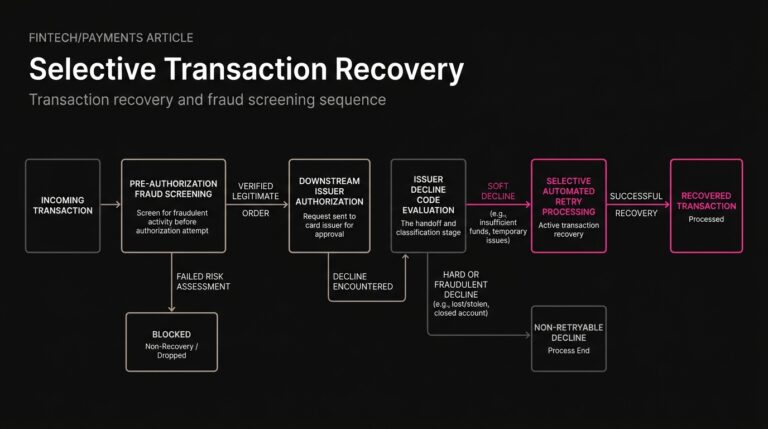
SmartRetry bridges this gap by focusing on payment optimization and intelligent retries of declined payment transactions, helping merchants recover revenue and improve their overall transaction approval rate. By analyzing the specific issuer response, card metadata, and historical network patterns, an intelligent retry engine knows when a payment failure is a temporary soft decline that can be recovered and when it is a hard decline that should be left alone. The retry engine is working with verified, high-intent customer traffic rather than battling compromised credentials. Whether handling one-off digital purchases or resolving recurring subscription payment issues, pairing clean front-end risk scoring with data-driven logic to retry failed payments ensures that good customers aren’t lost at the final hurdle.
The Bigger Picture for Payment Operations
Gift cards are one of the toughest testing grounds in payments because the product is instant, liquid, and irreversible. Shifting from manual review to machine learning-driven scoring can lower manual workloads by 25% or more across merchants, issuers, and financial institutions (Source).
For payment leaders, the lesson is structural. Risk screening, checkout friction, issuer authorization, and transaction recovery are not separate departments solving isolated payment issues. They are sequential steps in a single revenue pipeline. Removing the manual bottlenecks at the top of the funnel speeds up customer fulfillment, sharpens the accuracy of the transactions sent to issuers, and creates a clean foundation for automated recovery when legitimate payments falter.



 Find me on Linkedin