

Payment operations rarely feel more precarious than when a primary payment gateway stops settling funds into your business bank account without warning. Keeping a business running smoothly takes more than driving top-line sales. It means keeping dispute ratios safely below card network limits, maintaining a clean denominator of approved transactions, and diversifying your payment processing flow before a risk review ever starts. When teams ignore the early warning signs of rising disputes or overly aggressive retry logic, the result is often a locked reserve and a halted checkout page. Globally, industry-wide chargeback volumes are projected to reach 337 million by 2026 (Source).
The Silent Freeze: Keeping Your Payment Infrastructure Alive When Dispute Ratios Climb
The difference between a stable revenue stream and an operational crisis often comes down to how well a team understands the invisible guardrails of payment authorization and risk monitoring. Product and growth leaders naturally focus on conversion and customer acquisition, but the underlying plumbing of card payments runs on strict compliance rules. Understanding how those rules interact with day-to-day transaction volume is the most reliable way to protect a merchant from unexpected operational disruptions.
What Just Happened
Across industry forums and operator communities, including a widely discussed thread on Reddit’s smallbusiness community, founders and payment leads have been sharing contingency plans for a specific operational bottleneck: what happens when a primary payment facilitator like Stripe or Square places a hold on a business account or pauses the ability to process payments entirely. These conversations aren’t triggered by a single isolated outage but by a recurring pattern of automated risk reviews that catch growing businesses off guard.
In many of these documented scenarios, merchants experience a spike in transaction volume, a shift in seasonal purchasing, or a slight uptick in customer disputes. In fact, 83% of issuers say increasing customer awareness of the dispute process is driving rising chargeback volumes (Source). Because payment facilitators aggregate thousands of sub-merchants under a single master relationship with acquiring banks, their automated risk models are calibrated to react quickly to anomalies. When an operator’s profile crosses an internal risk boundary, the automated response is often a rolling reserve hold or a pause on payouts to checking accounts while a human underwriting team works through the queue. For businesses running on a single integration, this routine compliance check feels like an immediate operational halt.
Why Payment Teams Should Care
When payment operations teams evaluate the health of their merchant services infrastructure, the conversation usually centers on the monthly fee, the transaction fee charged per transaction, and checkout conversion. Yet the way a business connects to the card networks dictates how much operational flexibility it actually has during a dispute spike.
How a Merchant Account Differs From an Aggregator
To understand why sudden holds happen, it helps to look at the structural difference between a payment facilitator (PayFac) and a dedicated merchant account. PayFacs are built for speed and frictionless onboarding. They let a company accept credit and debit card payments in minutes by underwriting the business after transaction volume starts flowing, rather than before. Because the PayFac assumes financial liability for the sub-merchant’s transactions, its risk algorithms are conservative. If a merchant processes an unusually large batch of transactions or sees a brief flurry of customer disputes, the algorithm may freeze settlements to protect the aggregator from potential losses.

A dedicated merchant account setup with a direct merchant account provider works in reverse. Underwriting happens upfront, with financials, fulfillment timelines, and historical dispute rates reviewed before a single card transaction is processed. This requires more initial paperwork to get a merchant account, but it establishes a customized baseline for the merchant. An acquiring bank that already understands your seasonal spikes or subscription billing cycles is less likely to trigger an automated hold when those expected patterns occur.
Managing Thresholds to Avoid Sudden Freezes
Whether a company uses an aggregator or a direct merchant account, everyone answers to the card networks. Visa and Mastercard maintain strict monitoring programs, specifically the Visa Dispute Monitoring Program (VDMP) and the Mastercard Excessive Chargeback Program (ECP).
Even so, payment teams frequently miscalculate how these ratios work in practice. Three operational mechanics tend to catch teams by surprise:
- Internal buffers are lower than network limits: A payment processor does not wait until you hit the official Visa or Mastercard limit to intervene. For acquirers, Visa identifies a portfolio as Above Standard if its VAMP ratio reaches or exceeds 50bps (Source). Crossing your merchant account provider’s internal line is what triggers reserve holds, even if you are technically compliant with the card brands.
- The denominator trap: The dispute ratio is calculated by dividing the number of disputes filed in a given month by the total number of settled transactions in that same month, or the prior month, depending on the network. If a merchant slows down ad spend or pauses new sales to fix a product issue, its transaction volume drops. When that denominator shrinks while disputes from previous months continue to trickle in, the ratio spikes mathematically, pushing the merchant account over the limit even though total dispute volume is falling.
- The hidden link between failed retries and disputes: When a subscription payment receives a soft decline, growth teams naturally want to retry it to recover the revenue. But poorly calibrated retry logic can inadvertently trigger risk flags. If a system hammers an issuer with repeated authorization attempts over a short window, it raises the likelihood of hitting hard decline codes or fraud blocks. And if a customer has forgotten about an annual renewal and sees multiple failed attempts followed by a successful credit card charge, their first instinct is often to call their bank and dispute the charge rather than contact customer support. Poorly timed retries can turn a simple billing friction point into a formal chargeback.
Recommended Actions
Protecting revenue infrastructure requires a mix of defensive compliance habits and proactive routing architecture. Payment teams can insulate their merchant accounts from unexpected disruptions by focusing on three operational areas.
1. Clean Up the Upstream Triggers
The most sustainable way to stay out of monitoring programs is to prevent billing confusion before it reaches the issuing bank.
- Audit your billing descriptors: A surprising number of friendly fraud disputes happen simply because the cardholder does not recognize the legal entity name on their bank account statement. Make sure your dynamic descriptors clearly state the brand name the customer interacts with, along with a recognizable support URL or phone number.
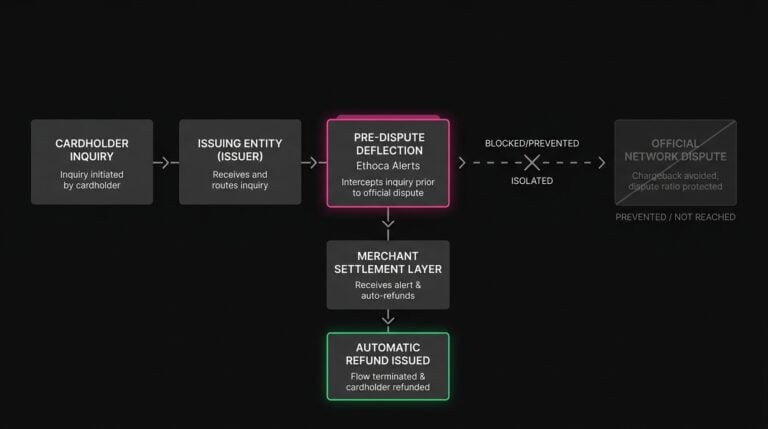
- Implement pre-dispute deflection tools: Networks offer tools like Visa’s Rapid Dispute Resolution (RDR), Verifi CDRN, and Ethoca Alerts. Between 2022 and 2023, Ethoca Alerts enabled the prevention of $1.6bn in fraud due to chargebacks (Source). These services intercept a dispute at the inquiry stage, when the cardholder calls their bank, and let the merchant automatically issue a refund before the inquiry converts into an official dispute. You still lose the transaction value and pay an alert fee, but the refunded transaction generally does not count toward your official network ratio.
- Align customer support with billing cycles: For recurring revenue businesses, sending a clear renewal reminder a few days before a large annual charge gives customers a simple one-click path to cancel or update their credit card method. Taking a voluntary churn hit is always cheaper and safer than absorbing a dispute fee and a strike against your merchant account ratio, especially as merchants incur an average of $82 in internal costs per chargeback (Source).
2. Build Redundancy Before You Need It
Waiting until a merchant account is frozen to apply for a backup payment gateway is like buying fire insurance while the kitchen is smoking. Underwriting for a secondary merchant account provider takes time, and if your primary provider has already placed you on the MATCH list (Member Alert to Control High-Risk Merchants) due to excessive disputes, securing a new acquiring bank becomes exponentially harder.
- Establish a multi-acquirer setup: Even mid-sized merchants benefit from maintaining at least two active merchant account relationships to accept card volume reliably.
- Decouple token storage from your payment gateway: If your customer credit card tokens are locked inside a single provider’s vault, a sudden termination means you cannot easily migrate your recurring billing book to a backup merchant account without asking customers to re-enter their card details. Using a processor-agnostic vault or network tokenization ensures that if one processing rail goes down, you can route those same tokens through a secondary acquirer immediately.
3. Align Retry Logic With Risk Management
Recovering revenue from a card declined at checkout or during a recurring billing cycle is critical for unit economics, but it has to be balanced against issuer signaling.
- Respect hard declines immediately: Never retry decline codes that indicate a stolen card, closed bank account, or explicitly revoked authorization. Continuing to retry these codes signals to both the issuer and your acquirer that your billing system lacks basic compliance controls, which can depress your overall transaction approval rate.
- Space out soft decline attempts: When handling payment failures caused by insufficient funds or temporary issuer timeouts, avoid rigid, rapid-fire retry schedules. Timing retries around natural liquidity events, such as standard payroll cycles, improves the odds of a clean payment authorization without irritating the cardholder or triggering velocity filters at the issuing bank.

SmartRetry’s Response & Capabilities
Navigating the tension between aggressive revenue recovery and conservative compliance management is exactly where intelligent payment optimization becomes an operational safeguard. SmartRetry is designed to help payment teams recover revenue from declined transactions while respecting the guardrails set by issuers and acquirers. Rather than relying on static rules that blindly hammer a card until it either approves or triggers a fraud block, SmartRetry analyzes the specific issuer response, historical transaction patterns, and card network rules to determine whether a transaction should be retried at all, and when it is most likely to clear cleanly. By filtering out unrecoverable hard declines and pacing soft decline attempts to match genuine cardholder liquidity patterns, the platform helps merchants improve their transaction approval rate and maintain a healthy volume denominator across every merchant account. That reduces the operational friction and customer confusion that often lead to downstream disputes.
Building for Long-Term Stability
The recent wave of community discussions around gateway holds is a healthy reminder that a merchant account is a form of short-term credit extended by acquiring banks. As transaction volumes scale, treating your payment stack as a static utility becomes a liability. The most resilient payment teams treat dispute ratios, authorization rates, and retry cadences as a single interconnected system. By pairing transparent customer communication and multi-processor redundancy with disciplined, data-driven retry strategies, merchants can capture revenue left on the table while keeping their merchant account risk profiles comfortably out of the spotlight.



 Find me on Linkedin