

When payment operations teams evaluate bank integration platforms, one question comes up often: does Numeral offer load balancing for payment requests? The short answer is no, at least not in the way card payment engineers typically think of traffic distribution. Numeral operates as a bank orchestration and API aggregation layer that connects businesses directly to partner banks for account-to-account transfers over rails such as SEPA, BACS, and wire. While it handles API rate limiting, queuing, and multi-bank routing rules, it does not function as a dynamic load balancer for real-time card payment authorization traffic. Understanding this distinction helps architecture teams avoid designing their payment processing flow around capabilities that belong to a different layer of the financial stack.
The confusion is understandable. Across fintech infrastructure, cloud computing terms like load balancing, failover, and high availability regularly overlap with transaction routing. But distributing web traffic across identical stateless servers is fundamentally different from distributing financial transactions across distinct banking institutions or payment processors. When a transaction is declined or a bank API times out, the underlying cause is rarely a simple server overload that can be solved by shifting the next request to a neighboring node. It usually involves liquidity constraints, cut-off windows, regulatory checks, and institution-specific risk parameters.
To build resilient infrastructure that supports payment optimization, technical stakeholders and product leaders need to separate bank connectivity from transaction orchestration. By examining how bank API platforms process instructions alongside how card networks handle authorization traffic, teams can see where load distribution fits, where it breaks down, and how intelligent retry logic bridges the gap when transactions fail.
How Numeral and Load Balancing for Payment Requests Work
To understand why traditional load balancing does not directly apply to a bank connectivity platform, it helps to compare the technical flow of bank rails with that of card rails. When a platform like Numeral sits between a business and its banking partners, it acts as a translator and courier for account-to-account operations.
The technical sequence involves four main actors: the merchant or fintech platform, the bank orchestration layer, the sponsoring or partner bank, and the central clearing system, such as the Single Euro Payments Area network or Faster Payments.
-
Initiation and Normalization: The merchant’s system generates an instruction, such as a payout to a vendor or a direct debit collection from a customer, and sends a single JSON payload to the orchestration API.
-
Queuing and Pacing: Banks enforce strict rate limits on incoming transmissions. If a platform submits a batch of thousands of transfers at once, the orchestration layer holds them in a queue and paces delivery so the receiving bank’s gateway does not reject the connection.
-
Clearing and Asynchronous Updates: Once the bank accepts the file or API call, it runs its internal ledger checks and forwards the instruction to the clearing house. Status updates, whether the transfer settled, bounced, or was flagged for compliance, return asynchronously via webhooks or return files hours or even days later.
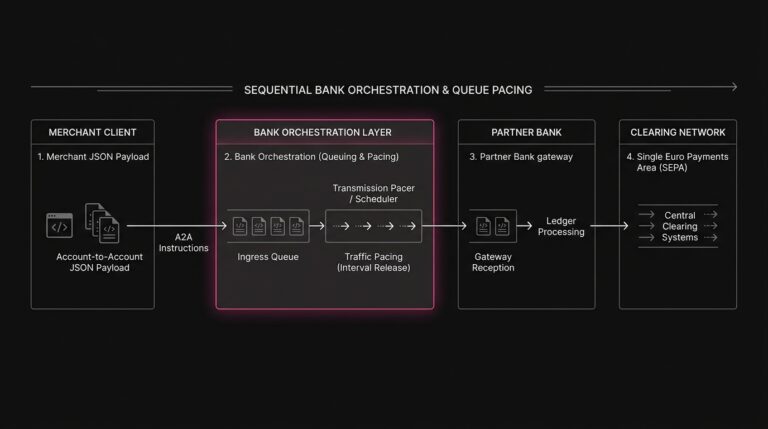
Notice the timing and state constraints in this sequence. In a standard card payment authorization, the customer is waiting at a checkout screen, and the round trip from the merchant to the acquirer, across the card network, to the issuer, and back takes a couple of seconds. Bank transfers, by contrast, are frequently asynchronous and tied to specific bank accounts where the merchant holds funds.
You cannot freely apply round-robin load balancing across two different partner banks unless the merchant maintains prefunded treasury balances at both institutions and does not care which account gets debited. Even when a business uses multiple banks for redundancy, shifting volume between them is a deliberate treasury and routing decision based on currency corridors, per-transaction fees, or clearing speeds, not an automated distribution of server load.
Failure Points & Optimization in Multi-Provider Routing
When payment teams ask whether a provider can offer automated traffic distribution, they are usually trying to solve a familiar set of operational headaches: downtime, latency spikes, and unexpected payment failures. Both bank rails and card rails suffer from these friction points, though they show up differently depending on the architecture.
Where Transactions Stall in the Pipeline
In any multi-provider payment environment, transactions encounter friction at three junctions: the technical gateway, the processing institution’s risk engine, and the end customer’s bank.
- Gateway Timeouts and Rate Limits: During high-volume events, such as payroll runs for bank transfers or flash sales for card checkouts, the receiving institution’s API may throttle incoming calls. If the sending system lacks an internal queue with exponential backoff, these calls end in HTTP errors or dropped connections before the financial data is even read.
- Maintenance Windows and Cut-Off Times: Legacy banking cores regularly go offline for scheduled batch processing or weekend upgrades. In the card world, acquirer endpoints occasionally experience degraded performance or regional routing hiccups. Sending traffic blindly into a degraded endpoint turns healthy customer demand into checkout issues.
- False Declines and Risk Mismatches: Even when the technical pipes are completely clear, the receiving institution may reject the transaction. On bank rails, this might be due to a strict formatting mismatch or an unverified beneficiary account. On card rails, an acquirer or issuer might decline the request because of velocity checks, cross-border routing penalties, or conservative fraud filters.
The Trap of Naive Load Distribution
When engineering teams build their own routing layers to handle these bottlenecks, a common mistake is treating payment endpoints like interchangeable cloud servers. A team that splits card traffic evenly between Acquirer A and Acquirer B to balance the load often ends up hurting its transaction approval rate.
Why does this happen? Payment processors and issuing banks rely on historical data patterns to assess risk. If a customer’s recurring subscription payment has gone through Acquirer A for six months, the issuing bank recognizes that specific merchant ID and acquirer fingerprint. If a naive load balancer suddenly shifts the seventh month’s billing request to Acquirer B just to even out volume, the issuer sees an unfamiliar routing path and is more likely to return a soft decline.
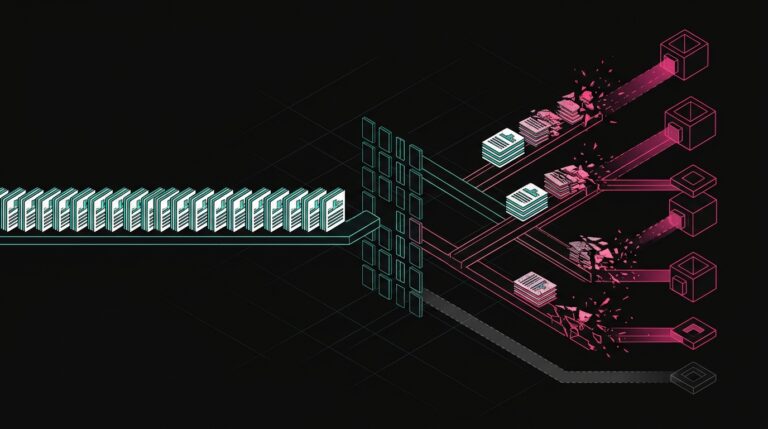
Real optimization in payment routing is not about spreading requests evenly. It is about matching each transaction to the path with the lowest latency, lowest cost, and highest probability of acceptance. For bank transfers, this means routing domestic euros through a local SEPA Instant partner while sending cross-border pounds through a UK-native sponsor bank. For card transactions, it means pinning domestic cards to local acquiring entities to preserve domestic interchange rates and familiar risk signals, and reserving secondary processors for targeted failover or specific decline recovery scenarios.
SmartRetry’s Role in Payment Request Optimization
While bank API platforms manage the queuing and formatting of account-to-account instructions, recovering lost revenue from declined card transactions requires a specialized intelligence layer. When a card is declined during a live checkout or a recurring billing cycle, simply rerouting the same payload to another processor through a basic load balancer rarely fixes the underlying issue and can trigger network penalty fees for excessive retries.
This is where an optimization layer fits into the architecture. Instead of treating every transaction failure as an infrastructure outage, SmartRetry functions as a platform focused on payment optimization and intelligent retries of declined payment transactions, helping merchants recover revenue and improve transaction approval rates. Rather than blindly distributing initial requests, it analyzes the issuer response code, card metadata, and historical network telemetry after a soft decline occurs. With retry logic placed directly in the post-decline workflow, the system decides between two paths. It can trigger an immediate cascade to a backup acquirer with modified payload attributes, such as adjusted dynamic descriptors or stripped exemption flags, or it can hold the transaction and retry days later when the cardholder’s account conditions are more likely to support approval.

Separating initial traffic routing from post-decline recovery keeps the primary payment processing flow clean and predictable. The primary orchestration or gateway layer handles baseline routing rules, like sending European cards to a European acquirer, while the intelligent retry engine steps in only when an issuer rejects a valid transaction, turning potential churn into structured payment recovery.
Implementation & Monitoring Guide for Payment Teams
Whether your team is configuring bank transfer workflows through an API aggregator or managing multi-acquirer card infrastructure, a resilient setup depends on deliberate rule design and continuous observability. Routing and failover logic without proper guardrails can easily create duplicate charges, reconciliation mismatches, or unexpected processing fees.
Technical Setup Best Practices
When designing a system that routes requests across multiple banking partners or payment processors, engineering and operations teams should anchor their architecture around four core practices:
- Strict Idempotency Enforcement: Before implementing any automated failover or queuing mechanism, make sure every payment instruction carries a unique idempotency key that persists across retries. If a network timeout occurs, the system must verify whether the first institution actually ingested the transaction before cascading the request to a backup provider.
- State-Aware Routing Rules: Replace static percentage splits with attribute-based routing that considers currency, card BIN country, payment method type, and transaction value. If you use multiple providers for redundancy, send enough baseline volume through the secondary provider to keep the merchant account warm and the API credentials validated, rather than leaving it dormant until an outage strikes.
- Circuit Breakers for Degraded Endpoints: Implement automated circuit breakers that monitor HTTP response codes and latency from your downstream providers. If an acquirer or bank API starts returning consecutive system errors or timeouts beyond your threshold, the circuit breaker should temporarily halt traffic to that endpoint. Asynchronous requests can wait in a queue until the connection stabilizes, while live checkout traffic is diverted to a pre-configured backup.
- Segregated Retry Paths for Subscriptions: Handle subscription payment issues differently from customer-present checkouts. When a customer is actively looking at a checkout page, failover must happen in milliseconds using a secondary route. When a recurring billing job fails in the background, the system has the luxury of time and should pass the decline to an asynchronous retry engine instead of hammering a backup gateway right away.
Key Metrics and Alerting to Track
Once your routing and recovery workflows are live, monitoring basic uptime is not enough. An API can return a healthy HTTP status code while rejecting most of the financial transactions inside the payload. Payment operations teams should build dashboards and automated alerts around the following indicators:
- Authorization and Acceptance Rate by Route: Track approval rates segmented by processor, card brand, and issuing country. A sudden drop on a specific route often points to a localized issuer block or a broken formatting parameter long before the provider posts an official status page update.
- Latency Percentiles (P95 and P99): Monitor the tail latency of your payment requests. In synchronous card flows, creeping latency at the ninety-ninth percentile usually precedes a full gateway timeout and directly correlates with abandoned carts.
- Queue Depth and Webhook Lag: For asynchronous bank rails, monitor how many instructions are sitting in rate-limit queues and measure the delay between payment initiation and webhook confirmation. Growing lag means your volume is outpacing your bank partner’s ingestion capacity.
- Net Recovery Rate vs. Retry Cost: When evaluating retry strategies, measure the net revenue recovered after subtracting card network retry fees and gateway transaction costs. Effective optimization increases net settled revenue while keeping the ratio of retry attempts per recovered transaction low.
Ultimately, asking how to balance the load of payment traffic is the starting point for a much more valuable architectural conversation. Financial rails are not uniform pipes. They are complex networks of risk engines, regulatory checks, and legacy ledgers. By using bank orchestration tools to standardize and pace account-to-account transfers, and pairing multi-acquirer card setups with data-driven retry intelligence, payment teams can stop worrying about raw server distribution and focus on what actually matters: getting legitimate transactions approved on the first or second try.



 Find me on Linkedin