

Why Payment Tests Pass in Staging and Fail in Production
Testing a payment flow sounds deceptively straightforward on paper. You grab a dummy card number from your provider’s documentation, type it into a staging checkout page, and watch the green checkmark appear. Yet experienced engineering and payment operations teams know that a passing test in a sandbox tells you almost nothing about how that same code will behave in the wild. Real-world payment authorization is not a clean binary check. It is a messy, probabilistic negotiation between gateways, card networks, and issuing banks. To truly validate a payment system, teams need to look past happy-path connectivity and test for asynchronous state drift, ambiguous issuer responses, and the downstream mechanics of transaction recovery.
When a merchant’s checkout or billing engine only validates that a basic request formats properly, subtle bugs inevitably slip into production. These overlooked edge cases rarely cause a loud, system-wide outage that pages an engineer at midnight. Instead, they create silent revenue leaks: duplicate charges when webhooks arrive late, dropped renewals when a card is declined for a temporary reason, or cascading payment failures when a backup processor rejects a misconfigured payload. Building a resilient testing strategy means shifting focus from whether the checkout button works to how the entire system behaves when the financial networks push back.
The Sandbox Illusion: What Are You Actually Testing?
Every payment service provider offers a sandbox environment stocked with magic numbers. Enter one specific sixteen-digit string and you get an instant approval. Enter another and you trigger an insufficient funds response. These environments are essential for verifying that your application’s fields map to the right API parameters and that your database records the basic response payload. However, treating a sandbox pass as proof of production readiness is one of the most common pitfalls in fintech and e-commerce.
A sandbox is a deterministic state machine: send input A and you get output B, usually within a few dozen milliseconds. Live payment processing is neither deterministic nor predictable. In production, your request travels from your server to a payment gateway, through an acquirer, across card network rails like Visa or Mastercard, and finally into the fraud and risk engines of an issuing bank, where the average global card authorization rate sits between 85% and 90% (Source). Each of those hops introduces its own latency, formatting quirks, and risk tolerances.
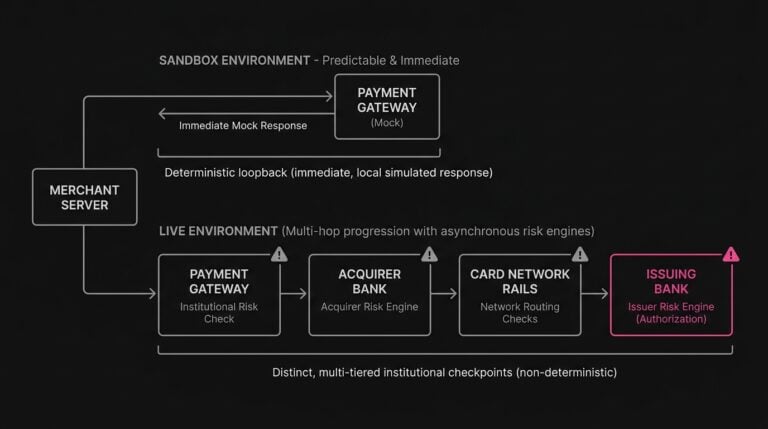
Sandboxes rarely reflect the fact that two issuing banks can interpret the exact same transaction metadata in completely different ways. One issuer might approve a recurring subscription charge without a postal code, while another rejects it instantly. Sandboxes also almost never replicate the erratic timing of real-world network congestion. An engineering team might build a checkout interface assuming every authorization request resolves quickly. Then, during a peak holiday sale, a regional issuer takes several seconds to respond, the merchant’s own frontend times out, and a customer whose card was actually just charged sees an error.
5 Layers of the Payment Processing Flow That Break Under Pressure
To move beyond basic functional checks, product and technical teams need to break the transaction lifecycle into distinct operational layers. When payment issues surface in production, they usually stem from an untested interaction between these specific boundaries.
1. Payload Hygiene and Metadata Survival
Modern transactions carry a heavy load of metadata. Beyond the card number and expiration date, a request might include 3D Secure authentication tokens, network transaction IDs for stored credentials, level-2 or level-3 purchasing data, and custom fraud signals. Failures commonly appear when a merchant adds a new payment method, updates their checkout SDK, or routes transactions through multiple acquirers.
Testing here means verifying that critical flags actually survive the journey to the acquirer, such as the indicator telling an issuer that a charge is a merchant-initiated recurring bill rather than a customer-present purchase. Once real issuers evaluate those requests, the transaction approval rate will suffer, especially given that the card-not-present authorization approval rate averages 81% for surveyed merchants (Source).
2. Asynchronous Webhooks and Race Conditions
Synchronous responses, meaning what happens right after the customer clicks pay, are only half the story. Much of the heavy lifting in payments happens asynchronously via webhooks. A customer might get redirected to their bank’s app to approve a transaction, closing their browser tab before returning to the merchant’s site. The merchant’s system only learns the outcome when the payment provider sends a webhook moments, or sometimes hours, later.
What happens when the webhook arrives before the synchronous API response finishes processing? If your system is not tested for race conditions, both processes might try to provision the user’s account or update the order status simultaneously, leading to duplicate fulfillment or corrupted database states. Effective test suites deliberately delay synchronous responses or fire duplicate, out-of-order webhooks in staging to confirm that the system’s idempotency keys and database locks hold up as intended.

3. The Ambiguity of the Issuer Response
In a sandbox, a decline is clean and specific. In production, issuer responses are often vague, overloaded, or misleading. Issuers have hundreds of internal reasons to reject a charge, ranging from suspected account takeover to a simple daily spending limit, yet they frequently map the vast majority of these scenarios to the generic “05 – Do Not Honor” code, which can account for 10% to 60% of declined payments (Source).
Good decline-handling tests don’t assume that every error code tells the literal truth. Product teams need to test how their application categorizes and reacts to different clusters of decline codes. If a test suite only checks that a card declined message shows up on the screen, it misses the operational logic underneath. Did the system properly distinguish between hard and soft declines—like a stolen card where you must never try again, versus a temporary system error at the bank where a later attempt makes sense?
4. Multi-Processor Routing and Failover Mechanics
Many mid-market and enterprise merchants use multiple payment processors to optimize costs, support local payment methods, or maintain uptime if a primary provider experiences an outage. Testing failover logic is notoriously tricky because it requires simulating partial degradation rather than a clean break.
More often, requests just hang until the connection times out. If a merchant’s failover test only simulates an instant error code, the team will be caught off guard when real-world timeouts tie up their server threads and prevent the backup processor from ever being called. Worse, if a request times out after the primary processor actually sent the charge to the card network, an untested failover rule might immediately send the same charge to a secondary processor, double-billing the customer.
5. Lifecycle Events: Captures, Refunds, and Partial States
A payment is not finished when the authorization succeeds. For merchants shipping physical goods or offering usage-based services, the gap between authorization and capture is fertile ground for bugs. Test matrices need to cover partial captures, multiple captures against a single authorization, and refunds triggered while a transaction is still waiting to settle.
Why Testing How You Retry Failed Payments Is Harder Than It Looks
For businesses relying on recurring revenue or high-volume transactions, the initial checkout is only the opening act. When a subscription renewal hits a snag, the automated logic designed to retry failed payments takes. Testing this dunning and recovery engine requires a completely different mindset because the primary variable is time.
In a development environment, nobody wants to wait seven days to see if a scheduled retry job executes properly. Engineers typically compress time in their test scripts, setting retry intervals to seconds instead of days. That confirms the cron job or queue worker runs, but it misses the business logic of payment recovery entirely.
In the real world, recovery workflows are bound by external rules imposed by the card networks. Visa and Mastercard maintain strict limits on how many times a merchant can re-attempt a declined transaction within a rolling window, and they prohibit retrying certain hard decline codes outright. If an engineering team deploys an untested change to their billing loop, such as a bug that retries a Closed Account decline every hour, the sandbox will happily process those dummy requests without complaint. In production, that same bug will quickly rack up network compliance fines and damage the merchant’s standing with acquiring banks, potentially lowering baseline approval rates across the board.

Testing recovery flows requires validating the decision tree itself. Before a retry is ever fired, the test suite should confirm that the system looks at the specific decline reason, counts previous attempts within the current billing cycle, and checks whether the customer has updated their payment details in the meantime.
This is where the distinction between static rules and dynamic payment optimization becomes apparent. Writing and maintaining tests for static retry schedules is tedious enough-especially since static controls block up to 10% of legitimate customers in some cases (Source)-as teams try to simulate how different customer cohorts respond to fixed three-day or five-day billing intervals. Many teams eventually realize that hardcoding and testing their own recovery heuristics is a losing battle against shifting issuer behaviors. Platforms like SmartRetry address this layer of the stack by taking over the intelligent retries of declined payment transactions. They evaluate transaction context and historical issuer patterns dynamically, so merchants can recover revenue and improve transaction approval rates without constantly rewriting and testing brittle internal scheduling logic.
Practical Methods for Production-Grade Payment Validation
Because sandboxes have inherent blind spots, seasoned payment teams extend their testing strategies into controlled production environments and build simulation layers that mimic the messiness of live financial networks.
- Build a chaos proxy for your staging environment: Instead of connecting your staging application directly to a payment provider’s clean sandbox, route the traffic through an internal proxy or mock server under your control. Configure this layer to randomly inject two-second latencies, drop connections mid-flight, return malformed JSON, or fire webhook notifications before the synchronous HTTP call completes. This forces your application code to prove its resilience against network anomalies before it ever touches a real dollar.
- Run structured live-card smoke tests in production: When rolling out a major checkout overhaul or onboarding a new acquiring bank, synthetic testing alone is not enough. Experienced payment ops teams maintain a dedicated inventory of live corporate cards, debit cards across different issuing banks, and digital wallets. They run scripted, low-value transactions in production, often behind feature flags or on hidden storefronts wired to live processing, and follow each transaction all the way through authorization, capture, settlement on the merchant statement, and refund.
- Use shadow routing for new optimization logic: When introducing a new fraud filter, routing rule, or recovery model, evaluate it in shadow mode first. Let the live transaction flow through your existing, proven pipeline, while asynchronously sending a copy of the transaction payload to the new decision engine to log what it would have done. This allows product managers and analysts to spot logic flaws using real production data and live issuer responses without risking a single customer checkout.
- Implement continuous canary monitoring on decline codes: Some payment issues cannot be caught prior to deployment because they are triggered by external changes, such as an issuing bank updating its fraud rules on a Tuesday morning or a regional acquirer suffering a localized outage. Treat production metrics as a continuous, live test. Instead of just monitoring whether your servers are up, set automated alerts on sudden shifts in the ratio of specific decline codes, drops in authorization rates for specific card brands, or spikes in checkout latency.
Shifting from “Does It Work?” to “How Does It Fail?”
The difference between an amateur payment integration and an institutional-grade revenue engine comes down to how the team views failure. If you treat a payment declined message or a network timeout as an exceptional edge case, your testing will naturally gravitate toward proving that the system works when everything goes right.
In the real world of global commerce, things go wrong on a noticeable share of transactions every single day, with issuers declining one in every 10 ecommerce dollars during authorization for the average merchant (Source). Cards expire, banks tighten risk thresholds without warning, mobile networks drop packets while a shopper is standing in an elevator, and processors experience brief hiccups. A mature testing strategy accepts this friction as the baseline reality of doing business. By designing test suites that intentionally provoke timeouts, scrutinize webhook ordering, respect network retry rules, and monitor live issuer behavior, teams turn their payment infrastructure from a fragile pipe into a defensive asset, one that quietly protects revenue when the unexpected inevitably happens.



 Find me on Linkedin