

The Balancing Act: How 3D Secure Affects Card Authorization Rates
Every time a customer hits the buy button for an online transaction, a complex risk assessment occurs in milliseconds. 3D Secure (3DS) changes the variables in that assessment. Originally designed strictly as a fraud prevention measure, 3DS has evolved into a central lever for payment optimization. For payment operations teams, the core question is no longer just about stopping bad actors. It is about understanding how adding an authentication step influences the final card authorization rate. Issuers view authenticated traffic differently. When a cardholder’s identity is verified before the authorization request is sent, the underlying risk profile of the card transaction shifts. This generally encourages issuers to approve more transactions, but the extra step also introduces a potential point of friction for the buyer.
The true impact of 3DS on your overall approval metrics depends on how you balance the issuer’s desire for security data with the customer’s need for a seamless checkout. Modern payment stacks allow merchants to apply this authentication method dynamically. To maintain steady revenue, you need to understand when to use 3DS, how issuers interpret 3DS data, how liability shifts influence their decision engines, and how to recover from inevitable payment issues.
The Changing Dynamics of the Payment Processing Flow
In a standard, non-authenticated transaction, the issuer has limited data to decide whether to approve or decline the request. They rely on basic card details like the credit or debit card number, the transaction amount, and the merchant category code. Because the issuer carries the financial liability for fraudulent authorizations in a standard flow, their risk models are naturally conservative. This caution leads to a certain volume of payment failures, even for legitimate customers whose purchasing behavior simply looks slightly unusual to an automated algorithm.
Introducing 3D Secure authentication into the payment processing flow alters this dynamic, primarily through the liability shift. When the cardholder successfully authenticates a transaction, the financial responsibility for fraud-related chargebacks shifts from the merchant to the card issuer. Since the issuer is now on the hook, you might expect them to decline more transactions to protect themselves.

In practice, the opposite usually happens. The authentication process gives the issuer rich data for identity verification. Once the question of who is on the other end of the screen is resolved, the issuer’s confidence increases. As a result, a successfully authenticated transaction typically has a higher likelihood of approval. Visa reports a 9% lift in authorization approval rates for transactions authenticated through Visa Secure (Source). Whether processed through Visa Secure or Mastercard Identity Check, the issuer knows the buyer is who they claim to be, so their authorization engines can approve the purchase with less hesitation.
The Mathematics of Friction and Your Card Authorization Rate
Understanding the relationship between authentication and authorization requires looking at the full checkout funnel rather than just the final binary response from the bank. A transaction declined by an issuer is a trackable metric, but a transaction that never reaches the bank because the user abandoned the checkout creates a different type of revenue leak.
When evaluating your card authorization rate, you must account for the friction introduced by the authentication challenge itself. If a merchant routes all traffic through a hard 3DS challenge, requiring every user to enter a static password, an SMS code, or open a banking app, the issuer approval rate for those who complete the step will likely be high. Indeed, authorisation rates for fully authenticated 3DS transactions average 97% (Source). But drop-off during the challenge phase can entirely negate the benefit of that high approval rate. A customer who closes their browser rather than searching for their phone or trying to remember a forgotten password is a lost sale, even if the issuing bank would have approved the subsequent request.
This is the central trade-off in payment authorization management. You are trading checkout fluidity for a higher degree of trust at the issuer level. For high-risk transactions or unusually large basket sizes, the trade-off is often worthwhile. For low-risk, everyday purchases, forcing a challenge might hurt your overall conversion more than an occasional unauthenticated decline would.
Navigating the 3DS2 Frictionless Flow
EMV 3DS 2.2 is now the strong preference of merchants, with 70% of digital volumes processed this way (Source). Its architecture lets merchants collect background data points, such as device information, IP address, and browser details, and send them directly to the issuer without interrupting the user experience.
This background data exchange supported by the 3D Secure protocol enables the 3DS2 frictionless flow. Here, the issuer receives enough contextual data to verify the user’s identity silently. If the issuer’s risk engine is satisfied with the data points, authentication is approved without the cardholder ever seeing a challenge screen or entering a one-time password.
Pushing a high share of transactions through the frictionless flow is a very favorable outcome for payment teams. It provides the liability shift and the data-rich trust signals issuers prefer, resulting in a healthy card authorization rate while keeping checkout smooth. If the issuer deems the silent data insufficient, they can still step up the transaction to a full challenge. Currently, when passing transactions through EMV 3DS, many EEA regions still see SCA challenge rates as high as 70% (Source). Managing this routing, including knowing when to request an exemption and when to accept a step-up challenge, is a core part of payment optimization.
Handling Soft Declines and Step-Up Authentication
The regulatory landscape, particularly Strong Customer Authentication (SCA) requirements under PSD2 in Europe, formalized how issuers respond to unauthenticated traffic. UK issuers, for example, accept exemption requests at rates 10 percentage points higher than issuers in the EEA (Source). If a merchant attempts to process a transaction without 3DS, but the issuer’s policies or regional regulations require it, the issuer returns what is known as a soft decline.
A soft decline is the bank saying it is willing to approve the funds, but the merchant must first prove the cardholder’s identity through 3D Secure. The transaction is temporarily halted, and the merchant’s gateway must step it up by triggering a 3DS challenge. If the user completes the challenge successfully, the merchant can resubmit the authorization request, which is then typically approved.
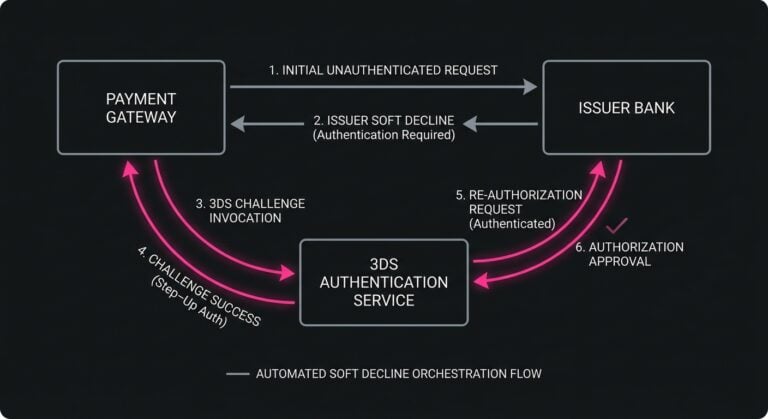
Handling soft declines smoothly is critical for minimizing checkout issues. If your payment infrastructure cannot interpret a soft decline and automatically trigger the 3DS challenge, the transaction registers as a hard failure. The customer sees a card declined error and may walk away. Properly parsing these responses and orchestrating the step-up flow seamlessly helps salvage transactions that would otherwise be lost.
Recurring Billing and Subscription Payment Issues
Authentication gets more complex with recurring revenue models. Subscription payment issues frequently arise because the customer is only actively present for the initial transaction. After the first payment is authenticated, subsequent billing cycles rely on stored credentials and run in the background.
Under current frameworks, setting up a subscription typically requires active customer authentication, and this first transaction establishes the billing mandate. Because the user is present on the website, applying 3DS here creates a secure baseline and helps ensure the initial payment authorization succeeds with the bank.

For subsequent recurring charges, merchants use specific network indicators to flag the transaction as a Merchant-Initiated Transaction (MIT). With the customer off-session, triggering a 3DS challenge is structurally impossible. If an MIT is improperly flagged, or if the issuer’s systems fail to recognize the initial mandate and demand authentication anyway, the transaction is often declined. Structuring the initial authentication correctly and passing the right trace IDs on subsequent charges is critical. It sets the foundation for a durable recurring billing chain and helps reduce payment declines over the customer lifecycle.
Interpreting the Issuer Response
Even with an optimized strategy and proper MIT flagging, some transactions will fail. When an authenticated transaction fails, interpreting the exact issuer response is critical for deciding what your operations team should do next.
An issuer might decline a fully authenticated transaction for reasons entirely unrelated to fraud or identity. Insufficient funds, expired cards, and temporary account holds are common realities in consumer finance. In these cases, the fact that the transaction passed a 3DS check has no bearing on the decline. The identity was verified, but the funds simply were not available.
A transaction can also fail the 3DS step itself. The user may fail the challenge or abandon the page, or the issuer’s risk engine may reject the frictionless data. In fact, exemption rejection is the single largest known authentication failure category in Forter’s network at 27.8% of failures (Source). In that case, the subsequent authorization request is usually either blocked proactively by the payment gateway or destined to be hard-declined by the issuer. Whether a payment was declined because of an authentication failure or an authorization failure dictates how you should respond. Forcing an unauthenticated authorization immediately after a failed 3DS challenge is generally poor practice and can push up your decline ratios.
Strategies to Retry Failed Payments and Improve Payment Recovery
When failures do occur, the recovery strategy must be informed by the context of the decline. Blindly retrying a transaction that failed an authentication challenge on the same day is unlikely to produce a different result and can artificially depress your overall approval metrics with your acquiring bank.
Effective payment recovery instead requires understanding the specific decline code and the conditions under which the transaction failed. If a decline was due to insufficient funds, timing the retry for a more favorable window, such as after a typical payroll date or at the start of a new month, makes sense. If a transaction was declined due to a suspected fraud hold despite successful authentication, retrying the same card repeatedly will likely lead to further declines. In those cases, prompting the customer to use an alternative method is often the only viable path.
Intelligent retry logic relies on mapping these variables and applying rule-based responses. This is where platforms like SmartRetry fit into the ecosystem. By focusing on payment optimization and intelligently orchestrating the timing and conditions to retry failed payments, merchants can recover revenue that might otherwise be lost. A nuanced retry system respects the initial issuer response, distinguishes transient failures from hard declines, and applies customized logic to improve the ultimate transaction approval rate.
Finding the Equilibrium
Implementing 3D Secure is not a binary decision of simply turning it on or off for all traffic. It is a continuous process of weighing security, user experience, and final authorization outcomes against each other. Issuers reward authenticated traffic with higher approval likelihoods because it removes guesswork from their internal risk models, but merchants bear the burden of managing the checkout experience.
The challenge for payment professionals is to harvest that issuer trust without alienating the buyer. Using modern protocols to share background data and relying on exemptions for lower-risk traffic lets merchants thread this needle effectively, even as frictionless authentication has fallen in 76% of countries globally (Source). The goal is a resilient payment infrastructure where risk is managed intelligently, checkout friction is minimized, and authorization rates remain steady. By carefully monitoring how different issuers respond to your authentication requests and adapting your routing and retry logic accordingly, you can turn 3DS from a mandatory compliance hurdle into a practical, strategic tool for revenue preservation.



 Find me on Linkedin