

Testing payment systems is where the tidy rules of software engineering meet the messy reality of global finance. In most software, a test is binary: you pass an input, verify the output, and move on. Payments do not work that way. When you test a payment flow, you are not just verifying your own code. You are predicting how a chain of gateways, acquirers, card networks, and issuing banks will react to a transaction at a specific moment.
The core problem is that you build in one environment and operate in a very different one. A sandbox tells you whether your API payload is formatted correctly. Bridging that gap means treating payment testing as an ongoing discipline of engineering validation and live experimentation, not a pre-release QA checklist.
Why Your Sandbox Is Lying to You (And Why Production Keeps Score)
Why Are Sandboxes So Polite Compared to Live Issuers?
Every payment provider offers a sandbox, and engineers love them for being predictable, fast, and polite. A specific test card and postal code returns a clean approval. Want a decline instead? Use a different test number or a cent value like ninety-nine cents, and it dutifully returns an insufficient funds code.
This deterministic setup is necessary for verifying basic plumbing, such as whether webhooks fire, transaction states update, and the front end shows the right error. But relying on a sandbox to predict live performance is like practicing for a hurricane under a garden hose. You get wet, but you miss the wind, the debris, and the power outages.
In production, determinism disappears. A real authorization hits an issuing bank’s risk engine, not a lookup table, and that engine weighs hundreds of variables in milliseconds: spending velocity, merchant category code, time of day, the distance between IP and billing address, and how the merchant formatted the data.

Sandboxes do not simulate issuer risk models. They do not get nervous about a gift card purchase at three in the morning, and they ignore legacy banking quirks, like an issuer returning a do not honor code simply because its ledger is in nightly batch maintenance.
The 4 Layers of Payment Testing Every Team Actually Needs
To build resilient payments without breaking live revenue, teams must separate what can be tested in isolation from what must be tested in the wild. A mature strategy spans four layers, each addressing a different risk.
1. Functional and Integration Validation
Functional testing, the traditional domain of QA, verifies that your internal systems handle transaction mechanics correctly. When a customer clicks buy, does your system create an order record, call the gateway, and stop double-clicks from generating duplicate charges?
This layer also covers asynchronous flows. Alternative payment methods, bank transfers, and Three-Domain Secure authentication rely heavily on redirects and webhooks, so integration tests must verify what happens when a webhook arrives ten minutes late, out of order, or twice. If an authorization succeeded webhook lands before the user’s browser finishes redirecting to your confirmation page and your system cannot handle it, expect confused customers and reconciliation headaches.
2. Edge-Case and Chaos Simulation
Once the happy path works, test how your architecture copes with friction. Payment networks are durable, but individual links regularly suffer latency spikes and brief outages.
Chaos testing means injecting artificial delays and network drops into staging. If your primary processor takes twelve seconds to respond instead of two, does checkout hang or time out gracefully? More importantly, if a connection drops after you send a charge request but before the response arrives, how does your system recover?
This is where idempotency keys become critical. An idempotency key is a unique identifier on a payment request, so if your system repeats the request after a timeout, the processor treats it as the same attempt rather than charging the customer twice. Testing this means simulating broken connections mid-flight and verifying that your recovery logic queries the transaction status or safely repeats the call with the exact same key.
3. Live Penny Testing and Smoke Checks
Because sandboxes cannot replicate live banking rails, major integration changes, such as boarding a new acquirer, changing how network tokens are passed, or modifying statement descriptors, must be validated in production.
Teams handle this through controlled live testing, often called penny testing, though varying amounts are common to avoid fraud filters that flag tiny transactions. Engineers and payment analysts run real transactions on company cards across different networks and issuers, covering authorization, capture, partial refund, and void. Days later, they check their own bank statements to confirm the merchant name and contact details appear clearly, reducing friendly fraud chargebacks.
4. Continuous Optimization and Routing Experiments
The final layer is not about finding bugs but revenue. Once an integration is stable, the focus shifts to optimization: running controlled experiments, such as A/B tests or multi-armed bandit algorithms, on live traffic to see which configurations yield higher approval rates.
How Do You Test for the Chaos of Real-World Declines?
For merchants at scale, especially subscription businesses, the most consequential testing happens around decline management. A customer declined at checkout is right there and can try another card. When a payment fails during an automated billing cycle, the customer is asleep or at work, and if the merchant cannot recover it behind the scenes, the result is involuntary churn.
Testing recovery logic in a sandbox is tricky because sandboxes treat every decline as static. A hard decline, such as a stolen card or closed account, means you must stop immediately. Hammering it will not get you paid, only penalized by the card networks, and it damages your merchant reputation.
Soft declines signal temporary problems like insufficient funds, exceeded velocity limits, or generic issuer errors. They are candidates for recovery, but a retry strategy has to account for issuer behavior changing over time.
Before exposing retry workflows to full production volume, teams need simulation harnesses that mimic time-based state transitions. Rather than a simple case where card X fails, the scenario must verify multi-step logic:
- Attempt one fails with a soft decline code.
- The system schedules a retry based on specific calendar or time-of-day rules rather than firing three seconds later.
- Before attempt two, the system checks whether an account updater service has supplied new card details.
- Attempt two succeeds, and the subscription returns to active without sending the user a cancellation email.
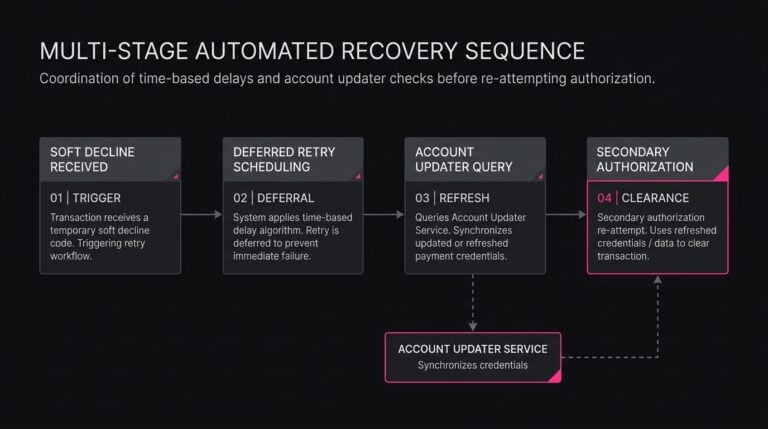
Suppressing customer emails during an active retry cycle deserves as much testing as the payment call itself. Few things annoy a subscriber more than a “your payment failed” email five minutes before a retry successfully bills their card.
The Tricky Art of A/B Testing in Live Payment Flows
Product and growth leaders often want to A/B test their payment stack like a landing page, checking whether Processor A beats Processor B in a given country, or whether a local payment method lifts conversion.
Clean experiments are harder here than button-color tests because the payment ecosystem has memory and feedback loops. If a card declined on A automatically cascades to B as a backup, your test data is polluted. B now receives a disproportionate share of pre-filtered, higher-risk traffic that A already rejected, so comparing raw approval rates at month’s end makes B look worse than it is, even if it is rescuing revenue you would otherwise have lost.
To run valid payment experiments, teams have to isolate their variables carefully:
- Randomize at the user or payment instrument level, not the transaction attempt level: Keep a given customer or card in the same cohort across attempts to measure true lifecycle performance.
- Separate primary routing from fallback routing in your analytics: Measure first-pass authorization rates separately from recovery rates achieved through cascading or retries.
- Account for issuer learning curves: Issuers do not recognize a new acquiring bank or merchant ID right away, and their fraud engines often decline more transactions for the first couple of weeks until a normal baseline without excessive chargebacks forms. End a test too early and you may get false negatives from a setup that never finished warming up.
- Watch out for network token mismatches: If one route uses network tokens and another uses raw primary account numbers, you are testing two variables at once: the processor’s acquiring connections and the data payload format.
Can You Test Retry Logic Without Annoying the Card Networks?
Nowhere is the tension between experimentation and operational constraints sharper than in retries. Merchants naturally want to test intervals, times of day, and message tweaks to see what wins an issuer’s approval.
The card networks, however, enforce strict retry rules. Too many retries within a rolling window trigger excessive retry fees and possible compliance warnings. Issuers also watch merchant patterns, and one that sees the same declined cards blasted every six hours on the hour may block that merchant’s traffic altogether, dragging down approvals even for good customers.
Safe retry testing takes discipline, not random intervals thrown at the wall. Experienced teams filter out non-retryable decline codes at the gate and set hard caps on attempts per transaction lifecycle.
They also look beyond timing. A transaction may fail because the recurring flag was poorly formatted, or because the payload carried an expired postal code the issuer never needed for a stored-credential transaction. Adjusting how data is presented, strictly within network rules, often beats resending the same request on Tuesday instead of Monday.
Because this infrastructure needs constant tuning as issuer rules shift, many merchants offload it. Platforms like SmartRetry turn decline recovery into a continuous, data-driven optimization process. Observing outcomes across many issuers, decline reasons, and industries, such a platform can spot patterns, like when a given bank prefers retries or which parameters improve approval odds, without merchants burning their own retry limits on blind trial and error.
Building a Culture of Payment Observability
Ultimately, the line between testing and monitoring in payments is blurry. Since you cannot replicate thousands of global issuers in staging, every live transaction is a tiny test of your infrastructure.
Teams that excel at reducing declines treat production analytics as part of their test suite. Rather than trusting aggregate approval rates, which can hide localized disasters beneath a calm average, they slice metrics by issuer country, card brand, BIN range, and currency. This granularity is crucial given that the average global card authorization rate is 85-90% (Source).
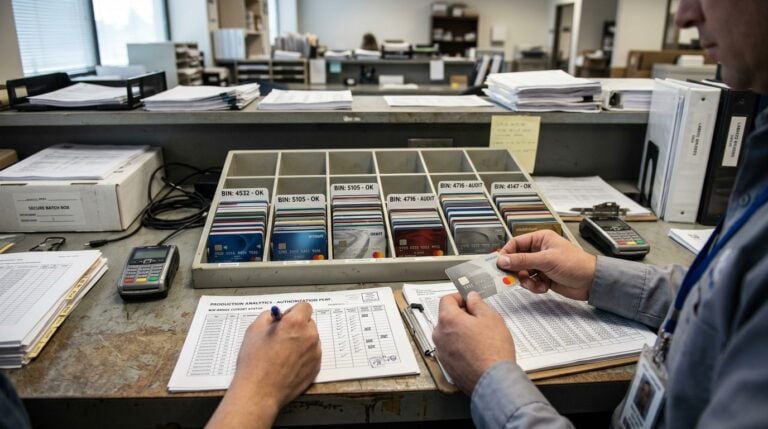
If an acquiring partner’s firmware update quietly strips a required exemption flag for European transactions, neither your functional tests nor your sandbox will notice, because your code did not change. Only real-time observability will, alerting the team when approval rates for a regional cohort dip below their historical baseline.
This rigor replaces “it passed QA, so we’re done” with ongoing curiosity about how external networks interpret every byte you send. Use the sandbox to avoid shipping broken code, chaos engineering to keep a sluggish gateway from taking down checkout, and disciplined live experimentation to turn unnecessary declines back into healthy revenue.



 Find me on Linkedin