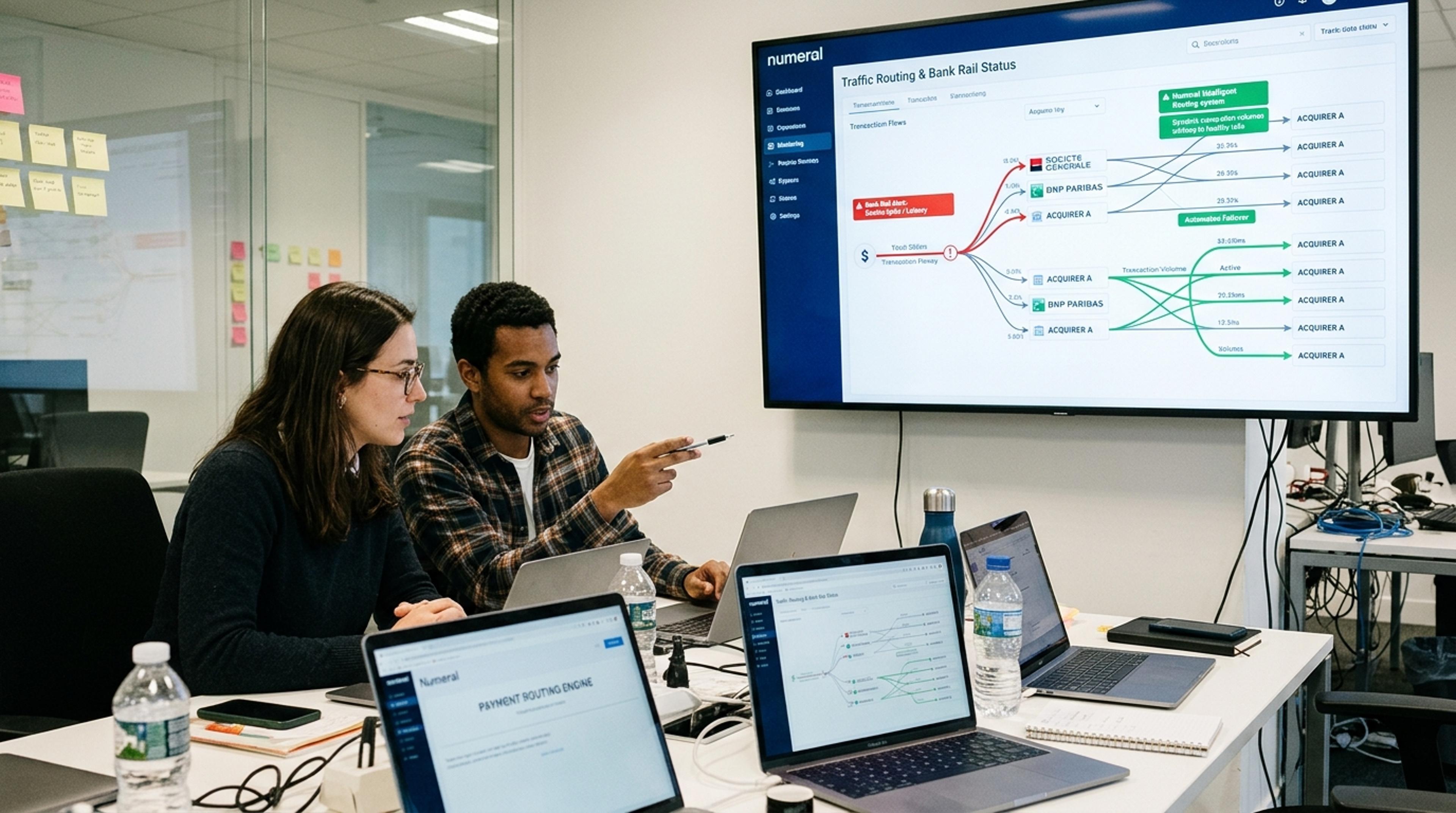
An account-to-account (A2A) payment is a transaction that transfers funds directly from a payer’s bank account to a merchant’s or payee’s bank account without routing through credit or debit card rails. Settled over clearing houses or instant payment rails, A2A payments eliminate card network fees and reduce chargeback exposure.
How does Account-to-Account (A2A) Payment work?
A2A payments bypass traditional card scheme intermediaries such as card networks, merchant acquirers, and card issuers. Instead, the transaction moves directly across domestic clearing networks, real-time payment rails, or open banking infrastructure.
The flow operates under two primary models: push payments and pull payments.
- Push payments: The customer initiates the transfer directly through their banking interface or an open banking Payment Initiation Service Provider (PISP). The merchant provides payment details or a dynamic QR code. The customer authenticates the transaction using their banking credentials or mobile biometrics, and the sending bank transfers the funds directly to the merchant account over instant payment rails (such as FedNow, RTP, Faster Payments, or Pix).
- Pull payments: The merchant pulls funds from the customer account based on a pre-authorized mandate, commonly used for recurring billing. Traditional examples include ACH debits in the United States or SEPA Direct Debit in Europe. Modern frameworks utilize Variable Recurring Payments (VRP), enabling automated recurring pulls through open banking APIs with authenticated consent parameters.
Once initiated, settlement occurs either instantaneously on real-time gross settlement rails or in scheduled batches over traditional automated clearing houses. The merchant payment gateway receives an asynchronous status notification or instant API webhook confirming execution.
Why does Account-to-Account (A2A) Payment matter for payment teams?
For payment operations and finance teams, A2A rails provide an alternative to the rising interchange and scheme fees associated with credit cards. By reducing or eliminating various card processing overhead costs, merchant fee savings from Pay-by-Bank compared to credit cards are estimated to be between 40 up to 85 percent (Board of Governors of the Federal Reserve System, 2025).
Operationally, A2A payments reduce involuntary churn caused by expired, lost, or compromised credit cards. Because bank accounts remain persistent over time, billing credentials do not require periodic card updater queries or card re-issuance updates.
Fraud dynamics also differ fundamentally from card networks. Because real-time push payments require Strong Customer Authentication (SCA) inside the consumer’s banking environment, unauthorized transactions drop sharply. Furthermore, traditional friendly-fraud chargeback mechanisms do not exist on instant push rails, significantly limiting post-transaction dispute costs.
What are common use cases for Account-to-Account (A2A) Payment?
- SaaS and subscription billing: B2B and consumer software providers use direct debits and open banking variable recurring payments to collect monthly dues without card expiration failures.
- High-ticket ecommerce retail: Merchants selling high-value items, such as luxury goods or electronics, leverage instant A2A checkouts to avoid steep percentage-based interchange fees and eliminate card credit limit declines.
- Marketplaces: Two-sided platforms rely on A2A infrastructure to manage escrow collections and execute immediate, low-cost disbursements to sellers and service providers.
- Digital goods and gaming: Gaming platforms deploy instant payment schemes to let users instantly top up wallets with minimal checkout friction via biometric bank authentication.
Account-to-Account (A2A) Payment vs Card Payments
| Dimension | A2A Payments | Card Payments |
|---|---|---|
| Rail Infrastructure | Central bank rails, clearing houses, open banking APIs | Card schemes (Visa, Mastercard, Amex), acquirers, issuers |
| Processing Fees | Flat or low-basis-point fees; zero interchange | Percentage-based interchange, scheme fees, processor markups |
| Settlement Speed | Seconds (instant rails) to 1-3 business days (batch ACH) | Typically 1 to 3 business days |
| Credential Expiry | Rare (tied to bank account lifecycle) | Frequent (cards expire, get lost, or are reissued) |
| Dispute Mechanism | Limited; payments are largely irrevocable once settled | Standardized scheme chargeback and retrieval processes |
What are best practices for Account-to-Account (A2A) Payment?
- Implement automated payment method cascades: If an A2A flow fails due to bank API downtime, authorization timeouts, or insufficient funds, seamlessly prompt the customer with a secondary payment method like a saved card.
- Align recurring pull schedules with payroll cycles: For subscription businesses using direct debit rails, schedule payment attempts around typical consumer deposit dates, such as the 1st, 15th, or final business day of the month.
- Verify account balances before pulling funds: In regions with open banking balance checks, verify that sufficient funds exist prior to triggering an ACH or direct debit transaction to prevent non-sufficient funds (NSF) penalties.
- Optimize deep-linking for mobile checkouts: Ensure mobile open banking journeys use native app-to-app redirection rather than web browser fallbacks, keeping authentication completion rates high.
How does SmartRetry help with Account-to-Account (A2A) Payment?
SmartRetry optimizes the recovery of declined transactions across multiple payment rails. When A2A transactions encounter soft declines or mandate initiation errors, SmartRetry detects the failure signature and triggers intelligent fallbacks. The engine determines whether to re-attempt the bank transfer at an optimal time or automatically route the customer to an alternative payment method.
Explore how SmartRetry coordinates smart retries and multi-rail recovery flows to preserve recurring revenue.