

The Secret Handshake of Online Payments: Decoding the Cryptographic Value Behind Secure Approvals
Every online transaction involves a quiet crisis of trust. A customer clicks buy, and an issuing bank has milliseconds to decide whether the person at the keyboard is the real cardholder. A wrong call either costs the bank fraud losses or declines a good customer. That tension is why the cardholder authentication verification value, or CAVV, exists. It is a cryptographic token from a 3D Secure check, proving the bank verified the cardholder before authorization.
For payment engineers and fraud teams, the CAVV is more than a security artifact. It shifts fraud liability away from the merchant, calms issuer risk models, and influences whether a transaction succeeds. Handled properly, it turns a guess into a verified handshake. Mishandled, it quietly drains revenue.
What Is CAVV and How Does It Anchor the 3D Secure Flow?
It is a cryptographic hash generated by the issuing bank’s Access Control Server (ACS) during a 3D Secure session. Visa coined the term, Mastercard‘s equivalent is the Accountholder Authentication Value (AAV), and American Express calls it the SafeKey Reference value. Engineers use CAVV for all three.
To see why it matters, separate authentication, which asks whether the cardholder is who they claim to be, from authorization, which asks whether the account can pay for the purchase. Without 3D Secure, the merchant sends a single authorization message and the issuer must guess at authentication from the card number, expiration date, and billing address.
EMV 3DS, the modern protocol, routes the two phases along separate paths that eventually converge:
- The Authentication Path: The merchant’s 3DS Server sends device, browser, and transaction data via the card network’s Directory Server to the issuer’s ACS. The ACS assesses risk, then either passes the user silently (frictionless flow) or prompts for a one-time passcode or biometric check (challenge flow) before generating the CAVV.
- The Handoff: The ACS returns the CAVV to the merchant along with an Electronic Commerce Indicator (ECI) and a transaction identifier, such as an XID in legacy 3DS1 or a Directory Server Transaction ID in EMV 3DS.
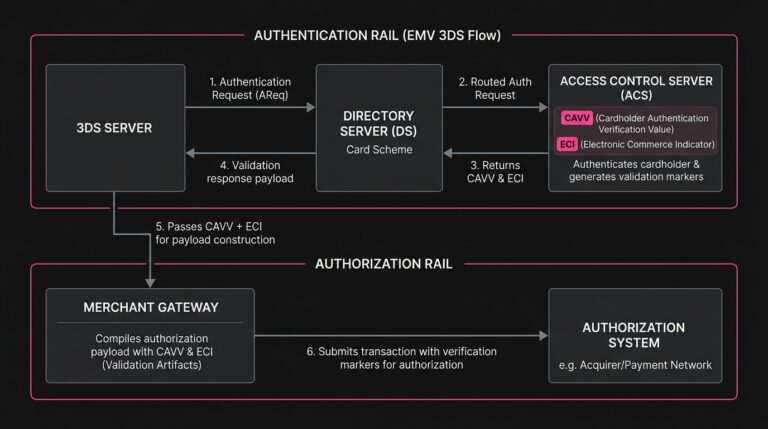
The issuer’s host does not take the merchant’s word for it. It validates the CAVV with internal keys against the amount, currency, and card number. Because the issuer created the token moments earlier, this closes the loop and proves nothing changed between browser check and backend charge.
Why Chargeback Liability Shift Depends on Cryptographic Proof
A chip card dipped into a terminal generates an EMV cryptogram proving the card was present. Ecommerce lacks that proof, and historically merchants bore almost the entire cost of card-not-present fraud: when a stolen number was used and the owner disputed, the merchant lost the revenue and goods and paid a dispute fee. Notably, authenticated eCommerce transactions show approximately a 45% reduction in fraud compared with non-authenticated transactions (Source).
The main incentive for adopting EMV 3DS is the chargeback liability shift. When a valid CAVV and matching ECI travel in the authorization payload, fraud chargeback responsibility moves from merchant and acquirer to the issuer, which by generating the CAVV is effectively vouching for the cardholder and session. For example, Best Buy Canada observed a 61% reduction in its card-not-present fraud rate two quarters after implementing EMV 3DS (Source).
This protection is conditional.
Nor does the shift require every customer to type an SMS code. Under modern protocols it covers three outcomes, each with its own ECI value:
- Fully Authenticated (Challenge or Frictionless): The issuer verifies the user through a challenge prompt or background risk scoring.
- Attempted Authentication: The merchant requests authentication and the network confirms eligibility, but the issuer’s ACS is temporarily unreachable or does not support the check. Though the bank never verified the cardholder, the merchant did their part, so the liability shift still protects them in most regions.
A merchant who forces the transaction into authorization anyway keeps full liability.
For fraud and dispute teams, the CAVV and ECI pair is the core evidence. When one slips through, the stored CAVV and transaction ID in representment are the standard way to reverse it.
Balancing Payment Authorization Rates and Checkout Friction
For years, growth leaders and product managers saw authentication as a conversion killer. The original 3DS1 protocol redirected buyers to a clunky bank page demanding a static password they had probably forgotten, and cart abandonment was common. Teams had to choose between more fraud and chargebacks or losing good customers at the finish line.
Modern protocols changed the math. Merchants can now pass dozens of contextual signals, like shipping address history, device fingerprint, and account age, so issuers approve low-risk sessions in the background and the CAVV becomes a lever for higher authorization rates. In fact, 40% of global eCommerce merchants use Strong Customer Authentication specifically to boost authorization rates (Source).
With a CAVV attached after frictionless authentication, the issuer sees the transaction far more favorably. Indeed, fraud rates for card payments were found to be about seventeen times higher when the counterpart was outside the EEA compared to domestic transactions (Source). With one, the host knows its own ACS already vetted the session, so approval becomes much more likely. Across its network, Visa reports a 9% lift in authorization approval rates for transactions authenticated through Visa Secure (Source).

Still, authentication needs calibration. Pushing every transaction through 3DS is rarely optimal, and outside regulated markets like Europe, where PSD2’s Strong Customer Authentication mandates it, optional 3DS carries real trade-offs:
- ACS Downtime and Latency: Every authentication call adds a network hop to an external bank server. If an issuer’s ACS is slow or down, the customer stares at a spinning wheel and abandonment risk rises.
- Challenge Drop-off: Even with better mobile app integrations and biometric prompts, some users will abandon checkout whenever an issuer forces a step-up challenge.
- Issuer Scoring Discrepancies: In some markets, primarily the United States, certain issuers’ 3DS setups lag their authorization engines, so sending a low-risk domestic transaction through 3DS unexpectedly can trigger a needless challenge. Even so, the average 3DS success rate in the United States reached 88% in 2026 (Source).
Experienced teams apply authentication selectively, using dynamic routing and pre-authorization risk scoring instead of a blanket rule. Underscoring this demand, 78% of merchants report using 3DS exemptions to reduce checkout friction (Source). Low-risk returning customers go straight to authorization for speed. High-value orders, mismatched billing and shipping addresses, and BINs with strict fraud filters go through 3DS to capture the CAVV, secure the liability shift, and give the issuer confidence to approve.
What Happens When a Payment Declined Response Follows a Valid CAVV?
Product managers and merchants are often baffled when a customer passes 3D Secure, gets a valid CAVV, and is still declined. Why would the bank verify the user and then reject their money?
The ACS handles authentication while the authorization host manages balances and credit limits, and they are often separate systems inside the bank, sometimes run by different vendors. Passing authentication proves identity, not that the customer can pay.
Declines can also stem from how the CAVV was handled between steps. Common triggers include:
- Payload Mismatches: The CAVV is cryptographically bound to specific parameters, most notably amount and currency. If a merchant authenticates one amount and then adds shipping or tax before authorization, the issuer’s check fails because the parameters no longer match the hash.
- Stale or Expired Tokens: A CAVV is meant for immediate, single use during a live checkout. If a merchant holds an authenticated order for manual review or delayed fulfillment and authorizes days later, the issuer may reject it as expired.
- PSP Mapping Errors: In multi-processor setups, where a standalone 3DS provider hands tokens to a separate gateway, formatting errors creep in.
When troubleshooting, engineers should check raw gateway logs. Beyond the two-digit response code, networks return a CAVV Result Code, such as Visa’s single-character indicator, showing whether the issuer validated it, rejected it over a bad hash, or ignored it. Validation failures almost always trace to the merchant’s or PSP’s data mapping, not the customer’s card.
How Should You Retry Failed Payments That Involve 3D Secure?
The CAVV lifecycle matters most when designing retries for failed payments in recurring billing and recovery flows. Because a CAVV is single-use and tied to one customer-present session, you cannot store it and reuse it tomorrow, let alone next month.
For subscriptions, the day-one CAVV authorizes the first charge and establishes a stored credential. To charge off-session later without pulling the customer back, the merchant must flag that transaction as a Credential-on-File (COF) or Merchant-Initiated Transaction (MIT) setup and capture the card brand’s Network Transaction ID (NTI).
Later recurring charges and soft-decline recoveries send that NTI, not the old CAVV. It points the issuer back to the original 3D Secure authentication, letting the off-session retry proceed without a fresh CAVV.

Transactions still fail because of network timeouts, issuer hiccups, or timing around available funds, and the follow-up attempt decides whether the sale is saved. Platforms like SmartRetry analyze the issuer response and context, including whether the payment came from an authenticated session or recurring chain, to run intelligent retries that recover revenue and lift approval rates without duplicate authentication prompts or network rule violations. In a pilot study by Worldpay, AI-driven 3DS optimization demonstrated a 5.5% average improvement in authorization rates (Source).
Teams building workflows around authenticated declines generally follow a few principles:
- Never Re-send a Burned CAVV: Once a CAVV reaches the issuer and draws a business decline like insufficient funds, it is consumed. Re-sending the same payload risks a replay rejection, so later off-session attempts must move to an MIT framework with proper network trace IDs or wait until the user returns.
- Isolate Soft Declines from Authentication Failures: If the CAVV itself failed validation, retrying only adds fees and hurts merchant standing with the networks. Fix the integration payload or ask the user for a fresh payment method.
- Use Decoupled Authentication Only Where Supported: Newer EMV 3DS specifications let issuers push an authentication prompt to the user’s banking app outside a live checkout. Adoption is still maturing, but it offers a structured way to get a fresh CAVV when recovering high-value declines via email or SMS links.
Treat the CAVV as what it is: a time-sensitive cryptographic receipt of trust between cardholder and bank. Generate it only when needed, map it cleanly, and link it to future recurring identifiers, and it both shields the business from fraud chargebacks and gives issuers the signal to turn borderline declines into approvals.



 Find me on Linkedin