

When the Processing Stops: Navigating Gateway Locks and Account Holds
Waking up to find your payment provider unavailable is an unsettling moment for any online business. Revenue stops moving, yet infrastructure costs, team payroll, and customer obligations keep running on schedule. When a platform restricts an active account, the first reaction is often a frantic push through standard support queues.
That approach rarely resolves the issue quickly. A restricted account should be treated not as a customer service misunderstanding but as a risk management negotiation. Understanding how an underwriting algorithm views your payment processing flow is the first step toward unfreezing capital and restoring normal payment authorization.
Surviving a freeze comes down to two distinct tracks: stabilizing incoming cash flow so the business can breathe, and presenting a structured, data-backed case to the provider’s risk department. Operators who keep revenue continuity separate from the compliance appeal tend to recover with far less disruption to their customers.
What Just Happened
A recent discussion on the HackerNews community forum highlighted the friction that occurs when automated risk rules collide with unconventional billing models.
The business had onboarded its initial client through a recorded phone agreement. The provider blocked the charge. Two days later, the platform shut down the profile entirely, noting that the charges did not appear to have been authorized by the customer.
The business owner submitted an appeal with corporate documentation, the invoice, and an explanation of the workflow. The provider rejected it the next day, citing an unacceptable level of risk associated with the business model. Even after an internal escalation, the decision stood. At no point did the platform request the recorded call, client messages, or direct verification from the buyer, who ultimately settled the invoice via a direct bank transfer.
In the resulting thread, other founders and payment engineers pointed out the signals that likely tripped the automated monitoring. However legitimate the contract was offline, the transaction metadata told a story the risk engine was programmed to reject.
Why Payment Teams Should Care
For product managers, revenue leaders, and payment operations teams, this incident is a clear reminder of the structural difference between a dedicated bank relationship and a payment facilitator (PayFac) or aggregator. Modern payment platforms are celebrated for their developer-friendly APIs and instant onboarding. A company can start accepting cards in minutes because the platform absorbs the initial underwriting friction by pooling merchants under its own master banking accounts.

The trade-off for that instant setup is delayed underwriting. Rather than vetting every operational detail before the first dollar moves, aggregators rely on continuous, automated transaction monitoring once the integration goes live. When a transaction falls outside expected statistical baselines, the system acts defensively to protect the platform and its acquiring bank partners from credit exposure and chargeback liability, especially with programs like the Visa Acquirer Monitoring Program enforcing an excessive merchant threshold of 1.5% (Source).
The Mechanics of Automated Underwriting Triggers
Risk engines do not evaluate businesses by reading their websites or listening to sales calls. They read transaction telemetry, and when an account shows a sudden shift in behavior, the software flags it for manual review or immediate restriction. Several common patterns routinely trigger these defenses:
- Ticket Size Volatility: Jumping from a micro-transaction to a four-figure charge creates a steep variance in average order value. Risk models treat extreme jumps in ticket size as a possible sign of account takeover or a merchant trying to cash out before abandoning the profile.
- Unfamiliar Card-on-File Cadences: Standard subscription payment issues are relatively easy for algorithms to parse because billing intervals and amounts stay predictable. Variable-amount merchant-initiated transactions (MITs) on irregular schedules, however, can look indistinguishable from unauthorized charges unless the gateway receives metadata confirming a standing agreement.
- Business Model Categorization: Lead generation, future service delivery, and third-party fulfillment carry higher historical dispute rates. If a customer pays today for a service delivered weeks later, or if the value of the service is subjective, as with marketing leads, the provider calculates a much higher probability of future chargebacks.
- Velocity and Decline Ratios: A spike in processing volume or a creeping rise in transaction declined rates tells the processor that either the cardholder base is unhappy or bad actors are testing stolen credentials against the checkout endpoint.
The Operational Cost of Locked Working Capital
For a business running on tight working capital cycles, having several weeks of revenue locked away can stall inventory purchases, marketing spend, or payroll.

If a SaaS platform or service business loses its processing connection mid-cycle, scheduled rebills fail outright. Customers see confusing error messages, voluntary churn accelerates, and engineers have to drop roadmap priorities to build an emergency integration with an alternative provider.
Recommended Actions
When a risk team restricts processing or withholds payouts, emotional appeals and repetitive support tickets tend to harden the provider’s defensive posture. Risk analysts review dozens of flagged accounts daily, and their main goal is making sure the merchant will not leave the platform holding the bag for unpaid refunds and disputes. Approaching the situation with clinical transparency gives an operations team the best chance of releasing held capital or reinstating processing privileges. Before drafting an appeal, the payment team needs to stabilize the business and audit its own transaction logs.
First, pause automated billing cycles and aggressive collection workflows tied to the affected integration. Pushing charges through a restricted endpoint generates cascading payment failures and degrades the quality of your customer billing records. If customers are actively trying to pay invoices, move high-value accounts to temporary alternative rails such as ACH bank transfers or wire instructions, just as the contractor lead-generation business did with its first client.
Second, pull a complete history of recent payment issues from your internal database before dashboard access is cut off. Look at the exact issuer response codes, the ratio of customer-initiated to merchant-initiated transactions, and any recent disputes or refunds. You need to see your profile the way the risk analyst sees it.
Third, prepare a structured underwriting packet for the risk review. Skip the lengthy narrative about company history and provide verifiable documentation that directly offsets the platform’s financial liability:
- Proof of Fulfillment and Authorization: Supply signed contracts, digital audit trails showing IP addresses and timestamps of terms-of-service acceptance, delivery receipts, or client communications confirming satisfaction with what was delivered.
- Financial Stability Documentation: Include recent corporate bank statements showing healthy cash reserves.
- A Clear Mitigation Plan: Explain how you will change your payment processing flow to prevent future false positives. For instance, if off-session charges on saved cards caused the friction, commit to customer-initiated invoice links with 3D Secure (3DS) authentication, which shifts fraud liability away from the merchant and processor.
Designing a Resilient Multi-Provider Architecture
Once the immediate crisis is under control, the long-term response has to focus on architecture. Relying on a single payment gateway makes it a single point of failure for revenue collection, prompting eCommerce merchants to use an average of four different payment gateways or processors. Even established businesses with clean processing histories can trigger automated flags during seasonal sales spikes, product launches, or expansion into new geographic markets.
Resilience starts with decoupling card tokenization from any one processor. When customer payment credentials are vaulted exclusively inside one provider’s ecosystem, moving recurring billing relationships to a new platform in an emergency means asking customers to re-enter their card details, and that reliably causes heavy subscriber drop-off.
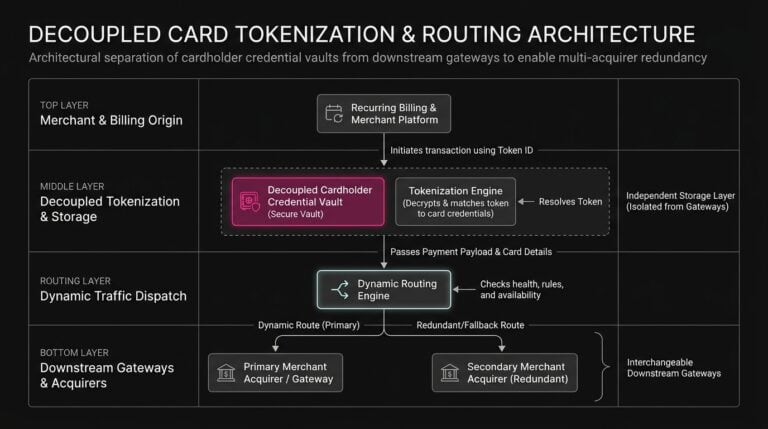
Diversifying your processing stack also means setting up a secondary merchant account well before you need it. Applying for a backup provider while your primary integration is shut down is difficult, because underwriters view distressed applicants with heightened skepticism. A secondary relationship, ideally with a traditional direct acquirer that does thorough underwriting before you process your first dollar, gives you an established escape valve-merchants on average use three different acquiring banks to support eCommerce payments.
Finally, align your billing mechanics with card network standards. Use dedicated setup intents built for storing cards for future off-session use, and make sure every subsequent charge passes the correct credential-on-file indicators to the issuing bank. Clear metadata keeps your platform’s risk engine calm, and it also improves your overall transaction approval rate by giving issuing banks the context they need to trust the charge.
SmartRetry’s Response & Capabilities
Keeping a payment profile in good standing with processors and issuing banks often comes down to the quality and predictability of the transaction traffic a business generates. When a card is declined, hammering the gateway with brute-force retries looks remarkably like card testing or fraudulent velocity spikes, which are exactly the patterns that draw scrutiny from risk algorithms and drag down authorization performance. Platforms like SmartRetry address this layer of the stack through payment optimization and intelligent retries of declined payment transactions, helping merchants recover revenue while keeping their processing hygiene clean. By analyzing decline telemetry to identify which failures are actually recoverable, and timing attempts to retry failed payments around issuer behavior rather than rigid schedules, teams can reduce payment declines without generating the noisy, high-risk volume that raises red flags with payment providers.
Treating payment infrastructure as a strategic discipline rather than a background utility changes how a company weathers operational bumps. Payment processors are risk-averse financial institutions operating under strict regulatory and card network constraints. When payment teams design their checkout flows, authentication methods, and payment recovery practices around how underwriters and issuers actually evaluate risk, they build an operation that avoids unexpected disruptions and converts legitimate customer revenue with far greater consistency.



 Find me on Linkedin