

How to Choose the Right Failed Payment Recovery Software for Your Business
Every business with recurring revenue or high transaction volume eventually hits a wall where legitimate customers try to pay and the banking rails say no, in a U.S. recurring payments market expected to generate $830 billion in transaction volume by 2025 (Source). Finding the right software to fix this starts with a simple truth: no single platform works for every merchant. The right payment recovery tool depends entirely on whether your primary bottleneck is customer communication, gateway routing, or the raw logic of how you handle a declined transaction. To pick the right tool, you first have to understand why your payments are failing. Only then can you match the software to your actual payment processing flow.
When teams go shopping for recovery tools, they often look for a single dashboard that will magically fix involuntary churn-up to 50% of which is caused by failed payments (Source). What they find instead is a fragmented landscape of dunning email tools, subscription billing add-ons, and deep-infrastructure optimization platforms. Each of these solves a different piece of the puzzle. If you buy a customer-facing dunning tool when your real problem is overly sensitive issuer fraud filters, you will end up politely asking good customers for new credit cards when their current ones are completely fine.
Why Do Good Customers Get Declined in the First Place?
Before evaluating software, it helps to look at what actually happens in the fractions of a second after a customer clicks buy or a subscription billing cycle triggers. A transaction request travels from your checkout or billing engine to your payment service provider, through the card networks, and lands at the customer’s issuing bank. The issuer’s job is to assess risk and check account standing before sending back a response.
Sometimes the reason for a payment declined message is straightforward. The card might be expired, or the customer might have reported it lost last week. The industry classifies these as hard declines, and no amount of clever software will convince an issuing bank to approve a charge on a closed account. You simply need a new payment method from the customer.
The real complexity, and the main reason an entire category of recovery software exists, lies in soft declines, which play a major role in the estimated 22% of online payments that are wrongly declined (Source). A soft decline means the account is valid, the card is active, and in many cases the customer wants the transaction to go through, but the bank rejected this specific attempt. Maybe the customer is hitting a daily velocity limit, maybe their funds are temporarily low two days before payday, or maybe the issuing bank’s fraud model found the timing of your recurring billing batch slightly suspicious.
To make matters trickier, issuing banks rarely tell you the exact reason for a rejection. They often map dozens of internal risk triggers to a single generic response, such as Do Not Honor. But handling it carelessly, by hammering the bank with immediate repeat attempts, can trigger network fines and hurt your reputation with the issuer.
The Three Flavors of Recovery Software: Which Problem Are You Solving?
Because payment failures happen for different reasons, the software market has split into three distinct categories. Understanding where a tool sits in the payment stack will save you months of integration work and mismatched expectations.
1. Native Billing and PSP Recovery Tools
If you use a modern subscription billing platform or a major payment service provider, you already have access to baseline recovery tools. These platforms offer built-in account updaters, basic automated retry schedules, and templated emails that go out when a card is declined.
For early-stage businesses or companies with relatively low transaction volume, turning on these native features is the smartest move. They require almost no engineering effort, cost very little extra, and catch the easiest recovery opportunities.
However, native tools are built for the average merchant on that platform, not for your specific customer base. Their retry logic typically relies on generalized rules or broad machine learning models trained across thousands of unrelated businesses. Once your volume scales, the gap between a generic retry schedule and one tailored to your transaction patterns becomes expensive.
2. Customer-Facing Dunning and Retention Platforms
The second category focuses on what happens when a payment cannot be recovered silently in the background. Dunning management platforms specialize in reaching out to the customer via email, SMS, or in-app notifications and asking them to update their billing information.
These tools are built for growth and marketing teams. They offer features like customizable branding, A/B testing for subject lines, and frictionless update pages where a user can enter a new card without logging into their full account.
Dunning software is essential if your business suffers from high rates of hard declines or if your customers frequently use prepaid cards that run out of funds and get discarded. The trade-off is friction. Every dunning email reminds a subscriber that they are paying for your service, effectively inviting them to consider canceling instead of updating their card-a danger underscored by the fact that 53% of subscribers say they would likely unsubscribe if a billing or payment issue disrupted their service (Source).
3. Intelligent Retry and Authorization Optimization Engines
The third category operates entirely behind the scenes. Rather than contacting the customer, these platforms sit in the transaction flow and focus on retrying failed payments cleanly and effectively.
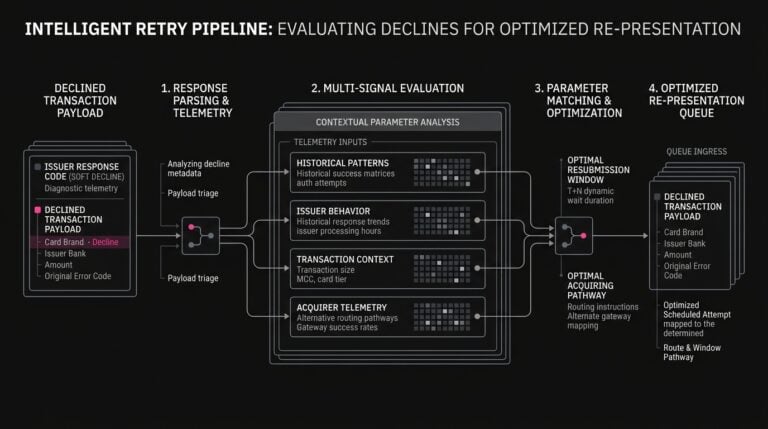
Instead of following a static calendar, such as trying a card again every three days, intelligent retry engines analyze the specific context of the decline. They look at the issuer response code, the bank identification number (BIN), the card type, the currency, the time of day, and historical transaction patterns across similar cards. Based on these signals, the software decides whether the transaction can be recovered and when to submit the next attempt. Sometimes it will even adjust the transaction payload or route it through a different acquiring bank to improve the approval rate.
Platforms like SmartRetry operate in this layer, focusing on payment optimization and intelligent retries of declined transactions so merchants can recover revenue and improve approval rates without interrupting the customer experience. By resolving soft declines quietly in the background, businesses can reserve dunning emails for situations where the card is genuinely unusable.
5 Questions to Ask Before Buying Payment Recovery Software
Vendor demos tend to look suspiciously similar, and every provider will show you a dashboard with an upward-trending revenue chart. To look past the interface and understand how the software will actually perform in your environment, ask these five operational questions.
1. How Does the System Differentiate Between Hard and Soft Declines?
In theory, the card networks define which decline codes are hard and which are soft. In practice, issuing banks do not follow the rulebook consistently. One bank in Europe might use a specific code to mean “never try this card again,” while a regional bank in North America uses the same code to indicate a temporary system timeout.
Ask the provider how they handle this ambiguity. If their system relies on a static lookup table of standard ISO or network response codes, it will inevitably make mistakes, either giving up on recoverable transactions or wasting retries on dead cards. Look for systems that evaluate the decline code together with the specific issuing bank that sent it.
2. How Does the Software Protect Your Standing With Card Networks and Issuers?
There was a time when merchants could use brute force to recover payments, hitting an issuer ten or fifteen times in a single week until a charge went through. Today, Visa and Mastercard enforce strict retry limits and charge fees for excessive attempts. More importantly, issuing banks monitor merchant behavior. If an issuer sees your merchant account flooding their system with failed attempts, their risk models may start penalizing your good transactions too, dragging down your first-attempt authorization performance.
A mature recovery tool knows not just when to retry, but when to stop. It should have built-in guardrails that respect card scheme mandates and suppress retries when the probability of recovery drops below a useful threshold, much like the AI models that allowed Stripe to reduce retry attempts by 35% while recovering more revenue than ever (Source).

3. Does It Integrate With Your Existing PSPs, or Require a Migration?
Payment infrastructure is notoriously sticky. If a recovery tool requires you to rip out your current payment gateways or force customers onto a new checkout experience, the engineering cost will likely outweigh the recovery gains for a long time.
Look for software that adapts to your current architecture. Whether you run a single payment processor or orchestrate transactions across multiple acquirers globally, the recovery tool should be able to ingest decline data and trigger retries through your existing pipes via clean APIs or webhooks.
4. How Are Recovered Transactions Measured and Attributed?
Attribution is the murkiest part of the payment recovery industry. Suppose a recurring payment fails on a Tuesday, the recovery software retries it on Wednesday morning, and it succeeds. Did the software save that revenue, or would your default billing system have recovered it anyway on its standard Friday retry?
Some vendors claim credit for every transaction that passes through their system, including cards updated automatically via network account updaters and customers who logged in and paid manually. During your evaluation, ask how the platform establishes a baseline. The most transparent way to measure value is through holdout testing or champion-challenger splits, which let you compare the software’s recovery performance directly against your existing setup or a control group.
5. What Happens When the Silent Recovery Fails?
Even the smartest background retry engine cannot fix a stolen card or an empty bank account that never gets replenished, and businesses often see up to 15% of their failed payments turn into bad debt (Source). Eventually, some portion of your soft declines will exhaust their retry window and need human intervention.
Check how the software works with the rest of your stack when it reaches the end of the line. Your silent retry engine and your dunning tool need to coordinate. If both run simultaneously without talking to each other, you risk emailing a customer about a failed payment just hours before a background retry succeeds, creating confusion and support tickets. The best setups delay customer outreach until the retry engine signals that background recovery is unlikely.
Matching the Tool to Your Business Model
The right software choice often comes down to the economics of how you charge your customers.
- High-Volume, Low-Ticket B2C Subscriptions: Media streaming, mobile apps, and consumer memberships deal with high volumes of subscription payment issues, debit cards, and prepaid cards. Timing is everything in this segment. Retrying a failed payment right after standard payroll cycles or adjusting for local time zones makes a noticeable difference. Silent, intelligent retry software is typically the top priority, because sending dunning emails for a low-cost monthly service often triggers voluntary cancellations, particularly when half of Gen Z consumers say they block payments to cancel a subscription.
- B2B SaaS and High-Ticket Recurring Services: When a corporate card fails on a large software subscription, the cause is often card expiration, employee turnover, or corporate spend limits. Background retries still help when a transaction hits a temporary velocity limit, but proactive, multi-channel dunning, including outreach to secondary billing contacts, carries much more weight.
- E-Commerce and On-Demand Marketplaces: While recovery is traditionally associated with subscriptions, on-demand businesses such as food delivery, ride-sharing, and buy-now-pay-later installments often authorize a card and capture funds later, or charge cards stored on file. These models benefit heavily from real-time decline analysis and multi-acquirer routing to reduce declines before the customer abandons the session.
Rethinking Recovery as Part of Overall Payment Health
When teams first look for failed payment recovery software, they usually view it as a cleanup crew, something you bolt onto the end of the billing cycle to sweep up lost revenue.
Experienced payment teams eventually flip that perspective. The data generated by your failed payments is actually a diagnostic map of your entire payment stack. If your recovery software shows that a specific issuing bank rejects your recurring charges every Sunday night, only to approve them on Monday afternoon, that is not just a recovery win. It is an operational insight telling you to shift your initial billing batches to Monday afternoon.
Choosing the right recovery software is less about finding the vendor with the flashiest recovery claims and more about finding a system that brings visibility and precision to your issuer interactions. When you handle declines thoughtfully by respecting issuer signals, avoiding brute-force noise, and keeping the customer out of the loop whenever possible, you do more than salvage failed transactions. You build a cleaner, more predictable revenue engine from the first attempt to the last.




 Find me on Linkedin