

When a credit card is declined, the immediate assumption is usually an empty bank account. In reality, modern payment failures are far more nuanced. A transaction gets rejected whenever any participant in the payment chain, whether the gateway, the acquiring bank, the card network, or the issuing bank, spots a mismatch in data, a breach of risk thresholds, or a temporary technical hiccup. For a consumer, a card declined notice is an awkward moment at checkout. For a merchant or payment operations team, it is a complex puzzle of risk rules, network formatting, and liquidity checks that play out in milliseconds. Solving it requires knowing whether the block came from a lack of funds, an expired credential, an overzealous fraud filter, or a dropped connection, because each cause calls for a completely different fix.
Why Is My Credit Card Being Declined, and What Actually Fixes It?
Understanding what goes wrong during a transaction means looking at the problem from both sides of the counter. A customer staring at an error screen wants to know how to complete their purchase right now. A product manager or payments lead looking at a dashboard of declined transactions wants to know why good customers are being turned away and how to recover that revenue without inviting fraud or network penalties.
The complication is that the payment ecosystem rarely speaks in plain English. Because security protocols discourage giving potential fraudsters a detailed roadmap of what they got wrong, the error messages sent back during the payment processing flow are notoriously vague. Both cardholders and merchants are often left guessing why a legitimate transaction hit a brick wall.
The Anatomy of a Split-Second Rejection
Every time a buyer clicks the purchase button, the transaction travels through a multi-step relay race. The merchant’s website or app passes the payment details to a payment gateway, which encrypts the data and hands it to the merchant’s bank, known as the acquiring bank. The acquirer routes the request through the relevant card network, such as Visa or Mastercard, which finally delivers it to the customer’s issuing bank.
At the end of this line, the issuing bank runs a series of automated checks to decide on payment authorization. The issuer looks at the cardholder’s account status, checks the available balance, validates the security codes, and runs the transaction details through behavioral scoring models. If everything looks normal, the issuer sends an approval code back down the chain. If anything triggers an alarm, a decline message makes the return trip instead.
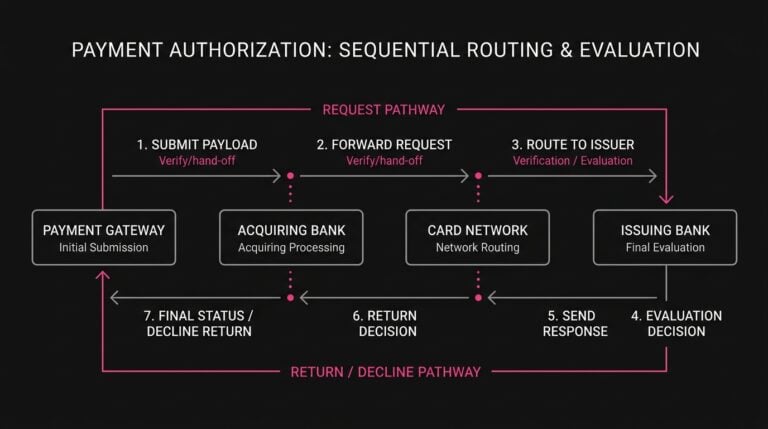
Crucially, the issuing bank is not the only gatekeeper that can stop a payment in its tracks. While issuers account for the majority of rejections, the merchant’s own gateway or acquiring bank might block a transaction before the issuer ever sees it. If a merchant has configured strict velocity checks, say blocking anyone who tries to buy more than three times in ten minutes, or if an address verification check fails at the gateway level, the merchant’s own system pulls the plug. Figuring out who said no is the first step toward getting to yes.
Why Good Cards Get Turned Away: The Four Main Buckets
When payment teams categorize declines, they generally look beyond the surface-level error and group the root causes into four operational buckets. Whether you are a cardholder troubleshooting a personal purchase or a merchant analyzing checkout issues, the rejection almost always falls into one of these categories.
1. Account and Liquidity Limits
This is the most straightforward category, where the account has hit its physical or financial limits. Insufficient funds on a debit card or an exceeded credit limit on a credit card are the classic examples. In fact, nearly one-third of insufficient funds declines involve low-risk payments, small transactions, or trusted recurring merchants. However, many cardholders run into trouble even when they have plenty of money in the bank.
Cards often carry daily or per-transaction spending limits that are much lower than the total credit line. If someone tries to buy a high-end laptop or book an international flight, the transaction might hit a velocity limit or a single-purchase cap. Similarly, if the cardholder recently checked into a hotel or rented a car, the merchant likely placed an authorization hold on the card. Those holds tie up available credit for days after check-out, quietly shrinking the spending power available for other purchases.
2. Credential and Data Mismatches
A surprising number of payment issues come down to simple clerical errors or outdated records. A typo in the card number, a transposed digit in the CVV security code, or an incorrect expiration date will immediately halt a payment.
Address Verification Service (AVS) mismatches are another frequent culprit. If a customer recently moved and enters their new shipping address as their billing address before updating their bank profile, the AVS check flags the discrepancy. In recurring billing, credential failures happen passively. Cards expire, or they get lost and replaced with new numbers, leaving subscription platforms trying to bill a piece of plastic that has been sitting in a desk drawer, or a shredder, for months.
3. Fraud and Risk Triggers
Issuing banks use automated risk engines that evaluate hundreds of data points in real time to protect cardholders from unauthorized spending. While these systems save banks and consumers from substantial fraud losses, they regularly catch legitimate buyers in the crossfire, producing what the industry calls false declines. Globally, false declines were estimated to result in nearly US$175 billion in lost e-commerce sales in 2024 (Source).
An issuer’s risk model might reject a transaction because the customer is shopping from an unfamiliar IP address, using a VPN, buying from a merchant in a different country, or purchasing digital goods at three in the morning. Even buying from a brand-new merchant without an established history with the card networks can look suspicious to a conservative bank algorithm. Because the bank would rather inconvenience a cardholder with a security text message than absorb a fraud loss, the transaction is declined until the customer confirms they are actually the one holding the card.
4. Technical and Routing Glitches
Sometimes a decline has nothing to do with the cardholder or the merchant. Payment networks are massive, distributed software systems, and like any infrastructure, they experience latency, maintenance windows, and brief outages.
If an issuing bank’s authorization server takes too long to respond, the card network may time out the request and return a decline code to keep the checkout queue moving. In other cases, a merchant’s payment processor might use an outdated routing table, sending the transaction through an acquiring path that does not properly support the specific card type or regional regulation, for example failing to trigger Strong Customer Authentication (SCA) where the law requires it.
How to Decode the Issuer Response: Soft vs. Hard Declines
When a transaction fails, the issuing bank sends back a two-digit alphanumeric code explaining why. However, the raw code is rarely shown to the customer, and even for merchants, the codes can be deceptive.
To make sense of the issuer response, payment operations teams divide these codes into two functional categories: hard declines and soft declines.
- Hard declines represent permanent failures. Codes indicating a stolen card, an invalid account number, or a closed account fall into this camp. When a merchant receives a hard decline, the transaction cannot be salvaged with the current payment details. Running the card again will only produce another failure and can trigger fines from the card networks for abusive behavior.
- Soft declines represent temporary failures. Here, the account itself is valid and open, but something prevented this specific attempt from going through. Insufficient funds, an exceeded daily limit, a processor timeout, or a generic Do Not Honor during a holiday shopping spike are typically treated as soft declines. Under the right conditions, a soft decline can succeed if attempted again later.

Distinguishing between these two states is the foundation of modern payment recovery. Treating a hard decline like a soft decline wastes money and irritates the card networks, while the opposite mistake leaves recoverable revenue on the table.
What Cardholders Can Do When a Transaction Fails
If you are the one trying to buy something and your card keeps getting rejected, hammering the checkout button five times in a row will only make things worse. Repeated rapid attempts look like a card-testing attack to both the merchant and your bank, which can turn a temporary block into a locked account. Instead, work through a quick mental checklist:
- Verify the basics: Double-check the billing zip code, expiration date, and security code. If you recently moved, try entering your previous billing address, since bank records sometimes lag behind postal updates.
- Check your banking app: Look for pending authorization holds from hotels, gas stations, or rental agencies that might be eating into your available credit limit, and check your inbox or SMS messages for a fraud alert waiting for your approval.
- Strip away network disguises: If you are shopping on a corporate VPN or using a privacy browser that masks your location, turn it off temporarily. When your IP address says you are in Zurich but your billing address is in Chicago, bank algorithms get nervous.
- Switch the checkout method: If entering the raw card numbers fails, try checking out through a digital wallet like Apple Pay or Google Pay using the exact same card. Digital wallets use tokenized credentials and device-level biometric authentication, which issuing banks trust far more than manually typed card numbers. That often produces an approval where a standard checkout failed.
How Merchants Can Reduce Payment Declines and Recover Revenue
For businesses, especially those managing recurring billing or high-volume e-commerce, waiting for the customer to call their bank or pull out another card is a losing strategy. Many shoppers simply abandon the cart, and subscription customers often let their accounts churn passively when a billing cycle fails. S. consumers say they would never return to a merchant after a false decline. Improving the transaction approval rate requires proactive intervention on the merchant side.
Clean Up the Data Payload
The quality of the payment request heavily influences how an issuing bank grades the risk of a transaction. If a merchant sends only the bare minimum of card number, expiration date, and amount, an issuer working with limited context is more likely to err on the side of caution and decline it.
Passing clean, complete data, including customer device fingerprints, verified billing addresses, and proper transaction flags, helps the issuer see the buyer as legitimate. For recurring businesses, accurately tagging the initial sign-up as a Customer-Initiated Transaction (CIT) and subsequent bills as Merchant-Initiated Transactions (MIT) with the proper network transaction IDs is essential. If a subscription renewal is accidentally formatted like a one-time checkout missing a CVV code, the issuer will likely reject it.
Adopt Network Tokenization and Account Updaters
To combat credential decay, merchants rely on automated background tools offered by the card networks. Account Updater services check a merchant’s vault of stored cards against network databases before a billing run, automatically pulling in new expiration dates or replacement card numbers when a customer’s card is reissued.
From Q1 2024 to Q1 2025, average global token adoption increased by 6% (Source). When the underlying physical card expires or is replaced due to loss, the network updates the credentials mapped to that token automatically. Because tokens cannot be easily skimmed or used by unauthorized merchants, issuers generally approve tokenized transactions at a noticeably higher rate than traditional card-on-file payments, with Visa reporting a 4.6 percent lift in authorization rates globally for token CNP transactions compared to PAN (Source).
Build Smarter Retry Logic for Soft Declines
When a soft decline occurs, particularly in subscription billing where the customer is not actively standing at a checkout screen, merchants have an opportunity to retry failed payments. However, the old-school approach of using static rules, such as retrying every failed card every three days at midnight, rarely works well.
Static calendars ignore how people actually get paid and how banks process batches. Retrying an insufficient-funds decline on a Wednesday afternoon when the customer gets paid on Friday morning simply burns through retry limits and racks up processing fees. Card networks also strictly limit how many times a merchant can retry a declined card within a rolling window before levying financial penalties.
To navigate these constraints, teams often turn to specialized infrastructure to handle the recovery process. Platforms like SmartRetry focus on payment optimization and intelligent retries of declined transactions. They analyze the specific issuer response, card type, geographical region, and historical approval patterns to determine whether a transaction should be retried and when it is most likely to clear. Spacing attempts around real-world banking cycles like Friday paydays, first-of-the-month deposits, or daily velocity limit resets, and halting retries immediately on unrecoverable codes, lets merchants recover revenue and improve approval rates without running afoul of network compliance rules.

Balance Your Own Fraud Filters
Finally, merchants have to look in the mirror. It is common for a company to tighten its internal gateway fraud rules after a wave of chargebacks, only to forget to dial them back down later. If an internal fraud tool is rejecting transactions before they ever reach the payment processor, the merchant is essentially declining its own revenue. For context, merchants reject an estimated 6% of eCommerce orders received annually due to fraud suspicions (Source).
Regularly auditing internal gateway blocks against issuer decline rates helps teams find the middle ground, especially as 60 percent of merchants plan to reduce or eliminate manual review (Source). Sometimes, routing a borderline transaction through an additional authentication step such as 3D Secure, or sending it to an alternate acquiring bank with a stronger local footprint, is all it takes to turn a suspicious-looking cross-border attempt into a verified sale.
Treating Declines as a Dialogue, Not a Dead End
A declined credit card is rarely a final verdict on a customer’s ability or willingness to pay. More often, it is a symptom of friction in an ecosystem trying to verify identity, liquidity, and intent across multiple independent institutions in less than two seconds.
For consumers, getting past a decline usually comes down to verifying account limits, clearing up data mismatches, or signaling to the bank that the purchase is legitimate. For merchants and payment professionals, the mindset shift is recognizing that a decline is actually a piece of diagnostic data. By reading the signals behind the rejection, cleaning up the data sent down the rails, and timing recovery efforts with precision rather than brute force, businesses can turn a frustrating dead end at checkout into a smooth, invisible recovery.



 Find me on Linkedin