

The hardest part of e-commerce shouldn’t be collecting the money after the customer has already decided to buy. Yet for many merchants, that is exactly what happens. A customer fills their cart, navigates the checkout process, and hits the purchase button. Then, somewhere in the opaque web of the payment processing flow, the transaction falls apart. A payment declined message flashes on the screen, and the revenue is suddenly at risk. Across the industry, an estimated 11 percent of ecommerce transactions fail, driving $430 billion in annual global revenue lost to false declines (Source).
For payment professionals, growth leaders, and operations teams, these checkout issues represent a massive, often hidden leak in the balance sheet. When you successfully guide a buyer to the finish line only to lose them to technical friction or overzealous fraud filters, you are not just losing a single sale. You are burning the marketing dollars spent to acquire that customer, damaging the user experience, and complicating your forecasting. Solving this requires more than hoping the customer tries another card. It demands a deliberate strategy to salvage lost revenue. This is why merchants must actively compare revenue and recovery platforms for ecommerce to find solutions that align with their operational complexity.
The Hidden Mechanics of Lost Revenue
To understand how to fix payment failures, we first have to understand the environment in which they happen. Every time a customer initiates a purchase, a complex digital conversation occurs between the merchant, the payment gateway, the acquiring bank, the card network, and the issuing bank. This entire sequence happens in milliseconds, culminating in a critical issuer response.
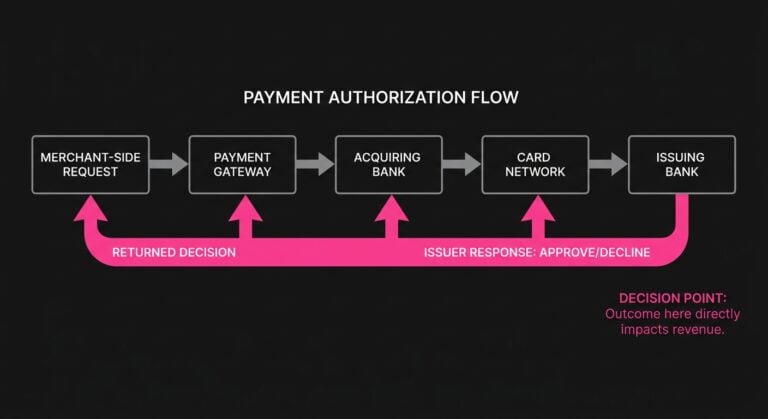
When that response is negative, the transaction is rejected. However, the reason for the rejection is rarely black and white. Payment professionals generally categorize these failures into two buckets: hard declines and soft declines.
Hard declines are terminal, occurring when a card is reported stolen, the account is permanently closed, or the card number is simply invalid. In these scenarios, no amount of technical maneuvering will force the transaction through. Retrying a hard decline is not only futile, it can also actively harm your merchant standing with card networks, leading to unnecessary scheme fees and compliance warnings.
Soft declines, on the other hand, are temporary roadblocks. They occur for a variety of reasons that can often be resolved with the right timing and approach. A soft decline might be triggered by a temporary lack of sufficient funds, a momentary network timeout, or an issuer’s risk model temporarily flagging a transaction due to irregular velocity. Because the underlying payment instrument is technically valid, these are the transactions that are ripe for payment recovery. Distinguishing between a terminal error and a salvageable opportunity is the foundational problem that recovery technologies attempt to solve.
The Cascading Business Impact
The financial implications of a declined transaction extend far beyond the immediate loss of a shopping cart’s value. For traditional e-commerce retailers, false declines can severely damage the customer experience. A shopper who is rejected at checkout often assumes the merchant’s website is broken or untrustworthy, leading them to abandon the purchase entirely and turn to a competitor. Furthermore, industry data shows that 45 percent of customers will not retry a payment if it declines on the first attempt (Source).
The damage is even more pronounced for businesses operating on recurring revenue models. Subscription payment issues are the primary driver of involuntary churn, with benchmarks indicating that failed payments put 9 percent of monthly recurring revenue at risk (Source). When a loyal subscriber’s monthly renewal fails because their card expired or their issuing bank unexpectedly changed its risk parameters, the merchant loses out on months or even years of potential lifetime value.

Relying on manual intervention to fix these problems creates a severe operational drag. Asking your customer support team to manually email every user whose card failed is inefficient and scales poorly. It creates friction for the buyer, who is suddenly forced to log back into a portal, dig out their wallet, and update their billing details.
Visibility is another major casualty of a poorly optimized recovery strategy. Much like how digital marketing teams rely on diagnostic tools such as https://search.google.com/search-console/performance to understand shifts in search visibility and user intent, payment operations teams require equivalent granularity for their transaction data. Without a clear understanding of why payments are failing and which recovery tactics are working, financial teams are essentially flying blind, unable to predict cash flow accurately or optimize their processing costs.
Evaluating the Ecosystem of Solutions
Given the high cost of failure, an entire ecosystem of software has emerged to help merchants capture lost revenue. When teams compare revenue and recovery platforms for ecommerce, they quickly realize that not all solutions are created equal. Broadly speaking, the market is divided into native tools provided by Payment Service Providers and specialized third-party recovery platforms.
Most modern Payment Service Providers offer some form of basic retry logic. These built-in tools are convenient because they require no additional integration, but they often rely on static rule engines. A basic rule might dictate that every failed payment should be retried exactly three days later at noon. While better than nothing, this is a blunt instrument that ignores the cardholder’s historical spending patterns, the specific decline code returned by the issuer, and the varying behavior of different issuing banks.
Specialized platforms approach the problem differently, treating payment optimization as a dynamic, data-driven science. Instead of static rules, these systems leverage machine learning models trained on vast amounts of network data. They analyze the specific issuer response and determine the exact day and time a retry is most likely to succeed. For example, a platform might recognize that a specific issuing bank is more likely to approve transactions on Friday mornings, when direct deposits typically clear, and delay the retry accordingly.

Another critical point of comparison is the methodology used to update payment credentials. The best platforms integrate seamlessly with network-level account updater services. If a customer is issued a new card because their old one expired, these services automatically and securely fetch the new credentials before a renewal is even attempted, preventing the decline from happening in the first place.
Finally, merchants must evaluate the balance between silent recovery and customer-facing communication, often referred to as dunning. Silent recovery happens behind the scenes, using network retries and credential updates to secure the funds without ever bothering the customer. Dunning involves sending automated emails or SMS messages asking the customer to intervene. While dunning is sometimes necessary, heavy reliance on it introduces friction.
Blueprint for Payment Teams: Strategy and Implementation
Understanding the landscape is only the first step. For payment operations teams, the real challenge lies in execution. Effectively navigating this space requires a strategic approach that balances revenue capture with operational costs and compliance.
The first actionable step is to conduct a thorough audit of your current payment issues. Teams should categorize their decline codes to understand exactly where the bleeding is happening. Are the majority of your failures due to insufficient funds? Are they categorized as generic do not honor codes? Or are you seeing a high volume of hard declines, indicating an issue with how you collect and store payment data at checkout? Establishing this baseline is critical for measuring the success of any future interventions.
Once the baseline is established, teams must carefully design their retry schedules to avoid network penalties. Card networks like Visa and Mastercard have strict rules regarding how many times a merchant can retry failed payments within a specific window. Aggressively hammering a declined card in hopes that it will eventually go through is a dangerous strategy that can lead to authorization fines and a degraded merchant reputation. A sustainable strategy relies on intelligent pacing, ensuring that every retry attempt is statistically justified by the underlying data.
Merchants should also evaluate the financial trade-offs of their recovery efforts. Processing transactions costs money, as every authorization attempt incurs network fees and gateway costs regardless of success. If a platform requires ten retries to recover a low-value transaction, the cost of those retries might completely consume the profit margin of the sale. Teams must ensure their recovery logic is context-aware, applying more aggressive recovery tactics to high-value transactions and taking a more conservative approach for smaller ticket sizes.
Ultimately, to effectively reduce payment declines, operations teams need to view recovery not as a set-it-and-forget-it feature, but as a continuous cycle of testing, monitoring, and refining. Consumer behavior shifts, issuing banks constantly update their risk models, and macroeconomic factors influence funding availability. A static strategy inevitably degrades over time. Continuous optimization is mandatory for maintaining high authorization rates, particularly as U.S. card approval rates have dropped below 87 percent (Source).
The Role of Intelligent System Design
Finding the right balance between aggressive recovery and cost efficiency is where specialized technology becomes indispensable. SmartRetry serves as a natural extension for merchants looking to automate this complexity through payment optimization and intelligent retries of declined payment transactions. By analyzing the nuanced variables behind every failed authorization, the platform dynamically adjusts retry timing and routing to maximize the probability of a successful capture. This approach allows merchants to recover revenue and improve transaction approval rates seamlessly, handling the heavy lifting of network logic so internal teams can focus on core product growth rather than micromanaging decline codes.
The Future of Revenue Operations
The evolution of e-commerce fundamentally shifted how businesses view the checkout process. Historically, payment processing was treated as a commoditized utility, a mere cost of doing business. When a card was rejected, it was viewed as an unavoidable reality of digital commerce. That perspective is now entirely obsolete.
Modern revenue operations recognize that the point of transaction is one of the most critical optimization levers in the entire customer journey. The friction of a failed payment is no longer an insurmountable barrier. Instead, it is a data problem waiting to be solved. By treating authorization rates with the same analytical rigor as customer acquisition costs or conversion rates, merchants can unlock a hidden tier of profitability.
As the underlying technology of the card networks continues to evolve, the gap between merchants who actively manage their recovery strategies and those who rely on default settings will only widen. For teams willing to dive into the mechanics of issuer behavior, network tokenization, and dynamic routing, the reward is clear. They gain a more resilient business model, a smoother customer experience, and a bottom line protected against the silent attrition of technical failures. The tools to capture this lost revenue are readily available. The only remaining requirement is the operational discipline to deploy them effectively.


 Find me on Linkedin