

Getting Your Online Payment Gateway Out of the Way of Your Revenue
When a customer clicks the buy button, they assume the hard part of shopping is. Behind the scenes, the real negotiation is just starting. Most online payment gateways are built, first and foremost, as secure encrypted pipes. They collect payment details, pass them to an acquiring bank, and wait for an answer. That works fine until a legitimate transaction is turned down for reasons nobody can immediately explain. Achieving optimal payment authorization is less about finding a magic provider and more about how you configure the handoffs between your gateway, your processors, and the issuing banks. If you want higher transaction approval rates, you have to treat your gateway as the first control point in an active payment optimization strategy, not as a static utility.
Many teams start looking closely at their gateway only when they notice a gap between checkout intent and settled funds. They see a spike in card declined notifications or recurring billing failures and wonder if their baseline infrastructure is dropping the ball. Often the pipe itself is intact, but the instructions attached to the transaction are incomplete, poorly formatted for a specific regional acquirer, or tripping overly sensitive automated filters before the issuing bank even gets a vote. Notably, VisaNet data showed that overall card authorization approval rates in the U.S. fell below 87 percent between April 2023 and March 2025 (Source).
What Does a Gateway Actually Do in the Payment Processing Flow?
To fix what happens inside the black box, it helps to separate the roles of the players involved. The lines have blurred in e-commerce because many full-stack payment service providers bundle everything under one roof. Under the hood, though, the distinct functions still exist and govern how your transactions are evaluated.
At its simplest, an online payment gateway is the digital equivalent of a physical point-of-sale terminal. Its core jobs are capturing the payment payload, encrypting sensitive cardholder data, running initial fraud checks, and translating the request into a message format that a payment processor can understand.
From there, the processor moves the data through the card network to the customer’s issuing bank. Once approved and settled, the funds land in your merchant accounts. When teams use an all-in-one payment provider, they are typically using a master merchant account managed by that provider, paired with the provider’s native gateway. As transaction volume scales, companies often unbundle these layers, setting up dedicated merchant accounts with multiple acquiring banks and using a standalone gateway to direct traffic among them. According to Boston Consulting Group, 43% of surveyed merchants use dynamic orchestration or a deliberately chosen single-acquirer model (Source).
This structural choice dictates how much control you have over your authorization rates. In a bundled setup, the provider handles the plumbing. That simplifies operations, but you inherit their default risk tolerances and routing preferences. An unbundled or multi-processor setup lets you tune the system yourself, though you also take on responsibility for making sure your gateway communicates cleanly with every downstream partner.
Why Good Transactions Get Blocked at the Front Door
It is easy to blame the customer’s bank whenever a transaction declined message pops up on the screen. Issuing banks do make the final call on whether a cardholder has the funds and passes behavioral checks. Yet a surprising volume of legitimate purchases never reach the issuer at all, or reach it carrying red flags that practically invite a rejection. In Q4 2023, Visa observed that card-not-present approval rates lagged card-present approval rates by 6% (Source).
1. Overzealous Gateway Fraud Filters
Most gateways come equipped with built-in risk rules: velocity checks, IP-to-billing-address comparisons, Address Verification Service (AVS) filters, and Card Verification Value (CVV) requirements. These tools keep bad actors at bay, but default configurations are frequently blunt instruments.
Say a gateway is set to automatically drop any transaction where the billing postal code does not match the bank’s records on file. A customer who recently moved and forgot to update their profile is blocked instantly, and the gateway records this as a blocked attempt before the issuing bank ever sees the request. Worse still, on recurring subscription charges where the customer is not present to re-enter a CVV, misconfigured gateway rules that treat a renewal like a first-time checkout will generate self-inflicted declines.
2. Data Stripping and Formatting Mismatches
A gateway must map the data collected at checkout into the specific fields the processor requires.
When a gateway connects to multiple processors, non-essential data fields sometimes get dropped during translation so the message passes basic validation. An issuer looking for specific device fingerprint data, customer account tenure, or recurring transaction indicators (known as merchant-initiated transaction flags) might only receive a bare-bones request containing the card number, expiration date, and amount. Without that context, the issuer’s automated risk scoring treats the transaction with heightened suspicion, which increases the likelihood of a soft decline. In contrast, an Adyen pilot with a large travel enterprise found that sharing enhanced data with optimized U.S. issuers delivered a 290 bps increase in cross-border authorization rates (Source).
3. Rigid Network Timeouts
Payment flows run on strict clocks. If an issuer takes slightly too long to respond during a high-traffic retail event, a gateway with an overly aggressive timeout threshold might sever the connection and return an error to the checkout page. In basic reporting, that error is hard to tell apart from a standard decline, so teams think they have a customer credit problem when they actually have a latency problem.
How Payment Gateway Routing Shapes Your Authorization Rates
When you process all transactions through a single domestic acquirer, every international card you accept is treated as a cross-border transaction. Cross-border traffic carries higher interchange fees and faces much stricter scrutiny from issuing banks, because it statistically correlates with higher fraud rates. If a customer in France buys from a merchant whose sole processor settles in the United States, the French issuing bank sees an unfamiliar foreign acquirer and may decline the charge out of caution.
Smart payment gateway routing solves this by matching the attributes of the transaction to the best available acquiring partner connected to your gateway. Experienced payment teams look at several variables when designing routing rules:
- Card Brand and BIN Geography: By inspecting the Bank Identification Number (the first six to eight digits of the card), the gateway identifies the issuing country and card type. Routing that French customer’s card to a European acquiring entity allows the transaction to be processed locally, which issuers generally trust much more than foreign requests.
- Currency and Ticket Size: Routing transactions in their native currency to an acquirer that settles in that currency avoids unnecessary foreign exchange conversions and aligns with normal local spending patterns.
- Processor Health and Uptime: Even top-tier processors experience intermittent degradation or brief regional outages. A gateway capable of dynamic failover can detect when a primary processor is returning abnormal system error codes and shift traffic to a backup merchant account automatically.
- Cost versus Approval Trade-offs: Some routing engines let merchants prioritize either the lowest processing fee, such as routing US debit cards across regulated pinless debit networks, or the highest historical approval probability. Cost routing saves basis points on fees, but optimizing for approvals almost always yields a higher net revenue return because it captures the full value of the sale.
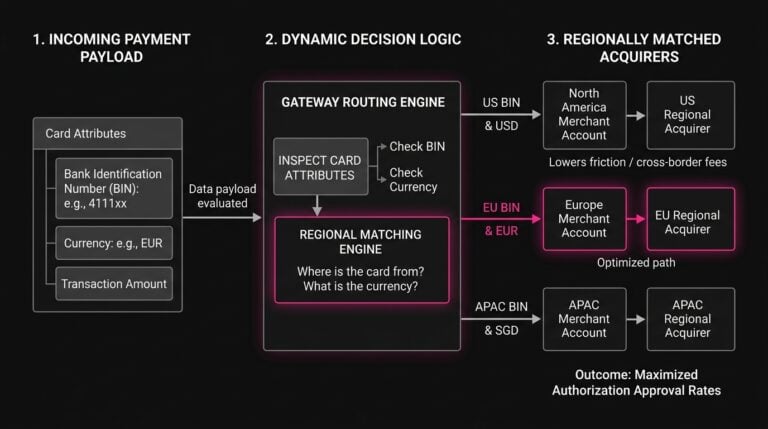
Setting up effective routing requires holding multiple merchant accounts across different regions or providers, which adds reconciliation and compliance overhead. For small merchants, the operational cost outweighs the lift. Growing platforms processing meaningful international volume or high-ticket recurring revenue are a different story, since static single-path processing leaves substantial money on the table.
Where Payment Stack Optimization Meets Intelligent Recovery
Even a finely tuned gateway with local acquiring bridges cannot prevent all payment processing declines. Issuing banks operate on proprietary risk algorithms that shift constantly based on macroeconomic trends, recent fraud waves, and the cardholder’s real-time credit utilization.
This is where the distinction between the delivery pipe and the brain becomes clear. A gateway is built for real-time execution: take the request, follow the static or dynamic routing rule, and report the issuer response. Most gateways are not designed to analyze a failure deeply, hold a declined transaction in limbo, and work out the optimal day, hour, and modified payload needed to turn that specific decline into an approval later on.
Issuers recognize this pattern immediately. Repeated, rapid-fire attempts on a declined card without changing any parameters look like a brute-force script or a poorly managed billing system. Card networks now actively penalize merchants with excessive retry fees if they hammer the network after receiving specific hard decline codes, and issuers may lock the card entirely to protect the account.
True payment stack optimization separates transaction delivery from transaction recovery. When a payment fails, you need an intelligence layer that sits alongside your gateway to interpret the exact decline signals. In one Latin American case study reported by Visa, an issuer achieved a 7% increase in approval rates within a year by optimizing its authorization and risk management systems (Source).

For example, when an issuer returns a generic Do Not Honor code or an Insufficient Funds response on a recurring charge, a specialized recovery layer looks at the wider context: the specific issuing bank, the card type (credit, debit, or prepaid), the time of day, and historical recovery patterns across millions of similar events. Instead of firing an immediate blind retry through the gateway, platforms like SmartRetry step in to manage the recovery flow. They evaluate the decline telemetry to schedule retries when the issuer is most likely to approve the request, and adjust how the transaction is presented across the merchant’s existing gateway infrastructure.
Practical Adjustments That Move the Needle on Approvals
If you are auditing your current payment setup, you don’t need to rip and replace your gateway to see improvements. Most optimization gains come from cleaning up how you use the features already available in your payment stack.
Audit Your Network Tokenization Setup
Traditional card-on-file storage relies on gateway tokens, which replace the primary account number (PAN) with a reference string for security. But when the transaction goes out to the card network, the gateway still detokenizes it and sends the raw card number. If the customer loses their physical card and gets a new one in the mail, that saved number dies, leading to immediate payment failures on the next billing cycle.

Network tokens, issued directly by Visa, Mastercard, and other major brands, stay linked to the underlying bank account even when the physical card number or expiration date changes. They also include a cryptographic value with each transaction that confirms the token came from the verified merchant where it was originally provisioned. Issuers view network tokens as significantly safer than raw card numbers, which often produces a measurable lift in payment authorization rates. Check whether your gateway has network tokenization enabled by default or whether it needs to be switched on at the configuration level.
Refine Your 3D Secure (3DS) Triggers
In regions governed by Strong Customer Authentication (SCA), such as Europe and the UK, sending a transaction through 3D Secure shifts fraud liability to the issuer and satisfies regulatory compliance. The catch is that every extra verification screen adds checkout friction. Customers abandon their carts because they did not receive an SMS code or forgot their banking app password.
Instead of pushing every transaction through a 3DS challenge at the gateway level, configure your gateway to use valid exemptions. Transactions below certain value thresholds, recurring fixed-amount subscriptions after the initial setup, and transactions flagged as low risk by your gateway’s Transaction Risk Analysis (TRA) engine can often bypass the challenge screen and go straight to authorization. Similarly, applying 3DS only to high-risk traffic in non-regulated markets prevents unnecessary drop-off among your most trusted customers.
Pass Enriched Level 2 and Level 3 Data
For businesses selling to other businesses or using corporate purchasing cards, passing standard consumer checkout data (card number, amount, zip code) often results in worse interchange rates and higher scrutiny from commercial card issuers. Gateways that can pass Level 2 and Level 3 data fields, such as tax amounts, customer accounting codes, invoice numbers, and line-item descriptions, signal to the commercial issuer that the transaction is a legitimate business expense. This extra context satisfies corporate purchasing controls on the issuer’s side and frequently lowers the processing fee assessed by the card networks.
Align Decline Handling with Actual Issuer Behavior
Take a close look at how your checkout and billing engine reacts to raw gateway responses. Many gateways map hundreds of granular processor and network codes into a dozen simplified platform categories for developer convenience. A simple card_declined message is easy for a front-end developer to display on a checkout screen, but it hides critical operational details from your recovery logic.
Make sure your system captures and stores the raw response code, Mastercard’s Merchant Advice Code (MAC), or the specific category data from Visa alongside the gateway’s summary message. These raw signals tell you explicitly whether the issuer wants you to try again later, ask for a new payment method immediately, or update the expiration date before retrying. Without capturing the raw telemetry passing through your gateway, any downstream effort to retry failed payments is effectively flying blind.
Building a Resilient Payment Architecture
Treating your online payment gateway as a set-it-and-forget-it component is one of the quietest ways to leak revenue. As your customer base expands across borders, card types, and billing models, the standard settings that served you well in your first year of operation start acting like a bottleneck.
The most resilient payment setups do not rely on a single gateway or processor to solve every challenge. Instead, they treat the gateway as a clean, well-configured switchboard: stripping out unnecessary friction, preserving rich transaction data, routing traffic to the right merchant accounts, and handing off soft declines to specialized recovery logic. When every layer of the stack does the job it was built, legitimate customers breeze through checkout, and revenue that used to evaporate in the background quietly finds its way to your bottom line.


 Find me on Linkedin